Tweaking 4E: Expanding uses for power points and healing surges

So while action points and healing surges are cool, I think they can be under utilized. I’m a huge fan of healing surges and think they make an interesting economy in the game. They are a requirement for recharging some magical items and I’ve liked that idea of using a PC’s vitality to enhance their power, so why not expand on that? Likewise, action points are cool but you can only use them once per encounter. Granted the bonus standard action is pretty huge, but only comes into play if you are going though several encounters in the game day.

A while back I talked about limiting choices of powers in my next 4E game. One downside of this is the limit of damage output players have. So to work on this I really wanted to be sure players could count on the limited encounter powers they have. Also, I wanted a way to get more powers that could inflict higher damage. So I’ve been thinking about the following changes.

Action points – Players have two options for action points:
A) Spend an action point can allow the player to do another standard action (as per rules)
B) Spend an action point to grant a +4 bonus to any roll. This can be done after the roll is made.

Players start with 2 action points at the beginning of each extended rest. They can spend multiple action points during an encounter, but can only take the additional action option once.

Healing surges
– Players may spend a healing surge to add one more damage die to at-will, basic, or trained basic attacks. This can be used after a successful to-hit die roll is made (but before any damage die rolls are made).
– If players activate an encounter power and it fails to hit, they may use a healing surge to recharge that power.
– Healing surges can also be spent to re-roll any single die roll. The second roll must be accepted as the result.

This is likely going to allow my players to really crank out the damage. However I want to encourage my players to use healing surges. Not to mention, those 2-3 healing surges they lose in an initial fight leading up to the big boss now have more impact. Players now have to weigh their options when using healing surges. Do they use the surges to keep on their feet, or use them to crank up the damage on an attack? I also want action points to allow the player to do big things. +4 is a huge bonus, but I want players to be able to pull out a huge attack, or pull out of that critical death save if needed. So I am making those action point bonuses go big or go home.

Taken as a whole with some of my other changes, I’m hoping it adds some spice to my 4E game and makes for some more engaging choices for the PCs.

c6092-willinghamslavers

Review: King of Tokyo

Who doesn’t want to play a giant monster rampaging through a city, duking it out to be the King of Tokyo, and Iello games allows you to do just that.

A competitive game for 2-6 players, each person plays a giant monster laying waste to either the city before them or each other to claim victory. Play centers around a Yahtzee mechanic, where players spend their turn rolling a pool of dice, selecting those to keep and which to reroll. After three rolls players either score points, inflict damage to other monsters, heal themselves, or gain energy which they can spend on special abilities. The first to 20 victory points (or the last monster standing) wins the game.

Smashing other monsters requires a player to step up and become King of Tokyo. The lone monster inside Tokyo gains victory points for each turn they remain there. They cannot heal themselves, and all attacks from other players are directed towards them. On the flip side, all damage caused by the King of Tokyo monster is inflicted on all the other players.

The game plays out like a variant of king of the hill. It’s very tough to remain the King of Tokyo for long. However the constant earning of victory points and ability to do tons of damage to other players encourages people to push their luck, and try to stick it out for just one more turn. On the flipside, you become everyone’s beating post and can only heal up if you step down from Tokyo, lick your wounds, and try to take the spotlight again on a later turn.

Players can (and will) be eliminated. It’s a classic beatdown on the leader until a new monster steps up to take over. And each turn a player will typically juggle with either trying to eek out a few victory points, or smash the King of Tokyo (or other players if you are the current King). What works for this game is the extra twist of special abilities and the small economy mechanic of spending energy.

Players can also focus on gaining energy when they roll their dice. This allows them to buy special powers from a pool of face up cards which are either one shot powers, or permanent bonuses. They do a variety of abilities, from being able to heal while in Tokyo, to inflicting more damage, to even earning additional victory points. It’s this small addition of the power cards that gives the game an additional push from being a simplistic elimination game to allowing for room of some strategic choices.

The Good – It’s a fun, light-hearted, competitive game with simple rules. Surprisingly players have a lot of choices during their turn, with a lot of direct interaction and the ability to snag up particular power cards before their opponent. There are a variety of paths to victory. Allowing a player to focus on victory points, smashing other players to bits, or a little of each. The components are nice and bulky, and the artwork is colorful and whimsical.

The Bad – This is not a heavy strategy game. It’s a push your luck game that can be heavily influenced by good (or bad) dice rolls. While it has an interesting theme, it’s not too heavily draped in it with the mechanics. You aren’t really smashing through a section of the city and everything is represented as very abstract points earned through dice rolling. So it may not quite have that ‘Rampage’ feel that some might expect. While you can play with 2 players, the game can be lackluster with so few people.

The Verdict – King of Tokyo is a light, monster smash game that is short enough with just the right amount of complexity. You aren’t going to have a complete game night revolving around this game. You will however easily have 2-3 quick bouts to see who is the toughest monster on the block as you gleefully tear into each other, picking up special powers, and laying waste to the city of Tokyo.

It’s a great, light, filler game, that is quick and enjoyable. While some might be put off by the elimination aspect of the game, it’s has just the right game length to not make it an issue. The simplistic rules are also a plus. Highlighting the fun, quirky theme of the game, with surprisingly enough choices and interaction to make the game worthwhile playing. A great game to add to anyone’s collection and a decent family game to boot.

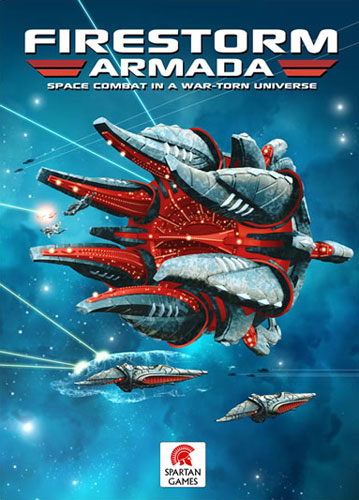
Review: Firestorm Armada

Firestorm Armada is a space naval combat game from Spartan Games. There is a hardback rulebook that has been recently released. I haven’t gone through it extensively, but for the most part, not much of the game mechanics have changed from the first softback edition.

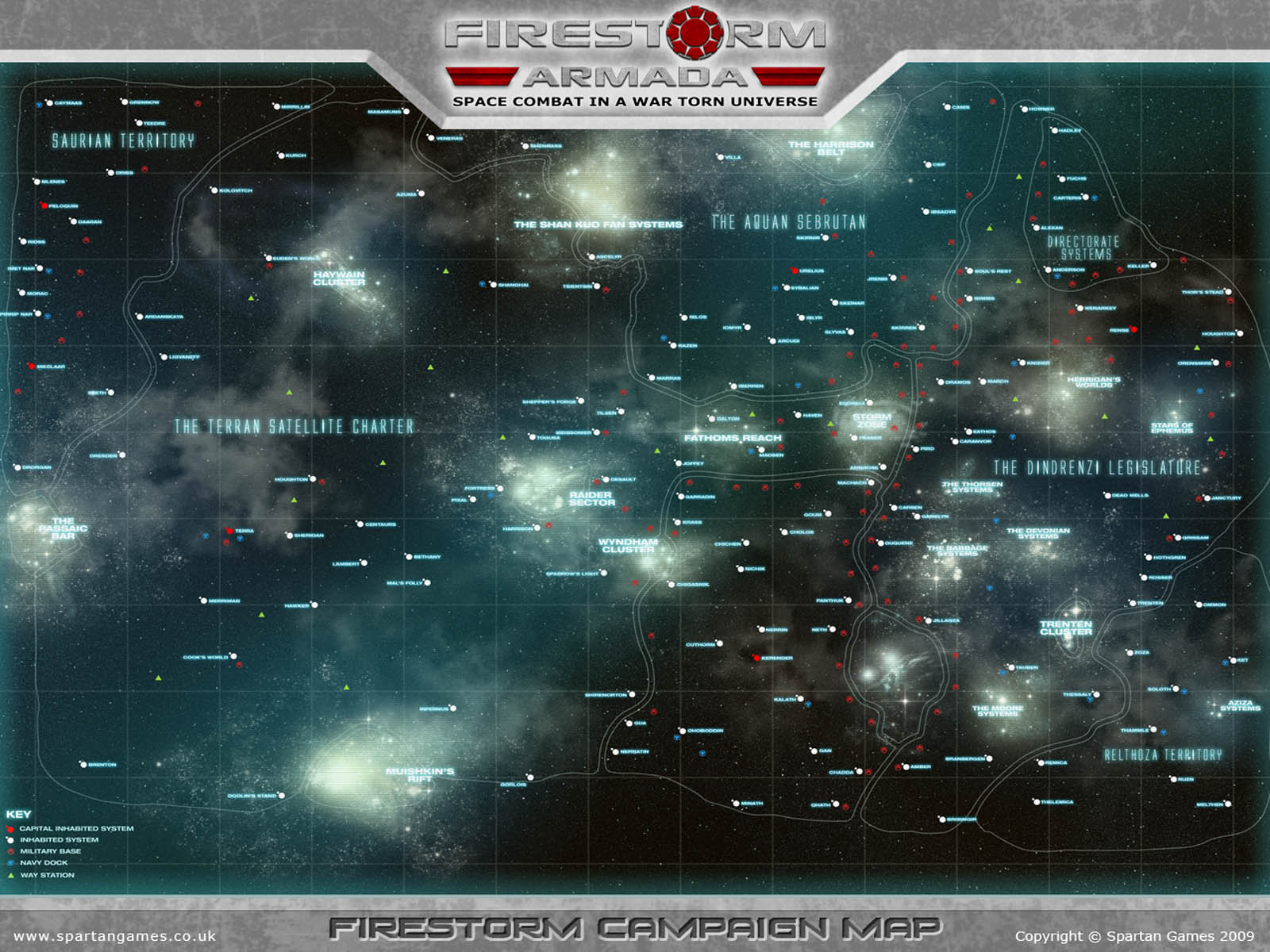
A snapshot of the background for the game universe is that mankind has discovered FTL drives, explored the stars, established many colonies throughout the galaxy, and in the process have encountered a handful of alien races. On the periphery of human-controlled territory, a faction of mankind has sought for independence. These two political factions of humans have begun a civil war that has expanded into a larger interstellar conflict, with different alien races pledging allegiance to each of the respective factions.

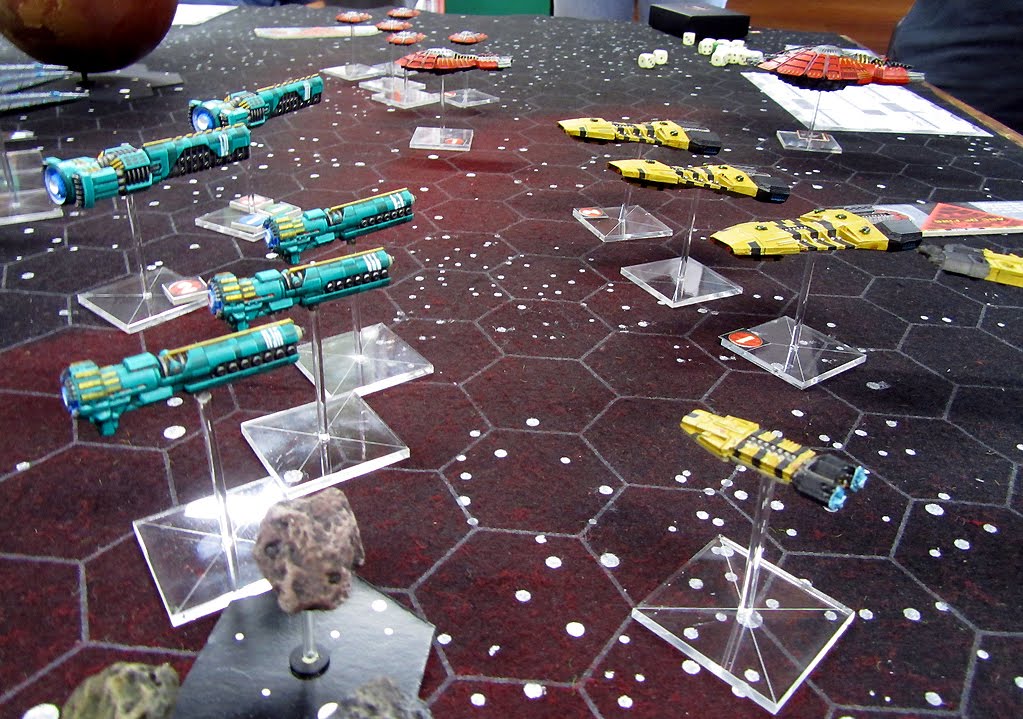
In Firestorm Armada (FA) each player commands a fleet of ships based on a point total, with some hard limits on the % composition for certain ship types. Players roll for a turn initiative, and alternate turns activating one ship squadron at a time. Squadrons can be independent fighter wings, a group of frigates, up to a single battleship. Each activated squadron moves and then resolves their fire, with the opponent doing the same with their forces. I enjoy this as it adds some tactics to deciding which group to activate, much better than a typical I-go-you-go for your entire force seen in other games.

The focal point of ship firing and movement is the base stand. Nearly everything decided from firing arcs to turning is based on the square stand your model is propped on. Targets are deemed in certain arcs based on where the center of the base sits, not on where most of the target model is. I like this as adds some uniformity to the rules, especially when working out what firing arc a target is residing in. It’s a nice simple way to streamline play and quickly resolve any sticky issues.

Ships move at a relatively constant rate, and have a minimum move distance. Turns are hard-capped at 45 degree increments, interspaced with requirements for moving straight ahead. Generally, the smaller the ship, the tighter it can turn, with larger ships being required to lumber forward more before committing to turning. Ships are considered to be able to move through each other and use a concept of ‘vectoring’, where they can shift in small increments to avoid stacking bases on other models.

I’ll admit that it throws any concept of physics out the window for movement. Full Thrust had a much better system where ships could constantly accelerate, but had a more difficult time turning a higher speeds. In FA, doing a full stop requires a half turn of movement to do so. Yet, once they stop there are no directional changes that can be made. Ships can’t slowly rotate in their position, they have to couple turning with straight movement. Additionally, models must move at least half their speed. If they opt to do nothing (including not firing weapons), they are limited to drifting straight ahead 2″. The movement is clean and simple, but doesn’t effectively use a z axis. This is especially true with certain terrain types, as planets are considered impassable terrain.

Firing at other ships is based on uniform range band increments and firing arcs. Some ships have additional firing systems like turrets that are more flexible, to specific arc channels that are more restrictive than the typical 90 degree firing arcs. Each range band has a number of attack dice that can be rolled to see if they inflict hits. As expected, longer ranges have very little dice pools, and the closer the target, the more dice can be rolled. As a nice twist though, there is a sweet spot with the range bands. Get too close and there is a drop off in the damage that can be done.

In addition to firing arcs, ships can link up fire with other ships within their squadron. They can also split fire with different weapon systems on their ship. So it is possible for a ship to open full port broadsides into one target, and throw its turret weapons to support another weapon volley with other ships in its squadron (or unleash another volley of fire from another arc into a different ship). The larger the ship, the more diverse the weapon systems meaning those huge battleships can lay down an impressive amount of fire to different targets.

All dice incorporate ‘exploding’ rolls. Most hits are successful on a 4+, with a 6 inflicting 2 hits. Further, all 6s are re-rolled and can lead to further rerolls. Inflict enough hits over the ship’s damage rating and a point of hull damage is taken. Score even higher and the possibility of additional hull damage, along with a critical ship system going offline, can result. As damage is inflicted, it also reduces the attack dice of the target. Crew hits can also reduce the number of attack dice (however this is not a cumalitve penalty). To counter damage inflicted, some races have shield or cloaking technology to reduce the number of hits.

An entirely different weapon system is torpedoes. These weapon systems are never reduced through inflicted damage, even better they always have a constant number of attack dice at all ranges. However they can be countered with point defense systems (in addition to shields and other defensive technology). More importantly, as torpedoes follow a set path to the target, ships in the same squadron can add to the point defense of the target. This makes for some interesting fleet tactics, throwing in smaller ships and fighter groups to provide defensive support to larger ships.

Fighter groups, or wings, are also ships that can be deployed. There are far maneuverable and can throw out a fair amount of damage. However they can be countered effectively with point defense systems. Wings come in different flavors, from bomber groups that can roll more attack dice, to well-rounded fighters, to heavy point defense interceptors, even assault craft for boarding actions.

FA takes the route of having abstract weapon systems and resolves many game mechanics in a similar way. Boarding actions are fairly easy to resolve and done through simple resolution of hits by rounds, scoring wins by simple attrition. With this simplicity and abstract mechanics however, you can get some blandness in with the game.

Since weapon systems are based on either attack dice, or torpedoes, most differences with races are based on the varying fire arcs of ships. Some ships have more flexible weapon batteries using turrets, while others are based on specific weapon arcs (like mostly fore arc weapons, or no aft weapons).

However, with these limitations there are some plusses. Record keeping for hull and crew damage is easy to keep track of (as is the reduction of attack dice). The game uses unified mechanics for attacking and defensive systems. And while movement is maybe not as ‘realistic’ as other games, it captures that idea that smaller ships are more maneuverable than huge capital ships very well. Best of all, a player has to plot out their expected movement for themselves as well as their target. Coupled with ideal firing rates being within a specified range, and not simply parking next to a target and unloading, makes for an enjoyable game. A more freeform movement system with rapid acceleration and deceleration (along with quick facing changes) would hamper this aspect of gameplay.

The hardback edition has incorporated Model Assigned Rules (MARs) in with the current fleets. Now each race and certain ship types have specific rules that alter them slightly from others. I think this adds a layer of complexity to the game and gives even more flavor for certain fleets. Best of all it is entirely optional, so you can still play with the vanilla rules if wanted. However, I like the tweaks that have been made with the different ships. MARs really helped differentiate the races and ship types to make for a more robust game.
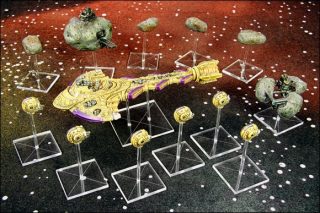
The Good – There is a nice fleet combat system within these rules. It has room for exploring different tactics that go beyond ‘move the biggest ship in as close as possible and unload.’ Maneuvering and trying to bring as many guns to bear, at the most ideal range, is a challenge and enjoyable. There are some differences in the race fleets, especially with the new MARs system. It’s not overly complex and has just the right amount of detail and weight for making a fun afternoon of wargaming.

The Bad – It’s not a hyper-realistic, super detailed treatment of spaceship combat. I’d go as far to say it really plays like a conventional sea naval wargame, with some trappings of science fiction. Some of the more abstract systems make for simplistic resolutions of actions, that might be too glossed over for some tastes. This is not a ramped up version of Star Fleet Battles. Also, luck can rear its head in some games. The exploding dice can make for some very ‘swingy’ turns.

The Verdict – I really enjoy this game. It has just enough detail and mechanics to make for an interesting wargame. I like the randomness of the dice that can lead to some spectacular outcomes, giving the game a few peaks and valleys with your morale during play that you might not get with other systems. FA has enough meat in the rules to make for a great space game, while not being too heavy and too clunky with having more simulationist rules.

There is enough variety of the races and fleets to make for different games, branching out with using varying tactics and experimenting with altering fleet compositions. There are a fair amount of scenarios and additional rules for civilian ships, space stations, and terrain, allowing you to create and play different situations other than your typical fleet battle engagement.

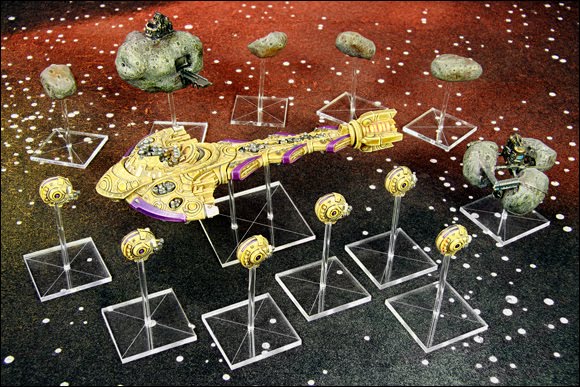
The models are reasonably priced and gorgeous. Also it seems the line is expanding with different ships and races, giving even more variety. However, the information of these new ships are not locked away and only available if you purchase the models. You can freely download the ship stats. Even if you have only the first edition rules, the MARs and fleet cards for the new ships are accessible.

I am however a bit torn about the different books. Some things I like about the hardback edition (cover pictured in this post) is that it cleans up a lot of things from the first softbound edition. Flights are no longer individual wing groups, but are consolidated into a single counter. Boarding actions now end with the target ship being destroyed, and not requiring to be fold-space traveled off table by the assaulting player.

What I do miss from the softback rules were tons of illustrated examples. They are there in the hardback edition, but more as simplified graphics rather than having figure legend explaining what is going on in more detail. I also think the layout of the rules were more organized in the 1st edition (not to mention a nice size font of the rules). It’s almost as if this book was written assuming players had the 1st softback edition already, rather than being for a completely new player. Fortunately, the game is not bogged down with tons of situational or convoluted rules, and are pretty easy to grasp.

If you’ve got a hankering to paint and deploy a fleet of starships. If you find the idea pleasing of deftly maneuvering cruisers to unload a broadside volley of mass driver cannons into an enemy capital ship. Then pick up these hardback rules. Firestorm Armada is well worth the investment.
Adding a bit of gray to those black villains (a la Walking Dead)

So I finished watching the latest Walking Dead episode. What I don’t quite get is the switch in Rick’s head that has completely flipped from ‘try to be decent’ to ‘eliminate any potential threat’ in such a short time. I expect they’ve been on the run for weeks, but it seems a tad quick for me.

I always chuckled at the fans of the show that railed against Shane so much for the first two seasons. Mostly because if you follow the comics, Rick has gone that route of doing anything to keep the group alive (at all costs) a long time ago. Again I wished they milked out the love triangle a tad more. That resolution near the end seemed to slip too quickly back into Shane simply wanting Rick out of the way for me. Oh well.

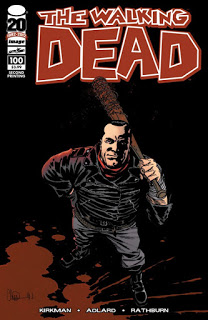
As the comic goes, I hope that Kirkman adds a few more twists to the recent villain that has reared his head, Negan. I’ve sort have been wondering how they’ve lined up their position in the world and wonder if at the heart of it, they have their own family and loved ones. They’ve simply slipped too far into accepting the ends justify the means. That other communities of people are just that, others. They aren’t their kin. They are outsiders. So it’s completely justified to offer them an ultimatum and follow through with violence if needed.

With some perspective, Rick in the comics has gone quite over the edge from having the moral high ground. After all he’s shot a prisoner he deemed a threat, ran down a member of Woodbury that may have been a traitor (remember that guy claimed some good people needed a place to escape from the Governor), hacked apart a man that threatened his son, tortured and mutilated a group of cannibals (admittedly for these last two I could see executing them, but gleefully tearing them apart is a tad much), and freely admitting to wanting to take over a community by force if necessary.

So enter Negan. Again, Rick’s group sort of forced his hand killing a group of his men. I expect most folks will not stomach anything but the worst fate for the guy. After all recently…

SPOILER ALERT!

…he was responsible for making things incredibly unpleasant for our favorite, former pizza-delivery guy.

END SPOILER

Still I hope Kirkman muddies the water a bit. Negan is not a nice man. No question about it. But it might be he’s taken Machiavellianism to an extreme and if he’s doing these things to protect his loved ones, maybe it should give us pause to consider if such horrible acts are ever justified at all. Who knows where he’ll take it. Likely we’ll end with another truly despicable Governor-type character. Maybe not.

As the show goes, I wish Rick clinged to that moral high ground a tad more. Mind you, while folks might argue putting a machete to the head of a prisoner was justified, locking that other out in the yard was harsh. I just wished he wrestled a bit longer with the demons of doing absolutely anything to protect his people, even if that meant abandoning any shred of humanity left. It may be well something the show explores. Who knows.

As gaming goes, I tend to stick with making my main villains really bad guys. I think for the fantasy theme and my players being heroes, they really enjoy the highs and lows of taking on the main baddie. If all the black hats are gray, it dulls this emotion some.

I’m not completely averse to this concept though. Recently I’ve been doing a Savage Worlds hack of Dark Sun. There is plenty of moral ambiguity to go around in that setting. I am certain that the group will be finding patrons that are literally the lesser (of several) evils. It’s just part of that setting. I likely will tinker with the motivations of some villains in this vein too. Athas is a harsh world and many are likely doing the best they can for the few they care about, and easily justify turning their backs on others.

Likely I won’t over do it too much. Sadly I think there is too much of this in the world today. No need to cram it into a pastime my group does for fun. Sometimes it’s better to keep those white hats and black hats the color they are.

Will be busy exploring…

…I wish I could say that. Let’s just say I’ll be out of town and stuck in meetings most of my trip. Still, I do enjoy getting a chance to do some international travel and have a bit of sightseeing time scheduled.

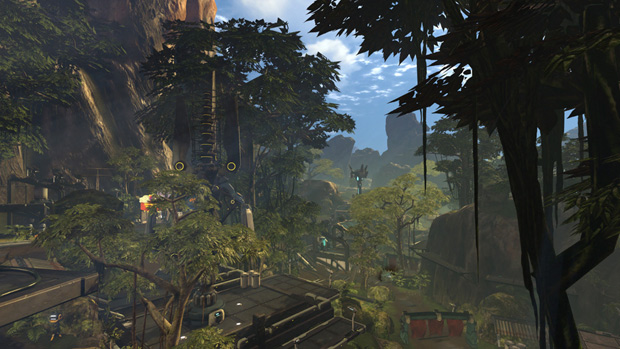
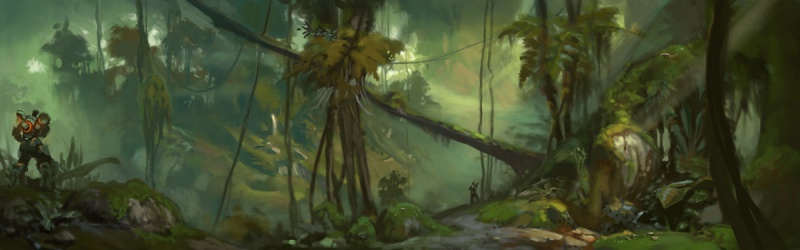
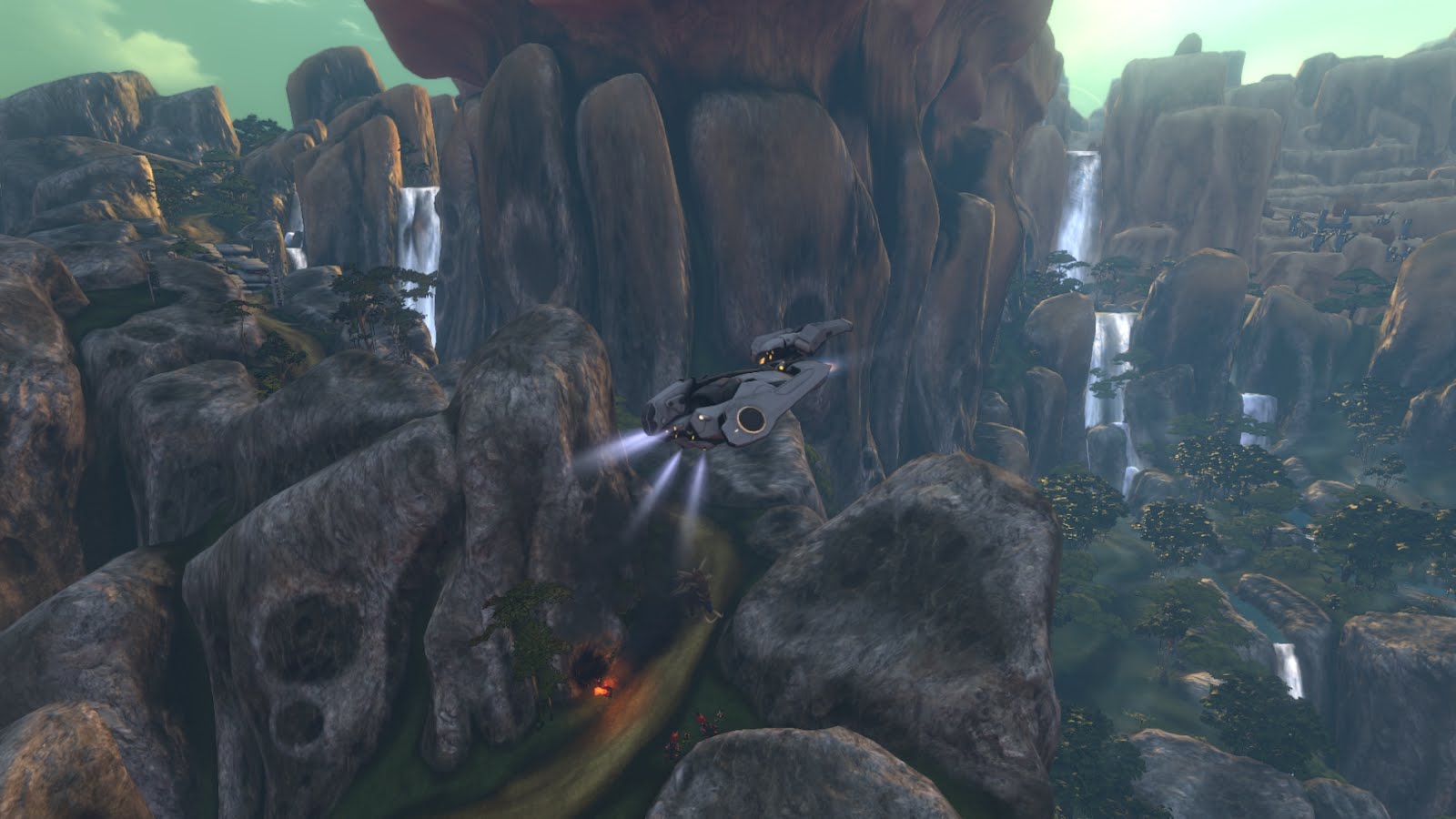
I wish that was my only reason for being away but I’ve been drawn into playing Firefall quite a bit also. Pretty fun game that seems to scratch a lot of FPS itches for me. It’s sparkly too and an interesting theme. I’ll show some of the wonderful concept art and cutscenes from the game.

Borderlands 2 also has been sucking up my free time. Man, I need to get a little more focused how I spend my geek time. So no posts for a couple of weeks. I’ll be traveling and exploring (both real and imagined) for a while.

Tweaking 4E: Trimming down the power selection

One thing that crept into my game was analysis paralysis. My players got to late heroic tier and things began to shut down in combat. They had this huge pile of cards and all these options to go through, with magic items thrown in to boot. It became a little unmanageable.

My feeling with 4E was the cool bit about being able to do lots of different things, also became it’s fault. I think level 3 is the golden level for 4E (possibly level 5). At that point players have 2-3 options of encounter powers and dailies, with a few choices of repeatable standard attacks (at-wills and basic attacks). As they level up, this just starts adding on. You get more and more options, and all those choices seem to gum up the thought process for players. They just have so many choices and feel that pressure of wanting to do the most optimal action possible during their turn. So I began to think about power expansion differently.

Instead of adding more and more, why not reach a set amount of powers and abilities and cap it? As players level up, instead of gaining more options they swap out powers and upgrade the ones they currently have. The emphasis of having more options begins to lean towards fine tuning and improving the powers and abilities they have. With that in mind, there are a few other things to tackle too.

One magic item with a power/tier – For my next game I am leaning more towards the magic items that give static bonuses, over an optional power. While it’s cool to have that +1 acid sword that has a daily ranged attack, having another 3 items that also have daily/encounter powers just layers on the stuff players have to go through in their decision process. This can seriously add to analysis paralysis of the PC. If anything, I’ll add more consumables and one-shot items. Dark Sun introduced the idea of static enhancement bonuses for players without using magic items, and that is something I am also seriously considering. Another option would be to bump up the items they have making that +1 dagger slowly morph into a +3 dagger with +2 fort vs. poison.

Cap the number of powers – Players will have a limited selection of standard powers as they progress. At most from the advancement table, they can have 1 At-Will, 2 Encounter, 2 Daily, and 1 Utility in-combat utility power. Players may gain additional utility powers as described, but their use must have some out of combat effect. This is highly subjective, with the final interpretation of a utility power being decided by the DM. All bonus powers from class or race are not subject to this limitation (ex. Channel Divinity, Wizard Cantrips, Elven Accuracy).

Last time I was talking about using a trained attack in place of your out-of-the-book basic attack as an option for players. At face value, it’s really just a glorified at-will attack. Mechanically, it’s no different from having a 2nd at-will power, but it’s a subtle shift from an additional power to becoming a fall-back regular attack. Rather than having another card in front of the player, it’s on the character sheet and emphasizes that point of when in doubt use this attack. It’ll never be a horrible choice for a player to use the trained basic attack as it’s geared towards their ability scores as an optimized attack.

Some classes are going to come out ahead with power choices. Your wizard and cleric are going to have more options than your fighter. But at the core of it, even the classes with limited choices should still have situational options. They just won’t have a laundry list that’s what is in the game now.

Allow for more retraining each level – At each level, players can retrain up to 3 powers. In addition they can retrain 1 feat. This is key to limiting powers. Each level you have to allow the player to get cooler toys. While they may not be able to add more to what they have, they can at least pick up powers and abilities to create interesting combinations and improve on the attacks they make.

Limited choices break down – This is far from perfect. Utility powers become a huge issue. Some classes get situational skill bonuses that transform into static bonuses. Some classes have utility powers that can only be used in combat. It’s just the way to the cookie crumbles. By the book, at level 10 players have 3 utility powers tacked on to all the other powers they have. Utility powers make a good target for power pruning.

Psionic classes just don’t work with this. This cap power limit is doable with your core classes, but psionic augmentation powers just break down. If anything, possibly the number of power points might be reduced. I don’t play with psionics for my game, so not too worked up over this. Multiclassing and hybrid classes might need a little more tweaking too, however my players never really explored those options.

It’s a huge game change, but I’m liking it. I think the focus shift from more powers to better powers will work out. It’s far from perfect, utility powers especially, but having a cap on the powers players gain through advancement will likely allow them to have more focus, while still retaining a few options, and hopefully curb that analysis paralysis.SutherlandBattle

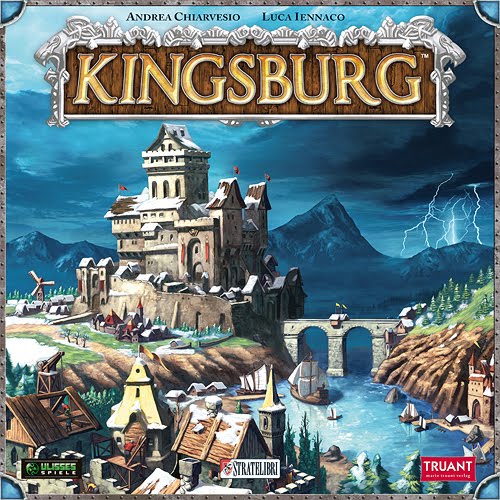
Board Game Review: Kingsburg

For the game night blog carnival this month I’ll be reviewing Kingsburg from Fantasy Flight games. It’s a 2-5 player worker placement game, with enough twists to set it apart from other games with a similar themed mechanic. It’s been seeing quite a bit on my table recently, mostly due to the engaging play and how it handles worker placement.

Players are governors for various towns under the command of a king. Their goal is to be the most prosperous governor, outshining the others after 5 years. This is typically done by completing the construction of different buildings within their respective towns.

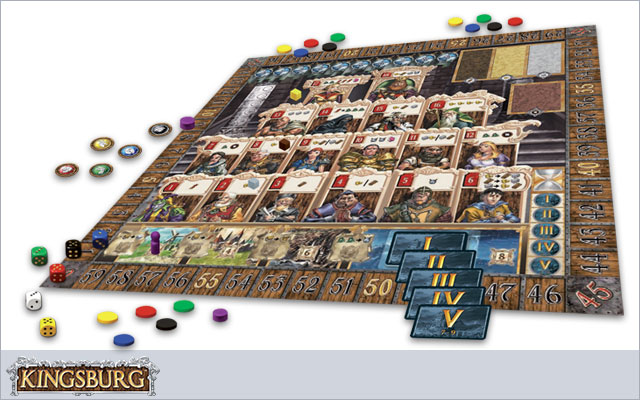
Each turn players roll 3 dice and place them on various sections of the board, representing the king’s court. Once a section is claimed, that player has the ear of a specific advisor, and no one else that round can ask for favors from that member of the king’s court. Each member of the king’s court offers resources (or other bonuses like troops and victory points) that can be used to construct buildings.

Players take turns assigning their dice until either all available spots are claimed, or they have no dice left. This can make for some very cut throat play where you choose to shut out one player, and use your last die for a lower member of the king’s court. The conundrum is the higher die totals will yield more aid from the royal court. But this can mean you are allowing other players to get resources from lower ranking court members. So the player is constantly thinking whether to use all their influence for a single advisor, or try to block out other players. It’s a fun way to handle worker placement.

Resources gained (wood, stone, and gold) can be spent to build one construction for the town. Each type of building is on a progressive track, where previous buildings must be made first. All the town buildings have some special function and earn victory points. There are definitely some interesting combinations between them, and as players progress up the building tracks, more and more powerful abilities become available.

One particular element I like about Kingsburg is there are plenty of opportunities to catch up if you lag behind during a certain year. Small consolidations are given to the player with the least amount of resources and buildings. The player with the lowest number of buildings always gets to influence the court first. During the middle of the year, they can also get an opportunity to construct 2 buildings, or gain favor from a court advisor that has already been influenced from another player. Not to mention every member of the royal court can offer something useful to the player, even the lower ranking ones (just that higher numbered court advisors are more powerful). It’s a nice way to keep everyone in the game.

Now, what I’ve described is a pretty standard worker placement/building type game. It’s pretty fun, but ho hum as you’d expect this from just about a dozen other games. Fortunately Kingsburg has a twist to the game play. Monsters.

Each year, you have a random monster threatening to rampage through the realm. And every year the threats become more powerful. As governors for various towns, not only are you scrambling to construct more efficient buildings, you also have to worry about the town defense. While fortifications might help with defending the town, they don’t offer the larger game bonuses of other non-military buildings.

Players that soundly defeat the monsters, and have large standing militias at the end of the year do get victory points. But that is fleeting as those militia forces disperse at the year’s end and have to be recruited again. Doing nothing likely means the loss of resources, or the destruction of buildings. So that monster threat can’t be ignored completely.

Another tweak is you have a rough idea of the monster strength coming at the end of the year, but won’t know the exact amount or the type of threat until they attack. Some fortifications are ideal against certain monsters (like a palisade against goblins, or a chapel against zombies), while not offering much protection against others. There is a way to gain some divination and see the approaching threat, but that usually means diverting needed influence for resources towards a court member that offers less rewards/resources. Without that knowledge you’ll likely over defend yourself, further diverting needed resources from construction (or worse, not be able to muster enough defense against the rampaging creatures).

The Good – It’s a light, approachable worker placement game that has enough strategy to making it engaging. You have to balance a lot of things during the game year. You have to try and develop your town, at the same time making sure you have enough forces to defend it at the end of the year. And all of this makes for interesting choices on which royal court members you will influence. At the same time, other players are doing the same thing and may prevent you from gaining that ear of a particular court member. The components are nice with beefy counters and nice wooden blocks. The artwork is whimsical and captures the fun medieval theme well.

The Bad – With repeated play, I can see some set strategies creep in. This is especially prevalent with 2 players. It becomes a bit easier to work towards a winning town building combination. The random monster threat helps counter this a bit. However I think the game really shines with at least 3 players, as you really feel the bite of not being able to court the royal advisor you want. As the 2 player game does this by randomly removing particular advisors each season, it still doesn’t beat having a 3rd or 4th player actively selecting advisors.

While there are stopgaps in the game to prevent a player from falling too far behind, this can happen (especially with the victory points). It’s more of a problem mid-game. If a player gets hit by a monster, they can lose a lot. Combined with poor dice rolls for a few seasons, they can really fall behind and not be able to climb back up. It can be a bit of a downer of having the game effectively end for them in the middle of play.

I’ll also add that while I enjoy all the choices and strategic possibilities, this can lead to some serious analysis paralysis. Be prepared to offer lots of advice to players to keep the game moving.

The Verdict – Kingsburg is great and one of my favorite worker placement games. It avoids a lot of the fiddly, worker drone shuffling of other games, replacing it with a simple dice roll. You have that feeling of progression as you slowly build up your town. The interaction with other players is there, as your choices (and theirs) have a direct impact on the play from turn to turn. All of this construction is under the shadow of a looming threat that will come at the end of every year, with each creature being randomly chosen from a small set of cards (adding some game-to-game variation).

I highly recommend this game. It’s approachable for relatively new gamers and has enough meat in the rules and play to keep a more seasoned board gamer interested. It handles a broad number of players well, with the 2 player game being as much fun as a 5 player one. This is a great game to have in your collection.

Tweaking 4E: Beefing up the basic attack

I’m still throwing the idea around of at least doing a one-shot of 4E once in a while. Maybe do another campaign if I can get some interested in giving it a go. So far they’ve been enjoying another setting and another game. One thing that I want to do is bring back the idea of using a basic attack or at the very least have it in place of an at-will.

Face it, a lot of at-will attacks have that generic option of a single target attack that simply uses a high ability score aligned with a certain class. As I mentioned way back in an old post, there is even a PHB2 feat that does something similar. So why not make a go of it and go full out? I think this actually might open up some classes to being able to focus on other abilities and not lag too behind other builds. Now I could have that CON-based fighter which could still be able to reliably roll out the basic attack damage. So here are my thoughts for a different basic attack-like ability.

All players at level 1 gain a trained basic attack. The player must select one option for this power at character generation, and cannot be re-trained.

A) The player picks a weapon group they are proficient with (ex. axes, bows, light blades, etc.). The player can use one ability score of their choice to be applied to that weapon group. If this ability replaces the default strength (melee) or dexterity/strength (ranged/heavy thrown) modifiers for that weapon, then the chosen ability score bonus is applied to both to hit and damage rolls. The power retains the martial keyword and weapon keyword. At 21st level, the power gains [2W] damage (plus appropriate bonuses).

B) The player gains a ranged basic attack that can target 1 creature. The power has a range and damage equivalent to a level 1 At-Will power of choice from their class. The power gains a damage keyword equivalent to the power source of the class (i.e. arcane, divine, primal, etc.) and the implement keyword. The power gains a bonus to hit and damage rolls based on an ability score of choice. At 21st level, the power gains one additional damage die, plus the appropriate bonuses (example, if the trained basic attack power does 1d8 + modifiers, at 21st level it will to 2d8 + modifiers).

Regular basic attacks are still in the game, but the player can have this listed first as their bread-and-butter attack. It’s the go to attack when they aren’t sure to pull out an encounter or daily power. A fall back choice for an attack and be comforted that they aren’t crippling themselves. I’ll have to tweak this some more, but looking forward to trying this in game.

SutherlandFight

No more +1s

So the gang is back together after an extended holiday and we’re discussing what to play next for our campaign. 4E is something still being considered. Think running with Savage Worlds will be the most popular choice, but 4E is still on the table. At the very least, it might be an occasional break from our regular game as a one-shot once in a while.

I’ve got some plans however to do some serious tweaking to the game. I’ve been thinking of some things to do for streamlining combat and speeding things up. I plan on still having a map, but throw out the grid. Also considering on really altering the number of powers players have in play and thinking of tinkering with the whole magic item power bit. More on that later.

One thing for certain, I want to get rid of the minor temporary bonuses that float around in the game. I want something with bigger effects. Static bonuses aren’t much of an issue, but all those little +1 bonuses seem rather fiddly. I’m thinking of a couple of options.

Make it all +2 – Not a groundbreaking change, but I’m liking the idea of making each bonus or penalty a +/- 2 and rounding things up. So that combat advantage with some temporary power boost might translate into a larger bonus to hit. That’s okay with me. I want the PCs to make those big rolls, the monsters are going to get the same thing.

Advantage/Disadvantage – The other idea I’ve had is using the advantage mechanic from DnDnext. Basically use simple color markers to indicate either a bonus or penalty to hitting a target. The marker with the highest total would grant either a disadvantage or an advantage.

This will likely make for some very chaotic combats, and I entirely expect my players to pummel the stuff I throw at them. However this might also put some hurt on them (given the proper circumstances), as I’ve just been able to double the chances of me critting my players. This might just make combats too wild and unpredictable, but of the two options I am leaning towards this more.

It’ll take a bit of playtesting. Fortunately I’ve got a patient group while I pull out the crazy houserule stuff. Honestly they haven’t been too keen on doing another fantasy campaign, but I might be able to get a one shot session in sometime. Certainly looking forward to trying this idea out.

Tips for teaching and playing Fiasco

Fiasco_coverI’ve gotten a few games under my belt for Fiasco. It’s a fun game but I think it can be a little daunting for newcomers. Likewise, there is a structure to the game and folks wanting a pure story-telling experience might be taken back somewhat with the dice mechanics. It’s a different game from your typical RPG, but with a few pointers you can easily teach and run a game without any major speed bumps.

Start with the aftermath… – When teaching the game, I’ve found it best to start with how the aftermath works. While story is king, at the same time you want to guide yourself to one color or the other. It can be counterintuitive that you can make a ton of bad decisions, earning a ton of black dice, and still come out on top. So having that guideline of working towards a single color helps.

At the same time, I reinforce that you want to push other players into bad decisions. You want to hand out dice that will give them a low score, drifting towards an even mix of white and black dice. All of it feeds into the aftermath, and understanding how the endgame works sinks in this concept of awarding a mix of dice.

…and work backwards – Of course how do the players get dice? It leads naturally into the different acts and establishing or resolving scenes. When describing this I emphasize that act two works just as taught (example, if a player is resolving a scene, they pick the outcome die). Act one is similar, but you give away the dice earned, leading back to the concept how the aftermath plays out. You want to be sure that the people whom you want to manipulate are in a bad situation. They need to be holding a good mix of white and black dice after act one, so be sure to push them using the dice.

Gloss over describing the tilt – Honestly, once players get through the setup and relationships, getting the concept of the tilt is pretty easy. Additionally, only two players will be deciding what tilt results come into play. It’s enough just to say that a few random events will come about after act one, and leave it at that. Once you are ready to determine the tilt elements, you can spend a little time explaining how they work for the game.

Have a clear agenda for a scene – A player should know (or say) what they want out of the scene and what they expect the other person should be agreeing to. This helps gives some direction and allows a better way to determine how good or bad a scene goes for them. There is not a lot of face time for each player. While some character scenes can work, its better to have players being proactive with the story and continually working towards character goals.

Say, “Yes, but…” A staple of improv that also works for DMing is the concept of ‘say yes and…’ For Fiasco I tell the players to “Say yes, but…” Players at odds with the active player should avoid shutting them down. Instead think how they can one up the other player. So instead of flat out refusing to hold a stash of coke at their home, how about counter with a request to burn down a lagging business? In effect that conflict becomes a you-scratch-my-back, I-scratch-yours arrangement. This opens a lot more story opportunities, allows that active player to get what they want, but still have an undesirable outcome (by giving up or agreeing to more than what they wanted to).

Award (or take) scene outcome dice earlier, rather than later – The natural inclination is to wait for a scene to conclude before you hand out dice. I think it gives better direction to players involved in the scene if the dice are awarded earlier. It helps avoid that long, drawn out conversation where each player dances around with what they want, and what they are willing to give up. At the worst, you end up with this contest of wills where the scene doesn’t go anywhere (which shouldn’t be an issue if they are using ‘Say yes, but…’).

Handing out dice earlier gives each of the players involved a huge heads up on how the scene should end. It’s a great way to indicate that one side needs to concede, agree with the plan, and move on. This gets trickier when a player is resolving a scene, but if they think they’ve made a solid argument, or will likely manipulate the other player, it’s a good way to herd the developing conversation towards that desired conclusion.

Stick to an approachable playset – A slasher horror, wild west, or post-apocalypse setting sounds fun, but new players might struggle with ideas. As much as folks may claim to have an active imagination, drawing ideas from everyday life can sometimes be easier. This is especially true if all the players can easily latch onto unfolding plot elements. Not everyone may have the same idea what life on a space station is like. For new players it’s best to work with the familiar.

One person picks the type of relationship (or element), the other picks the detail – I really like using this method. Sometimes this might mean having to skip a player during the setup, but it allows for both players to establish relationships, elements, or needs that define it. I may have a hankering to have a romantic relationship, or attach some weapon object to my partner in crime, but it’s the other player that would get to fill in the details. It forces both sides to compromise and allows each player to have some say in the story of the relationship.

Don’t be a slave to story elements – As everything unfolds and plans are made, you might find a certain location or object just isn’t part of the main stage and becomes more of a minor prop. Don’t try and force it back in. If you’ve got this wacky idea of something completely new, don’t fret too much about making it part of the game. The selected objects and locations are there as idea fodder. They don’t have to be central elements and you can use something else entirely if it just flows into the game.

Forcing selected elements to be part of the story can be problematic. I made this mistake trying to bring up a chosen object late in a game, where the plot had moved completely away from it being a more prominent element. Establishing a scene to drag it back in made the entire exchange fall flat. It would have been better to had just let it go and run with the other new ideas that cropped up as we played.

Don’t ignore story elements either – While you don’t want the chosen story elements to strangle the game, you also don’t want to bust open the fence of ideas and scatter the herd all over the place. Before you start throwing those free-form ideas around the table, take a look over the elements picked in the setup. Think again about trying to weave them into the narration. These elements have input from several players and making them part the story is a game in itself.

Be flexible – Be adaptable. If you’ve nailed down your character in the first scene, take a step back and reconsider their goals and motivation. Listen to what is happening around the table and think how you can weave your story into theirs. Sometimes this might mean altering what you envision your character as. Let things ferment a bit at least until the tilt. Remember it’s a collaborative effort, don’t adhere strictly to ‘what my character would do’, instead be flexible and work with other players to make the game fun.

Hope folks find these tips useful for teaching the game. Have some downloads that might be useful for running your game too (including a new playset). I’d be reminisce to forget Wil Wheaton’s Tabletop episode on Fiasco. It’s an informative and entertaining way to learn about the game.

EDIT: Some kind folks have pointed out that Bully Pulpit Games have their own tip sheet for running Fiasco. A nice resource to have handy when teaching the game.