Fun Flicks: Troll Hunter

So as ‘found footage’ films go I think it is a pretty tired theme for movies. Yet for the Norwegian fantasy horror movie, Troll Hunter, it works great.

In a nutshell the movie follows some Norwegian film students out to get some documentary footage on bear hunters that hunt down animals which leave protected areas and become a threat to the public. The students find out about a mysterious poacher that many of the hunters complain about. After all, they have to obtain a special licence from the government to kill these bears, and this poacher runs around killing bears illegally. As the students attempt to interview this poacher, they begin to realize this hunter is after other prey.

It’s a pretty fun movie that is less on scares and more on dark humor. But I’ll say there are definitely a few bits that get the hairs raising up on the back of your neck. I understand that the movie will be getting a US remake treatment. I think it’s pretty sad that distributors think a wonderful film like this just isn’t US market material. Instead you have to get a studio to basically refilm the entire thing for the english dialogue (come to think of it, why not just bring back good old dubbing?).

Granted sometimes remakes can do wonders. Of recent mind is Hammer Films’, Let Me In. But I’m more partial to the Swedish original, Let the Right One In. Still I guess if Hollywood is stuck in a rut for ideas, it’s great to give a nod to foreign films.

As for D&D, I’ll admit the movie gave me a few ideas. Overall it captured that excitement in exploring the unknown. I’ll have to add the tension of laying down bait to capture a potential monster was exciting too. It’s inspired me to consider the one shot adventure of having a group look into hunting down some mysterious beast. Getting the party come up with ideas to track, hunt, and trap (or kill) such a monster could be a big part. Nothing wrong with a good old Jabberwocky hunt I think.

Oh and for you folks responsible for Norwegian tourism, please push to promote this little gem of a film from your country. I found the scenic footage stunning. Odd to think such a small quirky film could capture the beauty of Norway so well.

Board Game Review: Jump Gate

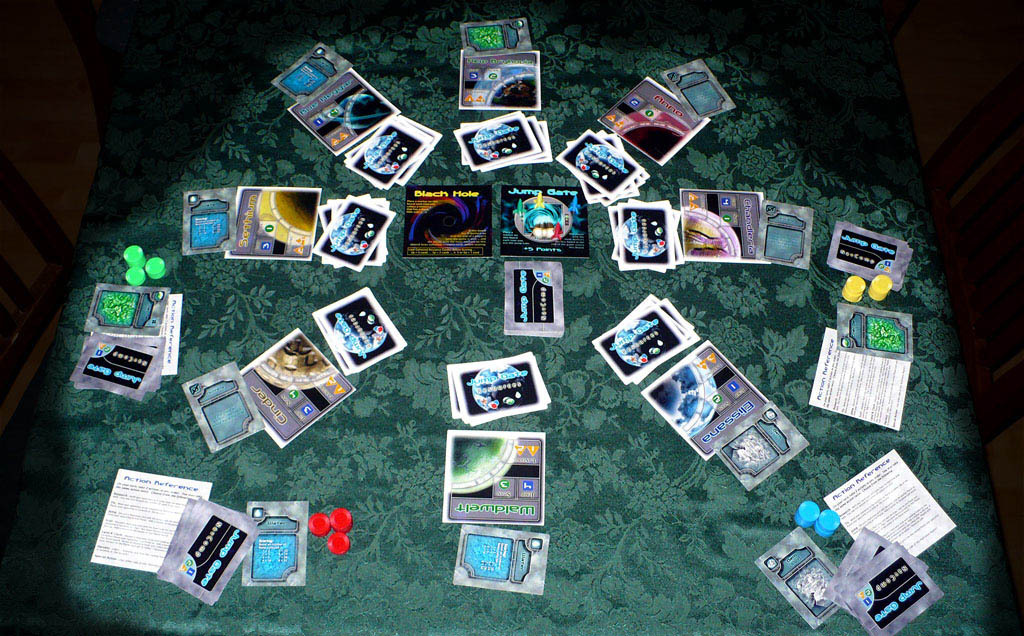
Jump Gate is a sci-fi themed, 2-6 player game. From Matt Worden Games it revolves around space exploration and gathering of resources. I managed to pick it up from Fun Again Games which released their own version of the game with a bound color rulebook and a larger box for all the components.

The objective of the game is to claim resource cards in various sets. As players explore and claim cards, some resource cards are linked with a black hole. When these cards are claimed, a player drops one of his tokens onto the black hole tile. When a total of nine tokens are collected on the black hole tile the game ends.

It can also end when all the planets are claimed and the only unclaimed resource cards have black hole icons on them. Having a low amount of tokens on the black hole tile is important, as the player with the highest amount of chips there gets a large penalty to their final score. This adds an interesting twist to the game, as players might have to balance out picking up a specific resource to fill out a set, potentially getting a lot of points, while at the same time contributing to ending the game and possibly having too many markers on the black hole tile.

Players travel around different planets moving around in a circle in either direction. Additionally they have a set of navcomp cards. These cards do a lot of game functions. They allow a player to utilize the jump gate and travel to a planet of their choosing. They also allow a player to scan and claim a planet, all of which is done by matching up the symbols and numbers on the planet with the proper navcomp cards. Additionally, many navcomp cards can also allow the player to have special actions (basically allowing them to conduct game actions without paying required navcomp cards).

Each planet starts with most resource cards hidden. As players travel around the planets, they can scan them, adding a player token to the planet tile. When the planet is finally claimed, each scanning token allows them a choice of the revealed resource cards. This becomes an important strategy as players race around the table trying to scan planets, allowing them to gain resources later in the game. Bonus points are also awarded to players that scan or claim planets.

Once a planet is claimed (and after others that scanned the planet have claimed their choice of resources) the remaining resources are up for grabs. Anyone that orbits the planet has a chance to pick up a card with no restrictions. Again this adds an interesting choice for players. Discarding specific navcomp cards, if a player scans a planet they can ‘stake a claim’ on future resources and gain extra points, however to get these resources someone must also later claim the planet. At the same time, once the planet is claimed then anyone can swoop in to take up the remaining resources freely without having to use navcomp cards.

At the end of the game players score points for claiming and scanning planets. Also the player that has the most tokens on the jump gate tile get a bonus. However, most of the victory points are earned for collecting recourse cards in various sets. The meat and potatoes of these points are from gem resources. Not only do you want to claim a lot gem resource cards, but also try and focus on having one color to make up your total. Additionally many other resource cards offer more points making a pair (dark and white energy) or forming up a large set (water), while others just offer a high point bonus. As all this is being tallied, the player with the most tokens on the black hole tile gets a penalty to their score.

This scoring can make for some interesting gameplay. To get a lot of points you need to focus on specific card sets. Meanwhile you want to claim resource cards to prevent your opponents from doing the same. This sort of makes for some cut throat play as players race from planet to planet scanning and carefully picking up select resources, all the while watching your opponents and trying to see what resources they are trying to collect. If players are going for the same resource, this can be a a little hectic trying to pick up the right cards that will offer a large point bonus at the end of the game.

Recently Jump Gate has been picked up by a larger publisher and will be released as Space Mission. The German release offers much nicer components and the rules have been worked over a bit for more streamlined play. There is no black hole tile in the German Version, and play ends when a certain number of special resource cards are discovered. Another tweak is with the scanning action. In Space Mission, players can look through resource cards and actually ‘claim’ a resource that will be picked up later once the planet is developed. It’ll be interesting to see how folks enjoy the different games. I might even consider trying out the Space Mission rules with my version of Jump Gate (it’ll require modifying the resource cards though).

The Good – Jump Gate is a pretty fun set building game. It captures the theme pretty well as players try an race around the board scanning and claiming planets at the right time. There isn’t much direct interaction with other players, but picking up certain resources and claiming planets can impact other players. Additionally there are more planet tiles than what is used to play, allowing for a slightly random layout of worlds each game.

The Bad – There seems to be a scoring dump when the game ends. You have to parse out a lot of resource cards into various sets, and it can be a little difficult to know exactly how many points you have as you are playing (unless you take the time to re-tally your score each turn by yourself). Also as strategy goes, it really seems that players need to rush in and scan as many planets as possible initially. Even though there are other options, it seems to push players onto one strategy track if they want to score a lot of points. Also I will say the components are a bit spartan and simple, even with my boxed edition that is supposed to be the more ‘upscale’ version. However, it’s hard to knock the game for that given it is from a smaller publisher.

The Verdict – Overall I enjoy Jump Gate and found it much more engaging with more than 2 players. While direct player interaction is limited, you do get a feel that you are at times in a frantic exploration race with other players. Getting to scan worlds before your opponents allows an opportunity to get choice resources when it is claimed later, and also allows you to plan out what resources to collect. While this at times seems to be the best strategy, having other players in the mix can muck up things quite a bit, so you have to be flexible with your plans.

I feel adding up victory points at the very end can be a little convoluted to tally. This also means it’s somewhat nebulous to gauge how well certain players are doing during the game. The components are a tad simplistic and low quality, but I bought my copy for about $15 USD and consider it a bargain for the game inside. I think Jump Gate captures that feel of space exploration well enough and makes for a fun game.

Randomizing the threat for attacks of opportunity

I like the idea of attacks of opportunity. It encourages players to position themselves in support of each other, and form up ranks to protect more fragile party members. However, I’ve been seeing in our games it’s becoming sort of a drag on combat.

I’ve noticed at times my players agonize a bit whether to move a particular route due to the threat of attacks of opportunity. This also drags the group’s sorcerer and bow-wielding rogue into action paralysis, as they struggle over deciding to fire off an attack or suffer the wrath of that orc standing toe to toe with them. I really want to encourage movement over the battlefield. 4E seems to really thrive on that. Yet, I’m finding the threat of attacks of opportunity starting to impede the maneuvering of the PCs.

I decided I needed to throw in a random chance if an attack would happen. Overall it would cut down the probability a player would get hurt, and still be a possible threat. This way, there was a chance a player could get hit running across the room, but not saddle them down with having to decide some precise dance of moving square to square in order to avoid a single attack. I work out my house rule as follows:

Roll a D4 – A player provokes a possible attack of opportunity as per the rules. Instead of it automatically happening I roll a 4-sided die. On a roll of 1-2 the player suffers an attack of opportunity and I make a basic attack rolling to hit verses their AC as normal. Otherwise, they don’t provoke an attack of opportunity and get to continue on with their action.

Chance of attacks increase – Each time a player potentially provokes an attack during their action, I increase the chance by 1 and this is cumulative. So if a player charges by two gnolls (possibly provoking an attack from each) the first roll is a 1-2 on a D4, the second would be a 1-3 on a D4.

Third chance and you’re attacked – If the player manages to provoke another attack of opportunity a 3rd time during a turn, I don’t bother rolling to see if it happens. The PC provokes an attack of opportunity as normal.

This works for the baddies too – This also goes for monsters, so everyone is using the same rules. Any time an attack of opportunity might happen, I have the players roll to see if they’ve got a chance to make a swing. I’m still playing around with this. I like the idea of balance (what is good for the players is good for the monsters too), but it can also put a wrench in the player’s tactics.

Some builds and powers take advantage of attacks of opportunity. Having that now a random chance might not go over well with some groups. Also while it will make fights more dynamic with movement, taking away that that edge of potential attacks for the players might mean fights drag out (less attacks of opportunity mean the monsters stay on their feet longer).

So far though this has worked great with my group. Assuming a normal melee attack vs AC would hit half the time, throwing this random chance of an opportunity attack means a player actually taking damage from a hit would be about 25%. This scales up slightly if the player keeps provoking attacks of opportunity, until the point the turn plays out as per the rules.

This means a player can take a gamble and possibly tempt an attack doing a desperate action. If they rush headlong into danger however, the odds stack up against them. Also there is still a fair chance an attack of opportunity will occur, it doesn’t eliminate it. So shifting is still a tactical option.

As I mentioned my players have been enjoying this tweak. It’s just enough to allow them a little breathing room if they provoke a single attack. In turn they’ve begun to make bolder actions in combat, something I want to encourage. I’d be interested if folks have changed how they run attacks of opportunity in their game.

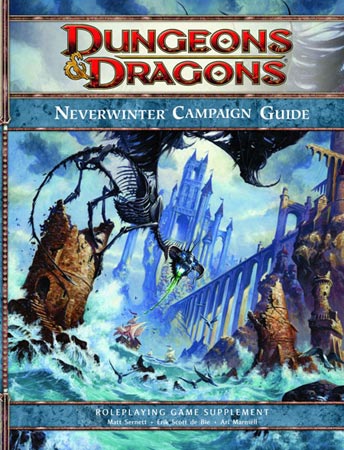
Thoughts: Neverwinter Campaign Setting

I managed to pick up the new campaign setting out from WotC while on holiday and I think I will echo what many have said, this is an amazing book. It’s chock full of story hooks and adventure ideas all squeezed into a pretty small landscape within the Forgotten Realms. There is a lot going on here in the book and I think WotC has really set the bar high for other campaign books to follow.

Themes – Aside from the nuts and bolts of the setting and locales, I really like the inclusion of character themes. Immediately players have an option to include something in their background that can align them with particular factions in Neverwinter, and give them some motivation or goals. For the DM, they immediately can have some hooks and adventure ideas to reel in the players. I could easily see the first session being folks just rolling up their characters, seeing what themes they might pick up, brainstorming their background a bit, and giving the DM a checklist of ideas to take the campaign off in a certain direction. It really has the potential to effortlessly mesh the main adventure story with the characters.

Heroic Tier – Looks like WotC has been digging through the character builder a bit and come to realize that people like the heroic tier. Some might consider it limiting, but I think it was a great decision to put a cap on the expected levels for the region. I think it gives the DM a broad assortment of villains, movers, and shakers in Neverwinter and allow for a lot of possibilities right from the start. Honestly I like heroic tier. I’ve yet to dabble much in the paragon tier (and haven’t even tried epic). It just seems that the high end of PC levels makes for a very different type of D&D game, with truly epic threats becoming a bit too large in scale for me. Clawing up through the heroic tier seems more manageable and engaging.

Lots of Tidbit Info – Much of the book is scattered with sidebars giving more detail and ideas to the DM. It breaks up the main text well and is a great way to disperse some story ideas without overwhelming the DM. Clearly outlying the goals of a particular villain is a given, but having that additional sidebar on the same page giving suggestions and ideas for adventures is a huge plus.

Politics and Factions – There are a lot of different groups vying for power in Neverwinter and the book does a pretty decent job of laying out the different relationships each has with other groups. There are a lot of options with the potential of enemies becoming allies for PCs (and vice versa). It’s a shame something like this wasn’t done with the other campaign settings. It really gives the DM a foothold in the politics of the region and allows options for that kind of game. Of course all of this could be skipped if you wanted a traditional hack and slash campaign, but it’s nice to have this type accessible.

Another thing I enjoy is that much of Neverwinter is dynamic. There are guidelines for the DM if certain groups take control (or if particular villains get defeated), so the landscape of power can change. There are also a ton of different groups in the region. So much so, you could run 2-3 different campaigns focused on different factions, and still have a lot of territory to explore. I could easily see a dual campaign going with different groups running simultaneously in Neverwinter. Paths might cross and outcomes could have an effect on the story for other groups, but you could also have such intersections a rare event. Things are that broad with the factions in the region and it allows for a lot of replay.

Embracing Wild Fantasy The underdark, demons, abysmal creatures, and the Shadowfell, it’s all here. You can have that gritty explore the ruins and tame the wilds kind of campaign, but it also allows for some pretty unusual locales. I especially enjoy the inclusion of Evernight, effectively a shadow version of Neverwinter, which throws down the framework for a planar campaign. Pretty fun stuff here and I’m glad that the book gives out a ton of ideas breaking away from the more traditional fantasy themes of past books.

Revisiting Forgotten Realms – I think Forgotten Realms as a 4E campaign setting sort of got a bad rap. Granted a lot of the canon of previous editions was thrown under the bus, but I got what WotC was going for with the new Forgotten Realms. They really wanted to push the points of light theme and it works.

Still, it seemed that each additional campaign setting that came out got better and better in presentation and material. Forgotten Realms seemed to have been kicked to the curb. That’s really a shame as there’s a lot of flavor with the underdark, spellplague, and constant demon incursions. As a high fantasy setting, it invokes a lot of imagination and seems to pull the right strings for making a ‘classic’ D&D campaign. I’m happy to see WotC hasn’t abandoned this setting completely. Hopefully they’ll look at sketching out more regions and groups through DDI content and other books.

To wrap up, I think the Neverwinter Campaign Setting is a great book, especially if you are looking at delving into a Forgotten Realms campaign. There is a lot here, and a DM should expect not to try and digest the whole thing from the start. Rather, I feel it is better to work with small pieces of the game world and run with it. There are so many options and ideas, you can easily revisit Neverwinter and run a different campaign all together the second time around. A good buy if you are looking for some inspiration in your game too.

TBEMFTB

Travelling out of the country on holiday and likely be too busy eating mexican food to blog. I’ll return late September. Until then, salivate over this feast.

Toodles for now!

The long and winding road of 4E skill checks

Since 4E has been released there has been quite a few changes with target values of skill difficulty classes (DC). This is something I’ve complained about before and I’m surprised that such a fundamental aspect of the game has changed so much since its release. I realize a lot will say this doesn’t affect how a group plays, that the DM can just adjudicate things and run the game they want. All true.

However having a standard, or ‘official’, set of rules for skill checks and skill challenges is important. It gives a lot of insight into what is expected as a reasonable challenge, and what should be a good yardstick for a DM to use in their own games. More importantly, if gives a lot of guidance to new DMs that might not have a lot of experience or knowledge of other RPG systems to draw from.

Lastly, I feel most players appreciate a system that has rules and is predictable. While good players realize at times a DM might need to herd the story in a direction, meaning some attempts at a skill would always fail. If things are too fluid and appear simply at the DM’s whim, players can get frustrated as they feel have no real influence on feats of skill.

Looking at 4E skill difficulty classes when it was released, easy, moderate, and difficult checks were set at values of 10, 15, and 20, respectively. These increased with the player’s level, but in effect relatively stayed the same as 4E introduced the idea of a constant modifier of +½ a characters level for just about everything from defences, attack rolls, and also for skill checks. Interestingly, there was an additional +5 modifier to all skill check DCs (DMG pg. 42), but was dropped in an errata.

When the DMG2 rolled around the DC values were dropped significantly to 5, 10, and 15, for an easy, moderate, or difficult check, respectively. This was a big change and really opened up how effective skill training (along ability modifiers) could be in skill challenges. Likely it was too lenient a bar as the latest iteration of the rules and skill DCs are now higher, almost to what they were with the initial release of the 4E rules.

Now for a level 1 character the DC values for easy to difficult check range from 8, 12, and 19. Further, where the older versions of the rules increased DCs every three levels, this new version increased with every level. Also, the easy DC values scale up a little less compared to moderate and difficult DCs.

These changes give some important ideas on how skill checks should be implemented and what a DM might consider when working with skill challenges.

Failure is always a possibility – Right off an 8 is needed to pass and easy DC check. Even with the appropriate skill training, a character can fail. Add in ability scores, typically with a standard array this would be a +2 or +3 bonus (although +4 is a possibility), and you can usually eek out a success for an easy check. This is an important philosophy with the game. There are no sure things, and PCs should expect to fail if making a check under duress.

Training is not enough – That +5 bonus helps a lot. But if PCs want to really improve their chances, they should expect to tag that training to ability modifiers. This is one aspect I am not too keen on, as it means there is no amount of training a player can undertake to make up for a similar character with innate bonuses from ability scores. However there is a work around of sorts with the last point…

Taking 10 can be the best option at times – Given that characters can fail, and that simply training in a skill alone will not guarantee a success, PCs really need to consider just taking 10. In fact, I’d push that a DM should offer this up as the default for any skill check made by PCs trained in a particular skill. If that streetwise rouge botches a simple check, I’d seriously consider that they came away with a little knowledge of the local comings and goings. I expect that taking 10 is not something a lot of players do. A DM should encourage it, as those non-skill challenge, non-threatening situations, mean that the players can accomplish quite a bit taking this route.

This leads me to an interesting observation with skill DC values, although they are scaled to take in account the player’s level, they really don’t break down more than just being an easy, moderate, or difficult check. Something overlooked (especially when considering making a challenge more difficult) is the level for DCs. I think this is something being explored with ideas floating around of ‘novice’, ‘journeyman’, and ‘master’ levels of knowledge. I expect this might lead to additional modifiers a DM can thrown into skill challenges. If anything, they’d give a DM a better gauge to figure what would be an appropriate challenge in certain situations.

What does this mean for my game? I’m looking at the idea of altering DCs for certain skill challenges taking level into account. As a general idea with combat encounter building, if I run a +4 level encounter I can expect a tough fight. Likewise, if I bump up the DC ‘level’ of a skill challenge by 5, I can expect a tough challenge even if it the complexity is simple.

It’s something to play with, quite possibly expanding the normal -/+ 2 modifier a DM uses to even greater values of -/+ 4 (which is in effect just bumping up skill DC levels). So that lock on the door of a high level mage might not just be a typical difficult DC check, but would bump up even higher taking the NPC’s level into account. I’ll have to tool around with it, but I think incorporating relative level in with DC values might give a more dynamic range of DCs needed for skill checks.

Expeditions of Amazing Adventure: the enigmatic arcane endurium of Estalycia

Far to the north east along the icy coasts of the north sea is Estalycia. A small city that carved itself out of the frigid barren rock long ago. The city is encircled by a windswept tundra and further isolated by the Whitepeak mountains.

For centuries this settlement was known for its fishermen and stoneworkers, a minor trade partner to the nearby dwarven cities nestled deep within the surrounding mountain range. The city managed to maintain a lifeline to other regions outside through their adept command of the seas, and merchants from this far off city have been known in the past to aggressively purchase wares from other ports to the south.

However, Estalycia’s role in the world has changed in the past two decades. Out in the tundra, adventurous prospectors came across a large field of strange ore. The dull green metal was malleable and oddly light. After extensive study, several wizards found that the metal could be enchanted and would retain simple magical energies for years. Fragments of this rare element could be infused to provide ever-burning lamps. Other small pieces could be infused with other ritual energies to give off searing heat, or numbing cold.

The craftsmen of this rare mineral called it, Endurium, named for its astounding ability to retain energy. Such amazing properties of this metal have allowed Estalycia to transport fresh catches of seafoods even further to other cities. Lampworks were created overnight, with the demand of their ever-burning lights being a prize possession for nobility and other citizens of status outside Estalycia.

Another wondrous property of endurium is that fist-sized chunks of this strange ore serves as a means to store vast amounts of motion energy. Such energies have served as perpetual engines, operating great lifts and ever-turning wheels that could drive large ships, or wheeled cart caravans. This advancement has even rivaled the ingenious dwarves and their clockwork automatons.

No one is sure how this metal came about. Some claim an ancient star must have struck the world. Others claim it is a patch of earth that was saturated in the blood of titans and demons during some long forgotten war. Nonetheless, this small etch of mineral has been a boon to Estalycia.

The city now has streets lined with smokeless lamps. The normally frigid homes have become comfortable residences with warmed floors heated by enduruim laced water pipes. The precarious coastal stone quarries hold several automated lifts, and its navy has begun to outfit many vessels with waterwheels that can continually churn the salty waters without the need of sails.

It is the inhospitable location and the natural barriers of the Whitepeak mountains that have allowed Estalycia to maintain their hold on the nearby endurium mines. Other more accessible cities would have likely been invaded by neighboring kingdoms. To this day, many whisper that the great dwarven clans would have taken these mines by force if they were not continually harassed by orcs and goblins. Although many more learned tacticians of war would claim the long trek across the icy tundra would be a difficult task for any army, even the stout dwarves.

As the prominence of Estalycia has grown over the decades, the city inhabitants have become even more cosmopolitan. It has become a very popular region for arcane practitioners to settle and conduct their mysterious research. The increase of endurium powered carts and ships have meant more trade, and now it is several merchants from far off regions that seek to enter the broadening markets of Estalycia. Many seek to obtain simple arcane infused goods, energized by fragments of the strange metal. Yet the most coveted good is endurium itself. The sale of the raw metal is severely restricted, and well over a king’s ransom for a large piece.

However many aspiring thieves have tried their mettle in obtaining samples of the enigmatic ore through dishonest means. More brutal ruffians have sought to strike out at the mines themselves. It is a near constant effort that one can usually find employment by local merchants and Estalycian military to stave off any attempts to steal endurium. Likewise, one could likely find a more dishonest benefactor to fund an attempt to gain a large hold of the metal.

A few more reserved opinions with an ear for politics claim that the great dwarven clans of the region seek to control all the sources of endurium. It is a matter of time before a clan attempts to take these fields of strange metal by force. However it is unlikely that one clan alone could do this, and such a prize would make other clans greatly envious. As this arcane element is so rare, there is no possible way all the neighboring clans could benefit from a small group possessing the mines. Hence many well versed in the dwarven kingdoms claim that several noblemen spend many of a long night, drinking ale, thoughtfully pulling on their long beards, pouring over maps and plans to determine how they could obtain this treasure of Estalycia, and still be able to retain it from opposing dwarven clans.

The problem with using virtual tabletops for D&D

I’m certain that WotC’s virtual table top will be getting released in the near future. I’m also certain you’ll get some interesting products for RPGs on the horizon as certain technologies becomes more attainable for the public. With more people getting regular access to wi-fi and smaller, more portable, computing devices, you’ll likely be seeing a demand for RPGs to work in a digital format. I expect that future incarnations of D&D will be going in that direction.

However my last game session made me realize there is a kink in this future digital format of D&D. As the pic shows, you’ve seen this slow expansion of tokens, cards, and other paraphernalia at the table (not to mention the ever present dice). Long ago I adopted using cards for player powers and magic items. I also started using tokens for action points and a means to mark combat conditions.

I think there has been a general shift in the gaming hobby from having very spartan and abstract way of handling player resources, to utilizing tokens, markers, and other items represented by physical objects. This is seen in other RPGs like the use of bennies in Savage Worlds, or fate points and I’m not surprised that has D&D followed suit.

While you can certainly keep track of everything on a sheet of paper, I think there is a stronger impulse to have some type of physical marker. There is something about having that visual and tactile representation of a game resource that seems more pleasing to players. It’s like a way of reminding the player, ‘Hey, don’t forget about me. You’ve got this handy tool to help out with this obstacle.’ Likewise, for D&D it can be a reminder that something bad is currently happening to your player that you need to shake off. You can record all of this on your character sheet, but I think we prefer having some other way to keeping track of this stuff.

This is something that the board game industry has definitely picked up over the years and have implemented in their game design. I expect that improvement and reduction of costs in manufacturing of plastics, distribution, and online marketing has a lot to do with it. However, I’ve noticed a trend in many games getting more physical bits and pieces in games. Sure you could keep track of victory points on a sheet of paper, however I’ve noticed a trend that most games implement some kind of marker or token instead. While I think years ago this might have been a feature for board games, it seems that now this is something that is required. I really feel that customers have grown to expect something like this when they purchase a game.

Where does that leave this with digital versions of RPGs? I dare say that is going to be a problem. Virtual tabletop RPGs are going to need to include features that allows players to manipulate some type of tokens. While you won’t be physically handling a bloodied marker, I can see a DM pulling a bloodied marker out of a menu and dragging it to a PC’s icon. In turn that player might see a new ‘token’ on their character sheet in their iPad. Removing the bloodied condition might mean the character passes that token icon back to the DM, simply dragging it off their sheet. Likewise, I can see player powers and abilities working like virtual cards, that ‘flip’ when used.

There is an alternative to this. That is to simply keep everything automated with minimal record keeping. A player might just click on their virtual miniature and see the range in squares they can move. Click on a power, click on a monster to attack, hit a button and all the damage and status effects are kept track of automatically. The new facebook game Heroes of Neverwinter looks like it might be going that route.

However, managing some game mechanics manually is needed to help reinforce that interaction around the table (subtracting hit points might be the exception). Otherwise I think games will slip into being too passive. I feel you’ll likely end up with people shutting down during fights, slipping into some automated mode where you click a few menu options and crank through combat.

So I believe that will be the challenge for D&D as it becomes a virtual product. Programmers and game designers likely will have to figure a way out to keep resource management that is handled through some type of ‘tokens’ that pass between players. Sure you could bypass it all and keep track of everything automatically, but you risk making the play experience too much of a passive experience, or at the very least reducing that interaction you get sitting around the table.

Board Game Review: Race for the Galaxy

Race for the Galaxy is a sci-fi themed resource card game for 2-4 people from Rio Grande Games,. The game portrays the player as a budding space-faring civilization attempting to expand its reach throughout space. On the whole I really enjoy the game, but there are a few reservations I’d have for certain gaming groups.

The object of the game is to gain the most victory points from a limited pool. The game ends when the victory points run out, or players have put 12 cards in play. Overall I like the effective time limits with the game. It really pushes players to try and make the most of each turn, as sitting back and biding your time won’t work. You have to be constantly trying to produce and sell goods, or continually make developments and claim planets. Players earn victory points primarily through building developments and colonizing planets. Another key means of earning victory points is through the selling of goods.

The cards are used for everything in the game (save for victory point chits). The cards themselves represent planets and developments (resources to allow the player to do special actions). However not only are they different cards what you actually play on the table, but they are also are used as a currency and as goods to produce and sell for victory points. As there is a hand size limit, it makes for some interesting choices to decide what cards you discard in order to ‘pay’ for colonizing a planet or building developments. Additionally, many cards have a synergy in effects so this discard choice can sometimes be a bit of a conundrum for players (as there are some really neat combinations you can make).

I actually like this idea. While it’s true that at times I enjoy having lots of components in games (ex. Terraforming Mars or Puerto Rico), it is refreshing to have a game that is a little more utilitarian with how goods and currencies are represented in game.

Each turn a player selects one action they like to take. Actions range from exploring (going through the deck and selecting a card to add to their hand), to placing developments and planets in their area, to producing goods to sell or gain victory points. If the player selects this action, typically there is a small bonus (say, paying one less resource to build a development). The twist is that all the other players also get to do the same action. So if you want to colonize a planet, everyone else around the table gets to do the same thing, save that small advantage you would get for selecting that action during your turn. It’s an interesting process. While you are rewarded with some bonus for taking a typical course of action, everyone else gets an opportunity to undertake the same activity.

There are some events that take a turn to two to develop, so it is not uncommon to try and produce and sell goods while other players have no resources available. So you are continually looking at the cards other people have in play, and trying to undertake actions that won’t be extremely beneficial to them. There is also a bit of gambling involved. As the bonus for selecting an action is not tremendous, sometimes you might opt to select another. All in hopes that the other player selects something that would help you, while you direct your limited choices to some other important action. Sometimes this works, and sometimes everyone focuses in on a particular course of action for the turn.

It plays rather well and moves at a fairly good pace. The only complaint I have (and it is a big one) is that there is a steep learning curve to the card symbols. While the game mechanics themselves aren’t too hard to grasp, each card has several icons on them relaying different characteristics and uses for the card. I find you really need about 2 games or so under your belt to recognize all the symbols and icons. This is further compounded with particular names and icons having nothing to do with the game, rather they relate to other expansions. Despite having large color icon cheat sheets in the game, it can still take a while for a new player to get up to speed.

As another quibble, I don’t think this might be everyone’s cup of tea as a strategy game. There is a lot of randomness with the initial draw of home planets and cards in your hand. Typically it takes a turn or three before you can cement a strategy. I like this aspect of the game, as it keeps your planning fluid and changes from game to game. I’d liken it to being a ‘puzzle’ game. You at first are unsure what route you need to take in setting up your empire. As things unfold, you get a clearer picture as you figure out a particular strategy. This might drive some players bonkers, as they want to sit down and try a particular strategy right from the start. In Race for the Galaxy you really can’t do this.

The Good – This is a fun strategy game. It’s random and deep enough to allow a player to explore a lot of strategies. While there are some really nice individual planets and developments, just about all the cards mesh with other particular cards, making for some interesting synergies in play. I also like the mechanic that has players select their turn actions that affect everyone. While it’s not quite involved as other games with trading of cards and such, it still requires you to take a look around at what other people are doing and think about your plan of action for the turn. You can play with 2 people which is always a plus.

The Bad – The learning curve is a bit steep on this one. As I stated, mechanics-wise it is not much however there are a ton of symbols, icons, and colors a player needs to process. It can be daunting at first and you really need to expect a new player to get a few games under thier belt to be able to grasp everything. Also, theme-wise there are a lot of neat little titles of cards with some fun artwork, but on the whole you could swap out just about any other symbols and names to mimic just about any other genre. So while it does has a sci-fi theme, the rules and actions are simply an abstract mechanic that don’t really seem to capture the feel of a space exploration and expansion game. Also, out of the box you can only play up to four people. I still like having a game that seat a few more around the table.

The Verdict – I really enjoy this game. I find it’s meaty enough with options and combinations to make for a fun strategy game, and just enough player interaction to make it interesting. There are several expansions for it, most of which add additional players (up to 6) and also add additional combinations and other variants to alter game play a little. I have found some of the expansions hit or miss, but I do appreciate allowing me to have additional players. Still, right out of the box you will find a great strategy game. I highly recommend having this on your game shelf.

July Blog Roll

So every once in a while I like to share some of the blogs I’ve been looking at over the past few months. While not all of them are about 4E, they’ve got something to offer your game.

Points of Light – While some of the writers use some adult language I think isn’t necessary, I’ve enjoyed this blog for several years now. They offer a very 4E-centric blog that keeps up on a lot of the new WotC content. Now that I’ve let my DDI subscription lapse, I’ve been definitely frequenting this blog more. I’ve enjoyed their analysis of new character options that roll out in Dragon.

The Id DM – A relative newcomer to the D&D blogging scene that has gathered a large following pretty quickly. The Id DM offers some really interesting analysis and thoughts on the dynamics of groups and the game in general. I particularly liked his breakdown of the Penny Arcade/PvP D&D podcasts, that provided a solid look at how much time combats take and how that time is spent.

A Character For Every Game – While not a 4E-centric blog, this guy does cover a lot of ground for the fantasy RPG. He offers some interesting articles on RPGs in general but lately I’ve been cruising his blog more for map posts. This guy offers some maps of really neat dungeons that have certainly sparked my DM imagination. Well worth checking out.

I hope folks enjoy the links. Please do give them a gander.