Board game review: Forbidden Island

Normally I would pass on something like Forbidden Island if I saw it in a store. This is from Gamewright, a publisher of kid friendly games, and I think the packaging definitely echoes that feel. I’m glad that I went ahead with my purchase though as I would have missed out on a very fun cooperative game.

The game is for 2-4 players, each playing a specific team member on an expedition to a mysterious island. The island is sinking, and the players have a limited amount of time to explore the island, retrieve treasures, and get back to the awaiting helicopter to escape before the island is submerged for good.

This is all represented by tiles that are randomly placed at the beginning of the game. On a player’s turn they can take a number of actions. They then draw from an action card deck which could be treasure cards, special bonus actions, or a limited number of water rising cards. A player completes their turn playing flood cards. There is a tracker that represents the amount of flood cards that are drawn each turn. As each tile card is drawn, they flip that tile over to represent it flooding. If a flooded location is drawn again, that tile section of the island sinks and is removed from the game along with any players that happen to be stuck on it (and if this happens everybody loses).
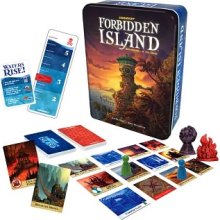
The objective is to obtain sets of cards for specific treasures and turn in those sets on the appropriate tile. After all 4 treasures are collected, the players have to return to the helicopter landing pad to escape safely. Each turn a player will find themselves trying to manage being on the right tile to trade away cards with other players, or shoring up key tile locations to keep them from sinking, all the while making sure they don’t end up on a location that will sink completely.

As the game plays players will draw water rising cards, increasing the number of cards drawn each turn as the tracker is moved up a notch. In addition the flood cards all ready drawn are shuffled back into the deck, increasing the likelihood that section of land will be subject to future flooding. This can make for some tense decisions as players balance making a run to get a treasure (or pass off cards to allow another to get it), while still keeping certain tiles from sinking.

This isn’t a deep strategy game. However it is fairly challenging and I like how it is an ‘everyone wins, or we all lose’ type of scenario. Everyone has to work together and most will find their turns being a bit of discussion with other players about the best plan of action. I like that each player gets a random team role that gives them a unique ability (effectively breaking some of the rules). As each player can do a special action, this adds a little difference to each game and gives players more options on their turn.

I also like that you can begin the game with a higher flood level. This in turn, ramps up the difficulty as you have less time and really have to plan out your turns efficiently. Combined with a fairly random island layout, and playing 1 of 5 different team roles, you can get a lot of replay out of the game.

The Good – Random layout, and different random player roles adds some variety to the game. Additionally, you can tailor the game to make it a bit easier or more difficult, allowing different groups to play and have fun. This is something refreshing when trying to play the same game with children or just adults. The components are very nice, with thick stock tiles, and solid-backed cards. The plastic treasure and player tokens are also beefy and can be handled easily (no little token bits here). The colored artwork is nice and plays to the theme well. The rules are well written and easy to follow.

The Bad – It is a random game. You won’t be able to plan out a grand strategy here. Basically your turn is a puzzle as you try to be the most efficient with your limited actions. Some of the player roles are situational and not all may be as useful as others (I’m looking at you Mr. Diver). While you can ramp up the difficulty, I’m sure with the right cards and groups that can quickly analyze and predict future sinking tiles, the game can be pretty easy to play. Additionally, it is a cooperative game. Some players might have more fun with griefing other players than with trying to contribute and win the game.

The Verdict – Forbidden Island is a fun, light strategy game. It captures the right amount of tension and player interaction. I think it would work with young children and still be a challenge to adults. It is packaged well with handsome components. Not to mention the price is just right for a game like this, being about $10-$15 USD. It is a fun cooperative game. Something I think would resonate very well with folks wanting to play games with their kids.

A very family friendly game, priced very reasonable. I’d say pick it up and look forward to exploring this mysterious island. Just don’t forget to ‘Get To Da Choppa!’
A new dev studio for Neverwinter Online?

News has leaked out that Atari is looking to sell of Cryptic Studios, the main dev studio for some MMOs (Champions Online and Star Trek Online) and the upcoming 4E version of the D&D Neverwinter series. This makes the fate of the online game a little questionable. In their earnings report, Atari’s business plan seems to be releasing less but more polished games, including moving into the mobile market. However they’re also determined to hang onto their signature licensed stuff including Dungeons and Dragons.

So what is the future for Neverwinter Online? If Cryptic is sold off, will they still be outsourced to develop the game? I wonder if another studio might be the ones to step up and finish off the project. I was mildly interested in the Neverwinter game. It sounded not quite like a full blown open MMO, but a more persistent instanced-based coop game. I have to admit I really would like to see video game treatment of 4E D&D. But it looks a little questionable how Neverwinter will proceed now.

Where is the WotC love for Gamma World?

I’ve been debating about renewing my DDI subscription. I find myself struggling to justify keeping it active. One thing in particular I’ve noticed is the absence of content for Gamma World with their online material. A few months ago WotC did have a great vehicle rules article and had a pretty good article on making your town a backdrop in Dragon magazine (way back in December). However the amount of other material out there for Gamma World is rather sparse.

I really like Gamma World (GW) and found it to be a fun game. I think it captures a really light-hearted feeling of just providing a wacky game experience. Something missing a bit in the recent RPG market it seems. While it might be a stretch to get a serious game out of it, that can be done. So I think it straddles different campaign playstyles fairly well.

I understand that the printed material for Gamma World is pretty much done. They’ve released the boxed sets and I think we can expect that is just about it for the game. I don’t think it’s a bad idea. I actually think it helps in promoting the sales of the game. You don’t have to feel like you are overwhelmed with stuff if you decide to pick it up. Each extra boxed set adds a little to the main game, and that is entirely optional (plus they seem reasonably priced).

What I don’t get is the lack of support for the game, especially with DDI. Gamma World seemed to be a hot item. I do think the excitement has waned a bit with each successive expansion release. As I said, I get that WotC will likely not release any more printed material for the game. Its print cycle is complete. Yet, I do wish they provided additional support for the game through their digital products.

Having some new adventures, a few new monsters, and maybe some additional vocations available through the online magazines would be nice. How about a little more fluff for some of the cryptic alliances? What about a detailed city or region with descriptive NPCs and some adventure ideas? They have an interactive character sheet which works as a functional online character generator. What about a mini compendium just for the monsters in the GW universe?

GW is so tied into 4E, I really wish there were more of an effort to have additional material for the game through DDI. Personally, I would see that as a greater incentive to maintain my subscription. I’ve got some thoughts on other old TSR properties, and if they will get a 4E treatment (more to post about later). However it seems like Gamma World was so much a flash in the pan for WotC, I wonder how other games would fare given the lack of added online support for GW.

I hope at least WotC does make a push for more GW articles in Dragon and Dungeon. I’m unsure if they’ve put out a call for articles related to the game. I think it’s a shame for WotC that so many people in the community have made a greater effort to get material out there to support it. As to whether more stuff will come down the pipe, I guess we’ll see provided (in my case at least) folks are keeping their DDI subscription going.otusGammaWorldA

City chase skill challenge using a flow chart

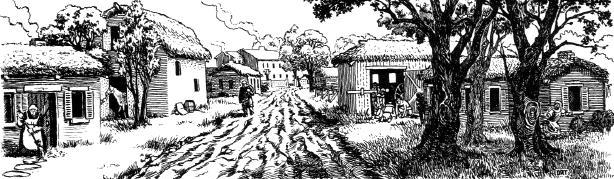
I wanted to try an extended chase skill challenge for my group. I wanted to try and mimic an extended chase scene in a city with city guards in hot pursuit of the players. It would be something based on skill checks, and avoid a protracted fight but still offer some danger. I looked over the traditional framework for skill challenges and found it lacking.

I ended up using a sort of flow chart. Each player would occupy a spot on the flow chart, with each section being set environments that required different skill checks. Each spot would offer a few choices on avenues to run to next. If they succeeded they would gain some distance from their pursuers. If they failed, they would lose ground with their attackers closing in.

Each turn if the players were a certain distance they would be attacked with either a ranged or melee strike. If hit, they would lose a healing surge. Additionally, every few turns I would require an endurance check. Again, with a failure they would lose a healing surge. When they lose all their healing surges, they were considered caught by their pursuers. If they managed to gain enough distance, they would escape.

It worked pretty well, but I had a few tweaks to make and I’ll offer some tips:

Three groups at most – Originally I had planned each party member to run off in their own direction. I soon found that 2-3 groups work best. I would have each group of players move through enough locations until they made their endurance check. Then I would move on to the other group to keep things moving. You can have each player run in their own direction, but I found things tended to drag for the other players while they waited for their turn.

Have one player make a check – If breaking the party up, have them work as a group. One player makes the check with others assisting. Failure affects them all. As potential attacks are resolved individually (I made a single attack and compared it to each of their AC defenses), they would each suffer healing surge hits separately any ways.

Keep 6 distance markers the goal – Originally 8 distance makers was my minimum, but after some play I found things going on a bit too long to get to that goal. Even with 6 distance markers, it can be a challenge. You may want to keep it closer to 5 or 6 if needed.

Keep needed DCs and skills hidden – When players move into an area, describe the location and let them offer a solution to how they’re going to navigate that section of the city. I tended to offer a few general suggestions if needed, but typically I let the players tell me what they wanted to do. If you just tell them the types of checks they need to make, it really becomes a less interactive challenge.

Be descriptive – I tried to give some different descriptions to the areas they were in and the potential routes available. I found my players came up with some interesting ideas as they made their way through the challenge. If you simply read off each area as a list of skill check options, you will get a boring challenge.

So my bustling room would be comes a dank crowded tavern, with several strong peasants taking a draught of ale after working the fields. When one of the players decided to throw a handful of silver in the air and yell out, ‘Grab some coin if you want another tankard!’, the resulting chaos made was something I’d definitely consider a diplomacy check. Without that ample description I’d likely never hear the player try something like that.

Use lots of modifiers – If players come up with some interesting ideas, offer to give them bonuses to their checks. I ended up liberally throwing around +2 to skill rolls when my players came up with interesting ideas. Don’t stick to the listed DCs either. If you describe a situation and a player comes up with something that would make it trivial, alter the DC.

Be flexible – The most important part is to keep things flexible and alter the flow if needed. Sometimes players will come up with some very good ideas. Sometimes they will fall into a pattern on the chart. So feel free to shake things up and cut off choices, or allow them to go against the chart flow and take different routes. Keep this in mind for skill checks too. If they come up with a skill use that would be more appropriate, then let them make the check with that skill.

One of my players was having difficulty continually making endurance checks. For one bustling room, I described a narrow shop filled with silks and a few noblewomen browsing the wares. A set of stairs led up to a second floor. Immediately my player thought up an idea to tell the shopkeeper and the noblewomen she was to be sent away from her family in an arranged marriage. She decided to run and her would-be husband’s men were following her. She pleaded to the shopkeeper to let her go up to the upper floor and get a moment’s rest before she fled elsewhere.

I allowed her a bluff check (with a bonus for a great idea). She was successful and I then said she could get bonus on her next endurance check, as her ruse allowed her some time to catch her breath. This was something completely off the track for an endurance check, but I liked her thinking and wanted to reward it. So keep things flexible and allow your players to be creative.

Not everyone has to make it – Actually it can end with some players getting caught and others getting away. Be prepared for this. I actually found it an opportunity to plan out a small side adventure where the escaped players would have to try and release their captured friends.

It’s also possible that captured players could get a final chance at escaping by playing out a small encounter in a narrow alleyway. If they are victorious in the combat, they make their escape (catching up to the other party members that slipped away). So don’t be afraid to let some of the players fail the challenge. It’ll lay the foundation for another exciting adventure.Trampier-Hommlet

Expeditions of Amazing Adventure: the clinging mists of Kymoria

Beyond the vast mountains to the east lie many mysterious and relatively unexplored lands. To the south east of the great continent is likely one of the most enigmatic, and tragic, of locales. Kymoria was once known for its fine horsemen and open plains. Infrequent caravans that managed to traverse the great mountains would bring forth pungent spices and fine silks as part of the exotic wares commonly found in this land.

Well over a century the dreaded necromancer, Al’Khameed, rose to power in this nation. Kymoria was always a loose confederacy of princes and Al’Khameed was rumored to have easily twisted the minds of some princes to his will. The remainder that were willing to fight him brought the country to its knees in a bloody civil war.

Tales say that it was at this time Al’Khameed had discovered a long lost ritual. A ritual of such immense power he was able to bring life back to the bodies of the dead. The ritual sapped life from the very land itself and soon he commanded a massive army of walking corpses. So great was his power, so foul were the magics he wielded, that the very ground wilted and died.

Ulaam of the One Eye saw the threat of Al’Khameed and offered his great arcane skills to the neighboring kingdoms that were threatened by the ever growing undead armies at their borders. While some sing of his praises, other more learned historians claim that Ulaam acted simply out of desire to obtain such a powerful ritual himself. Regardless of his motives, Ulaam of the One Eye accompanied a large force of horsemen to strike deep within the dead land.

None lived to tell the tale of that great battle that erupted as the two armies met. Great booming thunderclaps were heard and arcs of lightning and fire erupted from the horizon. What followed was a creeping mist that blotted out the very sun over Kymoria. A wet mist so unnatural, that to this day it still keeps the blackened land shrouded from sunlight.

Ulaam of the One Eye limped out from the damp veil of mist, claiming that Al’Khameed was defeated. Further legends speak of Al’Khameed fleeing further south to the desert wastes, his great army reduced to a meager war band. His every step was hounded by men-at-arms from wronged noblehouses, pursued like a wounded animal from kingdom to kingdom. It was only in the desert wastes he could find a final refuge, where the harsh dunes provided him respite from pursuit.

Kymoria itself withered under the relentless mists that clouded its once fair hills and rolling grass plains. Although the great armies of undead were destroyed, it is said that the land is still infused with necromatic magic. Occasionally scattered lowly undead will shamble from the edges of the mist to terrorize neighboring villages. Undead animals are also not an uncommon sight.

There are still some small fiefdoms within the mists of Kymoria. They are a shadow of their former glory as some stout-hearted folk still try and carve a life from this veiled place. Some whisper even darker tales of lords actually being vampires, as ever-clouded skies give them respite from the sun. The villagers and peasants are simply slaves to their malevolent overlords.

This does not daunt some merchants willing to travel to remote towns within the deep mists, ever trying to discover some prosperous trade route. Such caravans are always seeking men of the sword willing to guard such tenuous ventures.

There are also a wealth of ruins to pillage and explore. Some of the greater cities have been abandoned, or at best only a sliver of the former population still call these doomed places home. Many adventurers have been willing to brave these dark lands and explore the crumbling remains of towns and cities within Kymoria.

An alternate timeline for Gamma World

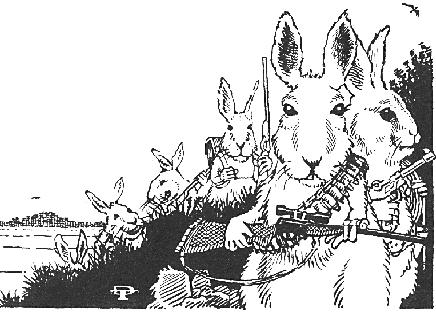
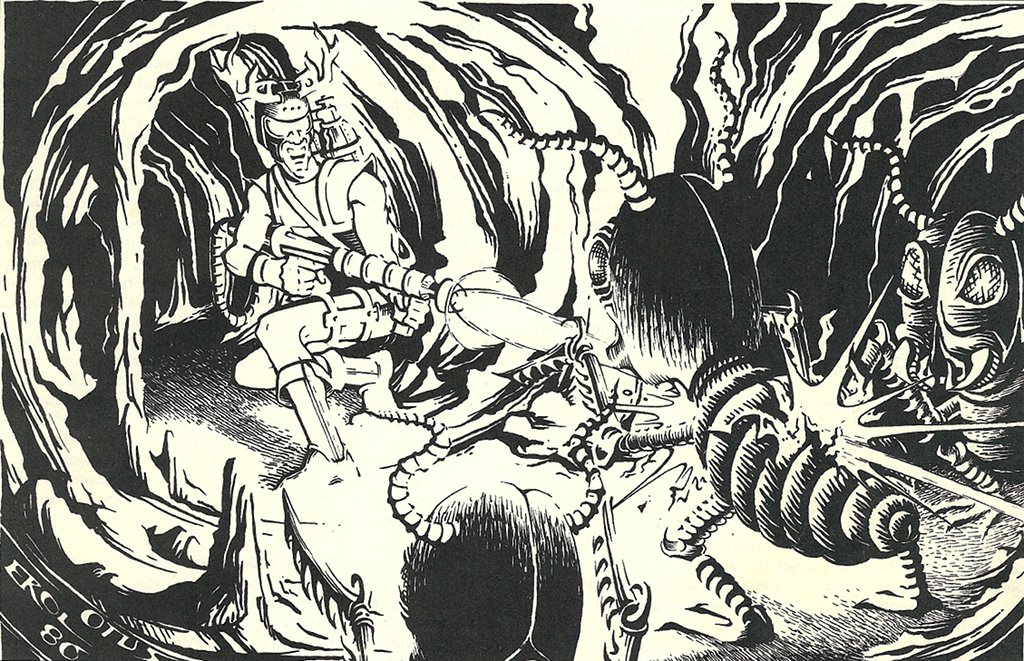
Trampier-GammaWorldRabbitsI like the new gamma world. It’s a fun game and a great way to get new players familiar with the combat mechanics for 4E. Not to mention a great game in its own right for something to run once in a while. The entire random character generation and throw caution to the wind playstyle really kept my group’s attention.

One thing I did miss though was the classic idea of people surviving some huge nuclear calamity, surrounded by technological wonders of some long lost race of ancestors. In fact D&D was a lot like the older Gamma World in that flavor of exploring old ruins, except you are running around with assault rifles and vibro swords.

So the new idea of all these alternate realities converging into one with the newest version of 4E fell a little short for me. One aspect I liked was the utter craziness you could come up with and it could fit in a sudden collapse of the world today. But I liked the idea of most societies being highly advanced, surrounded by wondrous technology, and then that world suddenly falling apart at the doom of a nuclear war.

So I worked a new timeline into my game. I wanted to move things ahead, but not so much that our entire concept of societies and communities were lost. I wanted the individual homes, high rise apartments, and a corner store still there, just surrounded in the trappings of high tech. You could still find some older technology around. Maybe things weren’t that advanced for everyone, with some countries in the third world still lagging behind a little.

Most knowledge would be lost, but you could have pockets of people that could hold onto those secrets. I also wanted the potential to throw something in from space, so you have colonies on Mars and the moon. Who knows if some of the colonists have returned and set themselves up as gods.

I wanted some kind of explanation why everyone gets a sudden mutation at the drop of the hat. So what if in the near future just about everyone incorporated some manner of genetic engineering? The systems and vectors for inserting selected genes then becomes a key target for random mutation. Be exposed to some potent chemical mutagen or a high dose of radiation and this pliable genome goes wild. It’s fantasy, but a serviceable explanation.

Lastly, I still wanted something to allow for the introduction of crazy creatures, mutated animals just wasn’t enough. I wanted something even more out there. I then remembered the short story (and horror movie too) by Steven King, The Mist. What about some great accident that opens up a hole into another dimension? And through that hole I could allow for all manner of monsters and wild beasts to pour into our own world.

It might serve as a way to explain a sudden collapse for Earth. It also might explain the use of nuclear weapons, some event so drastic it would require deploying these destructive weapons. Not to mention the possibility these dimensional holes might pop up repeatedly, allowing for another potential adventure idea. Yeah, I needed a different timeline. So below is what I use for my game.

Common History
None can remember the cause, but tales tell of two great tribes that went to war with such savagery and horrible weapons, they blotted out of the sun and scorched the earth. They had put a curse on the land and it twisted and contorted the life that sprung there for generations to come. Those that were able to survive crawled among the wreckage of great cities and slowly found their senses. The beings in this altered earth rebuilt and grew prosperous on the bones of the old world.

Some claim to know old speak, but many feel they are simply spinning tales of fancy. Others claim that some of the old race exists, hidden away in deep holes in the ground or even fallen from the sky. Again, many in the world think these legends and tall tales to pass time at the fireside. But no one can deny that a great race of man had existed. They had flourished and created a fantastic world of marvelous magical items. What happened to them, what was the cause of the Great War, no one can say. The people of the world only hope that they can avoid a similar fate…

True History
2015
The creation of a nano multi-lightwave emitter and photo detector is developed laying the foundation of organic computers. Now computer data does not have to be binary code, but can transmit different active states of information. Coupled with the ability to reliably synthesize one atom diameter gold nanowires using bacteria, computer processing power makes a quantum leap forward.

2030
Small scale cold fusion is developed. The creation of nanobots is now a distinct possibility. The advances in computer science have allowed for the sequencing of nearly every living organism on the planet. Advances are made in gene therapy. Genetic engineering of animals and plants become commonplace.

2035
Greater understanding of developmental biology has lead to the discovery of selective tissue cloning. This allows for rapid regeneration of tissues and leads the way for stunning medical advances, allowing doctors to selectively turn off (and on) genes, almost eliminating many forms of cancer.

2040
Solar powered nanobots are successfully developed to handle a multitude of tasks. Fusion power replaces the internal combustion engine (except in the most under developed countries) and advances are made to miniaturize fusion reactors.

2055
Wide scale gene manipulation becomes common for most developed countries. Nearly 1/5 of all children in the world are altered to express selected traits. AgriPepsiCo becomes the first company to successfully patent and release a genetically modified animal fit for human consumption, PigBox, a square shaped pig. Sentient AI is achieved in large super computers. Human cloning is banned worldwide, but many countries begin to develop secret military programs covertly. The first international colony on the moon is established.

2075
Fusion technology is refined to power many handheld devices. Automated robots with limited AI are commonplace. The development of cybernetic implants becomes a reality with the first quadra-transplant conducted on military volunteers. Genetically modified crops and livestock are the norm. Unique designer animal pets become the rage for many people of developed countries.

2085
Almost 1/2 the world’s population is either genetically modified or have cybernetic implants. Many genetic modifications include the incorporation of animal and/or plant genes. Mars is colonized by competing individual nations. The United States, desperate to keep up with the greater superpowers of China and the United Federation of Asia, uses genetically modified human clones extensively for this endeavor.

2090
In an attempt to develop faster-than-light travel a warp field generator is tested in Russia. This creates an rift into an unknown dimension. Hordes of creatures from this other world pour into Earth. Most of Asia falls into chaos with this rapid invasion of wild beasts.

2091
A large scale nuclear strike into Russia from the United States and Europe is done in attempt to close the interdimensional rift (some claim it was an excuse to strike at the greater neighboring superpower, China). As a response, the remaining Chinese provinces and remnants of India launch a counter strike to the US and European countries. It is unknown if the nuclear strike was successful in closing the rift. The great decline begins.

2100
Records are unclear, but some claim the worldwide nuclear winter finally lifts. Society has collapsed and the world man has known is gone.

2175?
Very little knowledge of the past is retained. Mankind is forever altered with pliable genomes susceptible to sudden mutations from intense radiation and chemical mutagens. Mutants stand side-by-side with the remaining humans in this strange new world.

I’m Back! Sort of…

Still doing some posts over at this is my game, but we’ve managed to gather 9 regular contribters so plenty of people to keep up the quality articles at that site. Since the workload there has lightened up considerably, I’ll be doing a lot more regular posts here. Be sure to stay tuned for more in the next few days.

Second Printing of 4E Core Books?

So essentials has been out for a while now. I think all the excitement of the new stuff has worn off and players are dividing into the ‘everything goes’, ‘essentials only’, and ‘no essentials’ campaigns about now. This really makes me wonder for the new player what they should pick up and what direction they should go for getting new material.

I’ve come to think that everything in 4E now is a bit of a mess. I loved the concept of the red box. Get people into D&D through baby steps, and introduce them to the other products. What has come from that though is this idea of a streamlined character build from the essentials books, verses the modular-too-many-choices build in the old PHB.

And let’s face it, the core books are out of date. The monster math is all off. The treasure parcel system has been dumped for a random system and the skill check values retooled. The stealth system was entirely reworked and put out in PHB2. There is a bit of errata out there for the classes. A new group could likely ignore the entire rule errata, but any effort to get into organized play or buying up the new material will likely make them want to run with the current updates on the rules.

So will a second printing come out for the core 4E books? Could we see an updated version of the PHB that takes up material from the PHB2? I could easily see a new Dungeon Master’s Guide that takes material from both the original book and the DMG2 also. Not to mention an expanded monster manual that has stuff not covered in the monster vault, but updates other creatures from both MM1 and MM2. Yeah, a few folks might be willing to pick up a complete new set of books that are errata free. However, the problem out there is the essentials books.

Some of that updated material is out now in the essentials line (monster vault as an example). And I think more material will be released that focuses in on the essentials type of campaign. Should development go towards new builds and entirely new power sets for the older 4E crowd? Would it be easier in development (read less time and money) to branch that out in new theme options? Dark Sun seems to have brought up character themes that is an idea the developers have clung to.

Face it, themes work wonders for essential characters. It’s just enough power flexibility to allow a player to customize their character, but at the same time not offer an entire grocery list of powers and options like the older 4E classes. Not to mention, a theme works for just about every class. No longer do you have to work up a new product that is arcane only, or martial only. Now with a themes book, you’ve got something every player will want to buy and use. Themes might just be a selling point to get a new version of a PHB out there too. The big question is will WotC take that route.

I could see a second printing on the horizon for 4E. The question is will WotC make that effort, or will they push on in the direction of supporting an essentials style of classes? There are some subtle differences in encounter powers and which classes get access to daily powers. Having a second printing for the core books might be a good way for WotC to have a ‘do over’ and just merge these different mechanics under one design. I guess it’ll depend on whether they feel it’s worth supporting those older books, or just focus in on the people running with essentials only from now on.

WTF is up with 4E Complexity?

There is a new article up on WotC’s site which has me dumbfounded at the poll they put up. I’ve heard folks bounce around opinions on blogs and tweets about 4E combat taking up a lot of time. I also understand some folks feel overwhelmed about the character generation with all the potential options out there over all the sourcebooks, PHBs, and Dragon articles. But then I see this poll trying to garner options on the complexity of past editions and I’m wondering WTF is this all about now?

A while back I pondered if essentials would end up diverging the 4E crowd. I understand the idea of offering a trimmed down character progression with limited options and making it a full blown class. That way you could get both the brand spanking new player and the person that has been playing 4E since release behind a new product. Yet I wasn’t sure how well it would gel and felt you might end up fragmenting 4E players even further into camps of ‘essentials’ and ‘no essentials’ (something I still stand behind).

What I am wondering now is how well essentials has been holding up. I’m certain a ton of folks picked up the red box like hot cakes. But several month’s after the release, I’m curious how many people have kept up with their essentials campaign. I’m certain the monster vault and rules compendium have also sold well (they are great products and a wonderful compact set of rules to DM-on-the-go). Yet I’m curious if the player books were moving as well as the other products. I get some 4E fans grumbling that essentials builds just aren’t that engaging in a fight with repetitive attacks. However I guess there are also those brand new players (or the AD&D fellows) that are simply loving it.

Which takes me back to this poll. It makes me very nervous what’s the next big jump for WotC and D&D. I’ve got my suspicions, but I do wonder if they are at a crux with what direction to take the game. On one hand I think you have a ton of folks that like the current system (I’m one of them). On the other hand, you’ve got the huge Pathfinder crowd. Maybe WotC is looking the pushing out a more streamlined, back to basics, type of game, and essentials might just be the stepping stone in that direction. Then again, maybe this is a way for WotC to show folks that despite how much they pine away at the nostalgia of older editions, it just won’t keep their big gamer brains engaged. I guess we’ll have to see once they post the results next week.

Images of Women in 4E D&D Art

So in the past few weeks a lot of the blogs and podcasts I frequent have exploded with the topic of sexism in RPG art and how they really don’t depict women in an ideal manner. I think it is an issue. I think with some entertainment industries (especially video games) folks could have a legitimate argument that they represent women in a sexist manner. However I want to take a look at D&D. In particular the art for the newest edition. More importantly I think there is a trend in the art that shows a far more empowering image of women despite the amount of clothing they are wearing.

Big disclaimer. I have not had any semblance of advance education in women’s studies, modern feminism, psychology or sociology. What you are getting here is an completely ignorant, uneducated, rambling of some random guy-on-the-street opinion. Despise what I say? Just rack it up to me being a big idiot (a more accurate descriptor would be a big fat idiot). I’m no expert. I’m not pretending to be. The following is an internet jackass opinion.

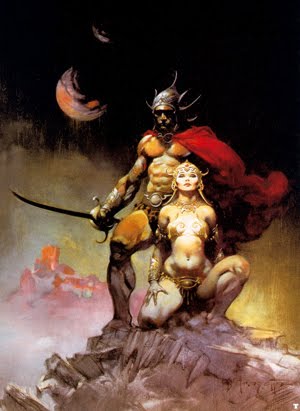
Above are some beautiful works from Frank Frazetta and Boris Vallejo. I’d say they are some classic depictions of fantasy art with women and men as both the subjects of the paintings. Now you can go back and forth about what the women are wearing, and if it would be considered sexist wearing such skimpy clothing. You might go off on how the women are curvy, maybe a few even a little top heavy. The deal is folks could go back and forth about this and I think neither side could really claim any ground.

As much as some women will say the outfits (or lack of) are a sexist depiction, I think you could say the same for the men. And then you get into the entire argument whether nudity is sexism. Still, I expect some women would find the above paintings objectionable based on the lack of attire the females are wearing, that it is demeaning and disgraceful. I’m certain there are some men that would claim the same thing and state it would be far better if they were wearing a full length burqa. I don’t think you can get a lot of mileage with some people on the lack of clothing being an indicator of sexism.

But let’s look at these images again. What does it say about men? Let’s look at the stances they depict. Powerful? Martial prowess? Fit? Strong? Protective? You could say they are fairly positive attributes. Now what does these paintings say about women?

Submissive? Incapable? Fragile? Weak? Dare we even say maybe as an object? See a lot of guys can completely wave off the lack of clothing bit. You can stand behind the opinion it is simply showing people’s bodies in their glory and natural beauty. There is nothing shameful about it. Yet, when you look harder at their stances. How the women are in relation to the men in the paintings. You really can’t say it depicts men and women equally.

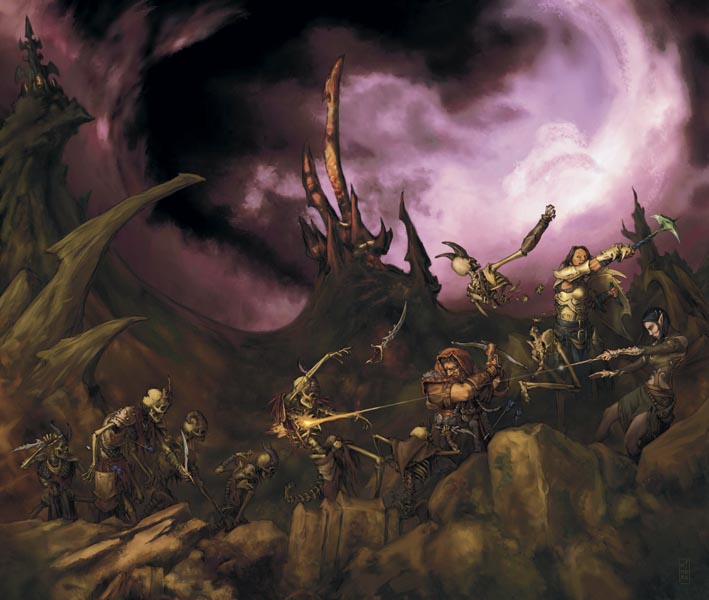
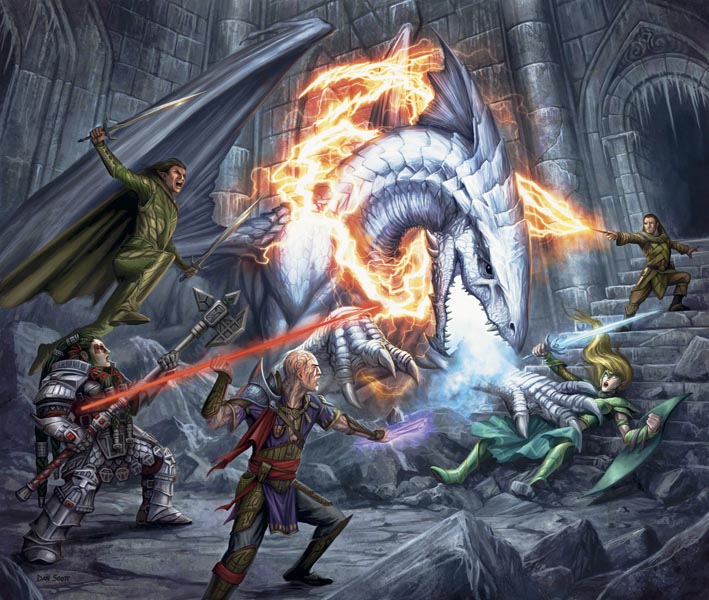
Let’s take a peek at some of the art from the 4E PHB. The first book that came out with all the 4E goodness of D&D (okay, you grognards bite your tongue on the ‘goodness’ bit and just agree this is the recent stuff from WotC).

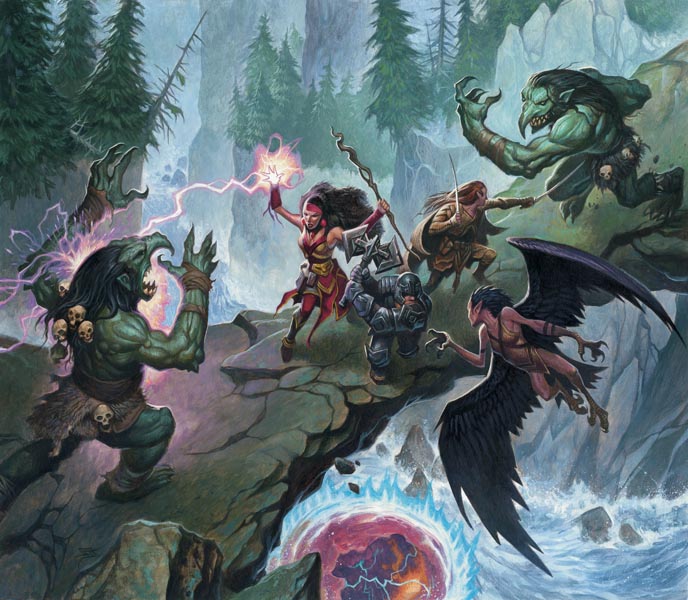
You don’t see women cowering behind men. I guess you might quibble about the eladrin getting stomped on by a white dragon (although I think you’ve got a woman warrior to the left ready to deal out some whoop ass). Still as a grab bag of dynamic action scenes, you see the women in these images engaging, competent, and on equal footing with the men.

Let’s look at some of the lone depictions of women….

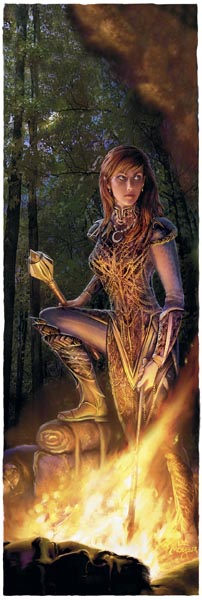
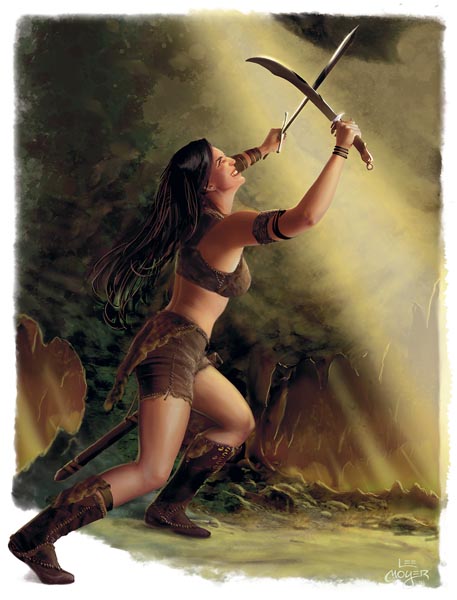
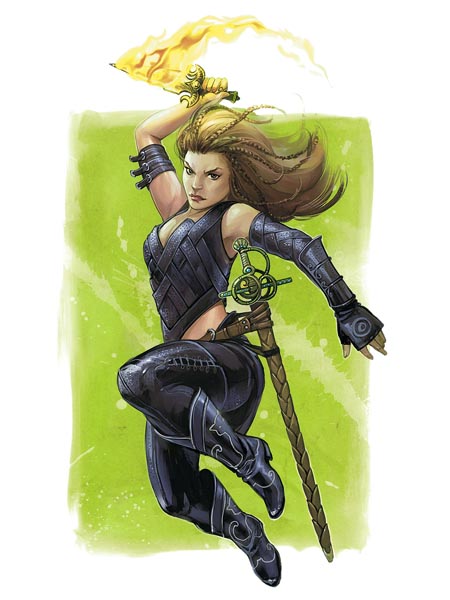
I think even the leather bikini babe is taking an engaging and proactive stance. They are not cowering in some submissive pose. They are striking, imposing figures, or having a watchful stance. They are not quivering on their knees waiting to be saved by someone. I think at least for WotC and the art now in D&D, you’ve got a lot more positive images of women.

This does get murky. Google Lara Croft or Bayonetta and I’m certain you’ll get an eyeful. While they are strong, capable women, they are still depicted in an overly sexualized way. However, I think that aspect is the most important. The characters are empowered. They are effective, strong, proactive, and most importantly aren’t crying for men to save them.

For D&D right now, I think it does a lot to push that image of women in their game art. Women are not fragile, submissive objects. They are standing right alongside the men, ready for adventure. I think that is the most important part. Something I feel is wonderful about this game and especially for little girls. You can be a hero. You can be strong, smart, and powerful. And most importantly, you can be just as good (or even better) than the boys.

(Note: I picked out some of the more objectified images of women from Frank Frazetta and Boris Vallejo’s works. Each have produced works of art with women in far more stronger stances than what I used here. I freely admit taking some of the more controversial images to make a point about classic fantasy art.)