Deck of many things for 4E

This month’s Dungeon has finally put out rules for a classic magic item, the Deck of Many Things. Overall I like it. I think it somewhat captures the spirit of the previous editions, but definitely tones it down some.

At the heart of this 22 card deck, is that it serves as an amazing Paragon tier artifact in its own right. The deck is treated like a magical tome artifact granting some neat powers forcing rerolls of opponents or allies as encounter/daily powers, with a hefty implement bonus thrown in. Concordance is gained by leveling and doing somewhat risky behavior such as having your HP dropped to zero, or slaying monsters above your level.

One big difference with the previous versions is that you may only get a single card from the deck. The more attuned you are to the artifact, the more cards you can draw being able to choose which one you will retain. In effect, making the odds better you will get something you want. But once you draw a card, poof… the deck is gone.

The card effects vary from the 22 card deck as a good mix of boons and pitfalls. Most of the boons are tangible awards like gems or magic items. Some are simple 1 shot boons such as consultation with an oracle. The more dangerous cards are pretty good but there is usually some way to rectify them. Some may be cured by a remove affliction, but others might require a major quest to undertake (which can lead to some interesting adventure possibilities).

One big plus I have with the article is that you can print out color versions of the cards to make a physical deck. Something a lot more enticing over rolling a couple of dice and checking on a table. However, since the deck is essentially a one shot deal, I wonder if it is almost too much work to go into making a physical prop you would only use once.

Still, I’m glad they got something up that was compatible with the new edition. It can lead to some pretty wild results if a character draws from it, but I have to say overall the results are a bit tame. No complaint with that however. Some might like the idea of drawing a card and having your character instantly vaporized. I like the idea that most trials that come about from using the cards can be overcome somehow (even if it is rather costly). I’d be interested in what other people think of the new version of this magic item.

New layout is a work in progress

I found my old layout to be a little clumped. I’m trying something different and hopefully a little easier to read with less blank margin space. Still doodling with the header border, but maybe I’ll just let it go (or try something different).

Feel free to post comments/critiques on the layout.

I am indeed a nerd…an online dice quiz has told me so.

This quiz at dicepool.com seems to be a bit of the rage among the RPG blogs. So here is my result:

I am a d10You are a d10: You are analytical, rational, and logical. You see the world around you as a succession of problems that can only be navigated via insightful and elegant solutions. You insist on precision are often forced to waste valuable time correcting others. Your attention to detail is extraordinary, and will sometimes focus all your attention on details that others consider unimportant. You are not so interested in doing the right thing, as you are in finding the best way to do it. In other words, you’re a complete nerd.

I’d be interested in seeing the distribution of results among the RPG bloggers. Maybe I’ll work on compiling that…

DIY 3D terrain from Worldworks Games

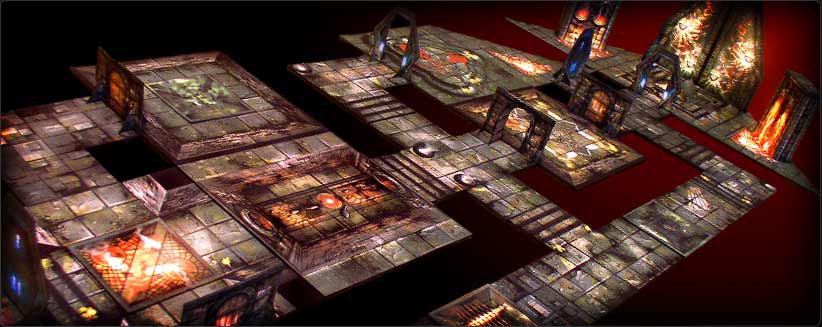
I stumbled on a link for Worldworks Games and was blown away by their products. What they offer is definitely for the do it yourself gamer and it appears that printing (or pasting to) cardstock is the way to go with their stuff. They’ve got a few tutorials up on how to work with their kits. Including a tutorial of their assembled product. It might be a little fragile, but I think on cardstock very serviceable and able to stand up to your typical tabletop RPG session.

They have a lot of different fantasy sets. Most of which have a gothic feel, but none the less they do look amazing…

It also looks like they have a lot of other themes available. I think this would be a great set for modern or post apocalypse games too. Might be a good buy if you wanted to jump into the updated Gamma World coming out at the end of this year. Drool… if I only had the time.

Homebrew classes with augmented powers

I think one of the challenges of creating new classes for 4E is the sheer number of powers and abilities someone needs to put to paper. Then balancing all these to what would be considered a decent at-will, encounter, or daily power. It’s a huge task. Some folks have taken a stab at it like at Dungeonmaster’s.com with their Necromancer class.

I think the new Player’s Handbook 3 and the introduction of augmented powers is a possible solution to this. Working with power points and augmenting a select number of powers is a little easier to work with. Bolstering a low level power with a small boost in damage, defenses, or attack for a ‘limited’ encounter power, while giving the same power a more increased effect for a major encounter power is something a little more structured.

Having augmented powers part of the psionic power source should not limit fledgling homebrew designers. Folks should freely use this to create their own variations of arcane, divine, martial, etc. classes. Using this system can make for a more manageable way to create balanced powers. I think it is also a way to stretch a few ideas a little further, rather than having to make up a slew of unique powers for a class.

I’m curious how WotC will expand this idea to other systems. Will we see this type of power usage in the new release of Gamma World? I guess time will tell. Hopefully we’ll see some interesting stuff from the community crop up in the next few months fiddling with this way of using, and creating, powers and abilities.

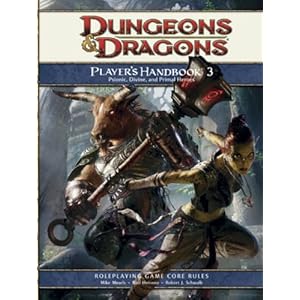
Thoughts: Player’s Handbook 3

I figure rather than waiting about four months before piping up about this book I’d go ahead and make an effort to get something out now. I actually managed to get my hands on the book in a rather timely fashion over other WotC releases. So let’s jump right into talking a bit about the new Player’s Handbook…

Races – 4 new races are listed in the PHB3. I find it interesting that they’ve really pulled the stops out and had some very unique creatures listed, including a brand new primal creation, the wilden. Some like the minotaurs and githzerai are more standard 4E races while others, like the shardmind and wilden, are really pretty far out fantasy-types. I think it’ll depend a lot on the flavor of the campaign, but most might find the incorporation of a lot of these races a bit tough.

One thing that does bug me a bit is the power creep seeping in with these races. One failing I’ll admit with 4E is the rigidity and importance of ability scores. Once you select your ability scores, it is few and far between in ways to advance them. Unlike older editions with various magic items and the rapid scaling of abilities, you are pretty locked in with your stats in 4E from the start. What else adds to this problem is how monsters scale in difficulty. If you flub an key ability score, 4E is pretty unforgiving as you level up, since much of the monsters are built around players maximizing their character abilities and feats.

The races in PBH3 get around this a bit by having a +2 bonus to stat A, and a +2 bonus to either ability stat B or C. I think it is a little bit advantageous having new races that can really bolster select abilities compared to the older races that were a little regimented. It’s a light form of power creep, and with some players I am shuddering on how these guys will munchkin campaigns.

Classes – There are two classes, the runepriest (a melee heavy leader) and seeker (a primal controller via ranged weapons) that I think could easily slip into just about any campaign. For the most part, I think the seeker is the most basic class introduced in this book. The monk, despite, being a psionic power source, could also fit into an existing campaign world fairly well, as how the use of this power source is not too far away from the flavor of primal/divine/arcane.

The last three definitely embrace the psionic power source using augmented powers. The battlemind, ardent, and psion (respectively, defender, leader, and controller) are the new entries that fit the theme fairly well. I actually think the augmented powers are a little more restrictive in practice once I got to read the rules a bit more. Players start with at will powers, with 2 extra points that can bolster the effects of these powers. There is some versatility in the use of their powers, but the choice of powers themselves is a little restrictive. It seems like a pretty interesting mechanic for 4E.

The monk and runepriest however really get a lot more out of their power use. A runepriest effectively gets a choice of adding one of two small bonuses to each of its powers. The monk gets both a move and attack ability with most of his powers, and can choose to take either one, or both, when a single power is used. As much of 4E tactics are structured around limited choices during a turn, having more choices/abilities adds a lot more tactical options. I see this as some power creep rolling into the game.

Hybrids – For the really unique multiclass characters, PHB3 also introduces rules for hybrid classes. Where the old multiclass character dipped a little into another class while firmly set in another, the hybrid continually double dips into each. They are forced to split HP and armor bonuses, only garnering a little combined advantage with defense scores and weapon proficiencies. As they level up, they have to ensure they get an even split of powers from each class (so a fighter wizard with 2 encounter powers must have one from each class). It’s interesting, and again I am wary of the power gamers out there, but it looks like a decent framework for that person that absolutely has to have an invoker bard. I think it is nice that PHB3 also provides options for swordmages and artificers from the campaign books also.

Skill Powers – Another neat idea. Essentially another pool of power option for players trained in a particular skill. Some of them are quite handy and I think are a good way for a player to pick up an ability or power without having to go the multiclass feat route. I liked the options provided and think this is something that could be added to just about any game.

Feats and Magic Items – A final wrap up of feats and magic items. Most are keyed towards the new races and classes, but there are a smattering of items and feats listed that will work with just about any character. Again, nice to have some new additions and for the most part will fit into just about any campaign (if not aligned with the new races/classes).

The Good – It’s always nice to see some additions to the game that give players some new options. I particularly like the hybrid and skill power rules. I think with these two additions, you can finally really get a character that fits just about any particular idea.

I think that the new races can also accommodate some really heavy fantasy worlds. I also like that having another power source along with a variety of class roles that use this source, as it can lay the foundation for an interesting campaign world. Having more tools and choices will help DMs in the long run, and there are plenty here to make for some fun D&D.

The Bad – Some of the stuff might not fit well within restrictive campaigns. Having a player race of living crystals or primal shifting elementals may not sit well in some worlds. The psionic power source might be a bit too far ‘out there’ also for some games. One thing I don’t quite like is the power creep. I can see players getting a lot of options with these characters that are lacking with the older edition counterparts. This might start surge of campaigns churning over so that players can get a chance to try out all the cool new stuff available. I think long established campaigns might get a little rumbling around the game table over PHB3 being introduced.

I’m also wondering if it is too much, too soon. PBH2 I consider a must buy. It really addressed having the limited races and classes in the first book. This is layering on even more, and it is less than 2 years with 4E being announced. Most of the stuff is pretty far out fantasy. Is this book really needed so soon? I can see some players feeling a little overwhelmed with choices before. PHB3 really ramps up the indecision even more. I’m just wondering are there that many groups that play so frequently, that they are completely bored with the current choices in PHB 1 and 2? I guess so, but less than 2 years into 4E with 3 books for players to roll up characters seems to be a little rapid expansion of the rules.

The Verdict – I don’t see PHB3 as a must buy. I can see many gamers easily passing on the entire book. I see everything in the book optional and none of it really necessary to have. Additionally, I think some of the races and powers might not fit too well with a standard medieval elf-dwarf-human type of campaign. Shardminds and wilden are fantasy, but they are stepping into the realm of some pretty wild stuff. It might not fit everyone’s world very neatly. Because of that I see PHB3 as a niche book for certain campaigns.

I do think you have a group of folks that have explored just about all the race and class combinations out there. They are bored with the current material and are looking for something different. In that light I think PHB3 delivers. So if you are wanting a different character, or getting a more unique flavor in your campaign world, the new player’s handbook is a good fit.

Minion tactics and tips

When I was first reading through the 4E monster manual I had to do a double take at the minion entries. What the heck was a 1 HP monster? It took me a while to wrap my AD&D mind around having low HP monsters that were literally fodder. Slowly I began to get an understanding the role of minions. It wasn’t necessarily a new idea. I particularly always thought Mutants and Masterminds had a clever idea using mooks (basically one shot minions) for their superhero D20 game.

For a while though, I struggled to use them. They were very squishy and seemed to drop too fast. I had some difficulty using them as an effective screen for other important creature types in fights. I could never get any reasonable positioning with them around the PCs. In short, I never felt my group had a challenge when I used a fair amount of minions so I started to shy away from commonly using them in encounters (just a filler of 2-3 to round out the XP budget). After a while though, my perspective changed.

I use minions quite frequently now. They are a perfect way to add a lot of bodies in a room, and not completely overwhelm the characters. Yes, they do drop like flies. However, that does  go well with my group. I think the players enjoy getting to feel powerful hacking through 4 to 8 guys before getting that evil wizard. Minions do work, but I found I needed to rethink how I used them.

Use their role – Check the DMG (pg. 54-55) and read up on monster roles. Starting with MM2, WotC has now started including this information in their monster stats. When you are thinking about setting up and running encounters, take this information into consideration. Most minions fall within the skirmisher role followed by brutes, but a few fall into other roles. This does have a small impact on how you run them, so keep it in mind. Also be sure to use your minions to support the other monster types in a fight. Positioning is important not to mention the following point…

Use Aid Another and Combat Advantage – Most PCs forget about aid another (PHB pg. 287), a DM shouldn’t. Get 3 minions adjacent to a player. Have 2 make a melee basic attack at AC 10. Odds are with combat advantage that 3rd minion that can now add a whopping +6 to his attack roll. Aid another is a great way to add some teeth to a minion’s bite. And if you’ve got your minions supporting a brute in combat, watch out. With aid another that brute will likely get a big bonus to his heavy-hitting attacks.

Use a lot of them – The 4 minions per standard creature in the heroic tier is a great yardstick, but I don’t consider it a hard rule. I usually will add another 1-2 to the entire encounter if I’m using minions. The group will make short work of them (and they should!) but you can hamper the group’s movement with a threat of attacks of opportunity, and generally providing a shield of bodies to the more important monster types. When using minions, be sure to not quibble with their numbers.

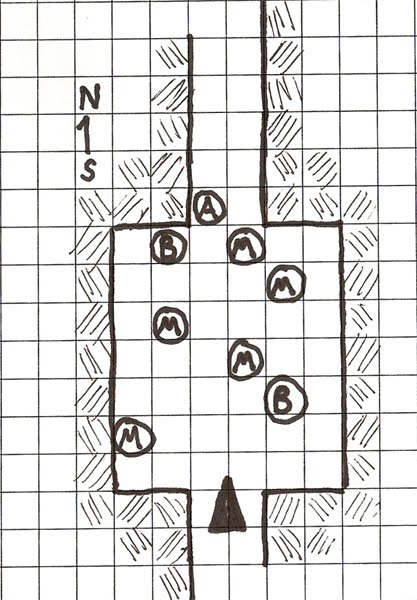
Throw waves of minions at the players – I used to have just about all my monsters out on the map the start of a fight. Sure I would have terrain and cover strewn about, but the players ended up having a good grasp of the battlefield right at the start. A simplistic view could be seen right depicting a smaller room. The group enters the south part of the room with a mix of monsters like artillery, brutes, and minions (M) ready to face off against them. In this situation, the players see all the opposition and can quickly plan out maneuvers and coordinated attacks. A worse case scenario, the group’s controller aces a initiative roll and splatters most the minions in one shot (note the room is a bit smaller than what I would use for a standard 5 player group).

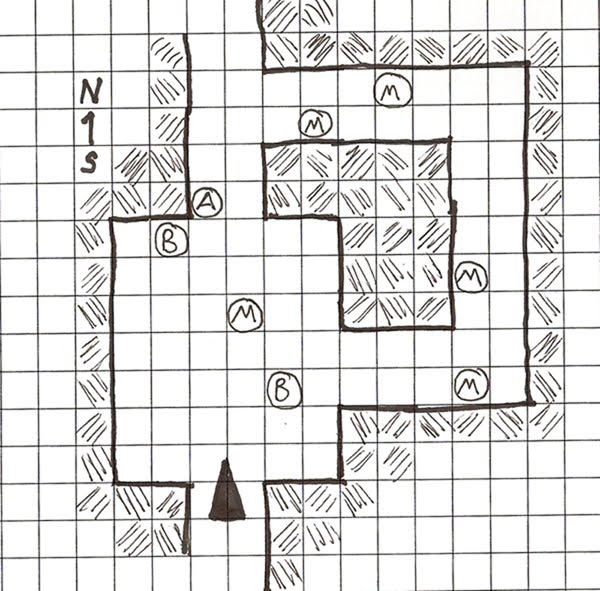
I stopped doing this when I have a fair amount of minions in the mix. I now usually keep a least half in reserve for the first turn. I get the players out into the room and see the general position of everyone, then I commit the rest of the baddies. One thing I have really strived for now however is to have multiple pathways to the same room (illustrated below). Here the player’s have to worry about additional creatures coming in from different directions. I can push the minions to pile through one entrance, or spill into the room from 2 directions. Even if the players turtle up down in the south west corner (in the below example), they are cluttered together for effective blasting by the artillery/controller types.

This really keeps my group on thinking on their feet. Definitely start to consider using your minions in waves. Avoid committing everything at the first initiative roll (lurkers work well keeping them back also). I also heartily suggest creating encounters where the players have to worry about multiple routes of attack. If the players have to face off to other directions, it ramps up the excitement and makes the combat more dynamic.

These are a few tips I have for using minions. I’d love to hear other tricks on how DMs have been using them.

Halting a campaign with a ‘Meanwhile…’

Over the past few months I’ve had some attrition with my players due to people moving on. It’s common here as most people I meet that play D&D are on temporary work contracts. So my group number has trimmed down some.

My first campaign had a pretty grand story arc. I could’ve easily seen it going up to the paragon tier. But as the group diminished, I felt I was losing a lot of the personal stake in the campaign. I wanted to run something tighter and smaller in scale, allowing a definitive end in a few months.

My kicker was that folks were enjoying the original campaign. Yet with a smaller group size (3), I just didn’t think I could have kept the scale as grand as I wanted. Not to mention, I had milestones planned out but was getting a little burned out with the current arc. I needed a break.

I wanted something smaller in scale and could wrap up in a few months. So my players were willing to jump into a new campaign. However, I was in the pickle of trying to figure out a good way to wrap up the current one. I thought if we tried to play some of it out, it would still take several sessions to tidy up all those loose plot ends. So I took a staple from comics and pulled a “Meanwhile…”

Basically the original group is still together, heading back to a city after exploring an Eladrin tomb. On the other side of the world, another adventure is unfolding with an entirely new group. Two completely different groups running two different campaigns in the same world.

At some point I may get the group to decide to pick up the original storyline, or keep rolling with the new party. As another possibility, I can have some characters fold into the ‘old’ group and jump back into the old quest arc.

This current campaign should end at a fair point and then we could jump right back into the old group. If possible, I might even keep things dispersed and separate. So if the group feels an itch to pick up the other characters, I could just run a few sessions with the alternate party.

I think this is a pretty good compromise. It allows for everyone to hold onto their old characters and still try something new. I think for this to work however, you need a lot of good notes and possibly a decent adventure log. Fortunately I’ve been keeping things up through Obsidian portal. We’ll see how things work out, but I’m excited.c6092-willinghamslavers

Out for a bit.

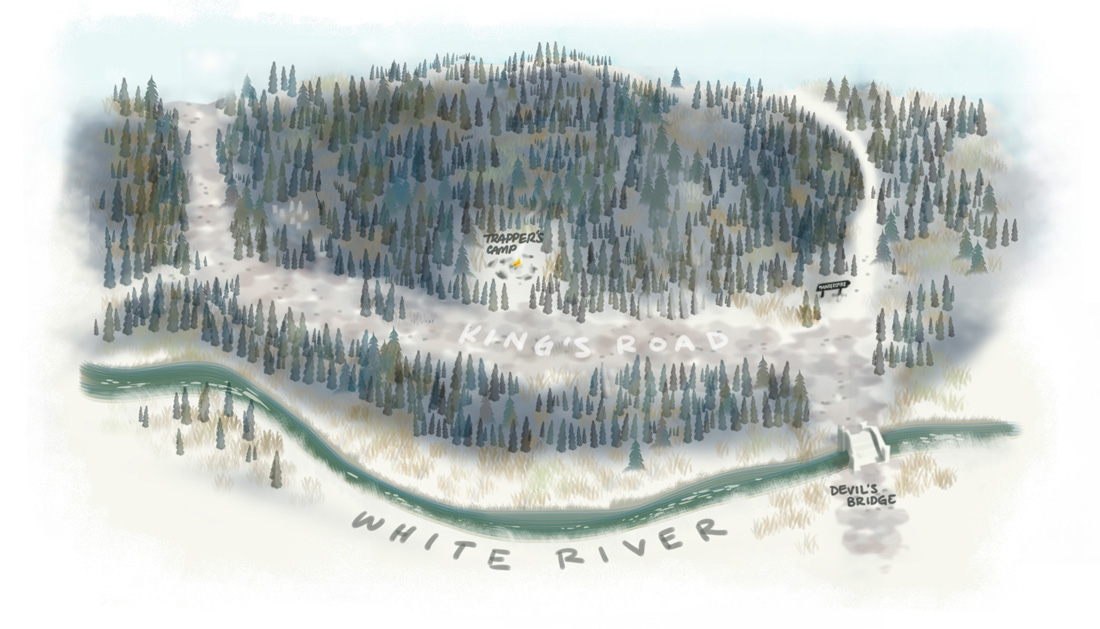
Travelling again, so I’ll be away and have spotty internet for a week or so. Till then I think you all should take a gander at D&D Doodle as he has started to put up a few wilderness maps of his campaign. They are some pretty inspiring maps and images. SPOILER ALERT: If you are a player, expect some peeks at secret stuff for maps like below. If you are a DM, you not only get a player version but also a DM version with a few key locations. Yes, Brandon Kruse is that awesome. Check it out!

Toodles for now.

Expeditions of Amazing Adventure: The shifting pillars of Porphimia

The remnants of these pillars still stand tall after 175 years. Their width nearly three men across, these heavy pillars manage to shift by some unknown force. At seemly random days, when the sun is at its highest, some (or all) of the pillars slowly inch to other positions. Within a day the immense columns have aligned themselves in another location, but each pillar will move at the most just ten feet. They serve as a fantastic demonstration of the immense power wielded by the great wizards, Ulaam of the one eye, Hisham the heretic, and Digby, as legends say the three put aside their differences to construct the pillars.

For over a century great wizards of the western empire have made attempts to discern a pattern in the pillar movement. Some have postulated that the pillars mark themselves by measuring changing constellations in the night sky. Others have theories that the stone columns act as an elaborate clock marking the passing seasons. A minority will stand by the whimsical nature of Digby, that the pillars were some manner of a wizard’s game, or even a monumental joke.

However devout followers of Ioun are convinced the pillars hold some religious significance. Pilgrimages to the remote site are frequently made by more pious members of the order. Some are willing to stand guard over the pillars, ensuring the faithful are party to any studies involving the strange arcane monument.

Expeditions to the pillars are frequent. Despite being studied for years, many companies of spellcasters seek to decipher the hidden meaning of the shifting columns. A few are convinced a secret trove of riches lie deep under the foundation. It is a matter of understanding the elaborate key of the pillar’s themselves. Such thoughts have inspired many nobles and adventurers to join company with other arcane academics, offering their swords and great wealth to help in fending off hazards that surround the remote location.