Card Protectors for Power Card Types

I love using power cards. I’ve found that with my group, especially new players, it’s so much easier to use rather than flipping through their character sheet.

In the past I made up cards at Dragon’s Lair using their power card creator. I liked it as I could save the cards as a PDF. Just about all the field information on the cards had drop down menus. If needed I could also reload the page and still have all the card information. They had a lot of white space on the cards so it wouldn’t completely drain the printer ink cartridge. I just print them out and sandwich them between self laminating sheets. Bam! You’ve got a set of cards that can take a little abuse and are functional at the table.

However, I kept a lot of the information on the cards pretty general. One thing I wanted to avoid was having the cards too tailored to each player, as that would mean I had to reprint them out when they leveled up and got additional feats and ability bumps. WotC character creator is a great tool, and I also like that cards are provided. But this also gets to be a pain as I need to print out a new character sheet each time they level up.

Hunting around I had stumbled on some nice power and item cards by JFJohnny5 at Dragon Avenue. They were in PDF format that could have text entered in the fields. They had a variety of layouts from a playing card to an index card. It was a bit of a chore filling in the information. Yet I could also leave some fields blank for my players to fill in with character specific info (if needed).

Having just slips of paper at the table were a little flimsy though. I also wanted to have some type of color coding besides using a color printer. Self laminating sheets were okay, but it was sort of a pain to make 1 or 2 additional cards (just easier slapping a standard full sheet on an entire printed page). So I was in a bit of a pickle.

I ended up getting a few packs of card protectors. Out of the variety of colors available, I settled on green, red, and black (for at will, encounter, and dailies) and picked up a yellow set for magic items. The cards I printed were just small enough to have the color backing of the card protectors poke through the transparent face. It’s not a big chore to print up a new card (plus I can just print them out in black and white), as I can write/type in the info and just slap them into a new card protector.

So far my group has been loving these. As your typical pack is about 50 protectors each, one set of each color type should be enough for just about any group. Pretty handy means to quickly differentiate between power types and still have a variety of power cards at the table for your group to throw around.

The D&D Action Pyramid

So when I jumped into 4E, all my players were new to the game. One had dabbled a bit in a 3.5 game but his experience with D&D was limited. I will be the first to admit that 4E combats can get a little overwhelming. The game takes a very tactical turn with structured melees. My group loves it. It has a lot of interesting decisions and maneuvering. We all have tons of fun.

But there is a bit to keep track of. There’s a lot of little bonuses and effects for marking, combat advantage, etc. When I was teaching the ins and out of combat, sometimes my players would get a little muddled on the number and type of actions they could take during their turn. Especially as you could switch out actions for other types, but only ones of a certain type.

So I began to explain player actions by describing an inverted pyramid. Players had 3 actions a turn. At the top of the pyramid is the standard action, underneath it is the move action, and at the bottom is the minor action. You can opt to switch out one action step for other actions below it.
It’s a pretty easy way to visualize actions a player can take during their turn. And I think the simple visualization helped tons. Now that the PHB 3 is out, and I think the WotC D&D Encounter events will be going into full swing, having some tools to help explain the game to new players would be helpful. So what other little tricks have folks used to help explain D&D to new players?

How to be a better GM.

To jump on the bandwagon from a Questing GM, he is graciously hosting this month’s RPG Blog Carnival Question, ‘How to be a better GM.’ There is a lot of thoughts I could add to this. I’ll bring up 2 things I think are the key though.

Communicate and listen – At the end of each session I say, ‘So what do you all think? Are you having fun?’ So many folks will point out that reading your players, knowing your group, understanding what your players want, all are important for being a good DM. Maybe you are a master at poker and can read your group’s enthusiasm well. Do yourself a favor and make sure your impressions are right. Give them all an opportunity to talk about the game with you, and do it frequently. Most importantly, be sure to listen to them.

Guess what? You are going to make bad calls. You are going to find some players bring interesting characters, while others are sort of dull, and this might make yourself slip towards favoring one player over another. You are going to make both game and personal mistakes. Give your players a chance to tell you about it.

Don’t let a player sit and stew about it for weeks on end. Eventually bad things are going to come to a head and things will blow up. Get people comfortable talking about the game. Don’t get defensive. Don’t get upset. Find out how they feel. Did I mention you should listen to the group?

If you are doing a good job, your players will realize that yes, you made a bad call. You flubbed understanding a power or whatever, but you are all there to have fun. It’s a game. The DM is not out to torture or punish anyone, just trying to make things challenging. Sometimes it works, sometimes not. But reinforcing the idea that everyone should be having fun, and more importantly, communicating that idea to the group helps smooth things out immensely.

You will learn things. Maybe they absolutely loved that stupid NPC you quickly made up. Maybe they felt the combat wading through lava was too tough and simply frustrating. The combat on an airship was cool. The fight on the ice sheet against trolls was tough, but they enjoyed the challenge. You will learn the things your players like and dislike, all giving you ideas to make future sessions better. Again, make sure you listen to your group.

Play games – First off, you should spend a little time in the player’s seat. You should get a chance to see how other people DM. You should find out new tips and tricks. You should experience someone making things engaging and exciting. Or experience a heavy handed jerk, making your group suffer (and learn it is not fun). You will get better ideas how, or how not, to run a game. I cringe when I hear some guy cackle that he has never played D&D as a character, has always been the DM, and has absolutely no interest in ever being a player. That guy is missing a big part of understanding D&D.

Play different games. – Lots of them. You will learn by exposing yourself to different game designs how they work. What things are engaging and fun. What things are tedious and boring. You can port these aspects to your game, and doing so you’ll learn how to be a better DM.

Maybe you’ll find that intricate paperwork keeping track of game effects is serviceable, but having simple tokens makes book keeping interesting. Maybe you’ll realize that having events every other turn is predictable and boring, while making it somewhat random is more interesting. Maybe you realize penalties that make you sit out the game for several turns is frustrating, and that having some other mechanism to keep the player engaged is more rewarding.

Play lots of different games. Communicate and listen to your players frequently. These are two things (in my simple mind) that will make you a better GM.SutherlandBattle

DM Tip: Insight is not a lie detector.

Sometimes you might have this happen. Some NPC spills his guts dropping off some key information to the party. You get one guy that grabs a D20 and says, ‘I’m gonna see if he’s lying with Insight.’ Nope. Hold on. Back up there, buddy.

See I don’t buy insight acting like a default lie detector, where players wave their hand an automatically read untruthful thoughts. Insight is also about reading social situations. Great insight allows a person to recognize the two people chatting civilly over in the corner really cannot stand each other. Insight allows a player to hear the slight strain in an NPC’s voice saying things are fine, and recognize that subtle shift of their eyes to some burly thugs nearby.

Want to go all out with insight being a BS detector like Christopher Walken in True Romance? I’ll be rolling a bluff check against it. As a DM you should always be rolling bluff checks to counter the ‘insight = truth meter’ that players pull out. If they blow it, I say they believe them. If they beat out the bluff check, I rarely say, ‘You think he is telling the truth.’ I always try to obfuscate the result with, ‘You think he’s holding something back’, or ‘You see him lick his lips and give a smirk.’ I rarely ever give a black and white answer to passed insight checks if they are just seeking a truthful answer.

To me, insight is more about reading the subtle body language of people. I like to frequently give clues to the NPC’s mindset more than if they are simply telling the truth. Does the person have a pleading look in their eye when they beg the group for help? Do the player’s see the Duke slightly roll his eyes when he thanks them for dispatching the orc marauders? Does the group see the inn keeper tense up when they approach?

I use passive insight checks a lot to allow a group to read an NPC’s motivation. Sometimes it is a much more effective hook having a NPC say one thing, but his body posture or mannerisms give a completely different impression. I find it frequently sparks that investigative process where the players slowly poke around an NPC through dialog. It is much more interactive than just having a PC roll a D20 and see if the NPC is BSing.

I also allow insight to get clues on other skill checks. Sure some PC might ace the diplomacy check, but he just successfully made the flunky patrol guard allow them to pass. It’s the seasoned sergeant of the guard that really decides who gets into the king’s court. Insight is the key skill to walk into the room and assess who are the likely people with some authority, seem knowledgeable, or are well respected by others.

When do I have PCs use insight for a yes/no answer? Illusions. Yup, most folks forget insight is the key skill in disbelieving illusions. Since the players have a tool at their disposal to counter illusions, don’t be afraid to pull them out. In a magical fantasy setting, there should be plenty of opportunities to pull out the illusion card. It doesn’t necessarily have to be diabolical either. Maybe a merchant uses a simple illusion to make his wares look plentiful. How about an enchantment to give an elder noblewoman a slightly youthful appearance (think of it as gnome magic botox)?

So the next time a player quickly rolls a D20 for an insight check, don’t just respond with a yes/no to queries for the truth. Tell the player he thinks an NPC is holding something back. State the NPC appears to be sweating profusely as he stumbles over his words. Get away from treating insight as just a lie detector.acb31-elmoretavern

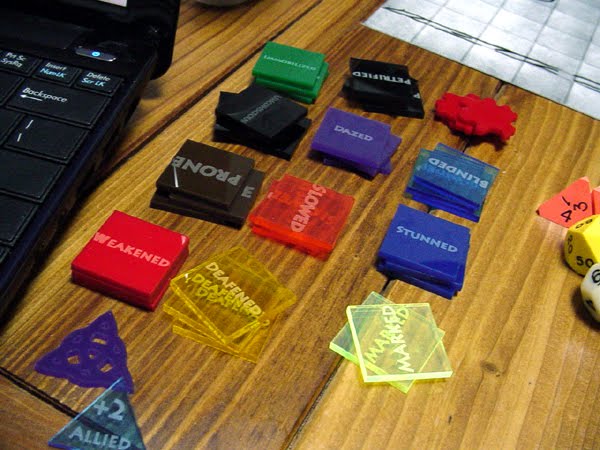
Litko 4E Condition Counters

A few weeks ago I posted a bit on using some conditional counters of my own making. I liked getting away from just a color coded method of using markers and use something that also had writing on them. The ones I made were functional, but I really wanted something a bit sturdier.

I decided to go ahead and invest in conditional counters from Litko. They have a pretty good set for marking most basic conditions. With that I picked up a player set to indicate marked, curses, and other bonuses. I went a bit further and also picked up a blast and plasma set to indicate other zone effect powers.

They are sturdy plastic about 3 mm thick, with text etched into the surface. The 4E condition markers are a double sided set. I like the beefy colored plastic and can throw them around without worrying about the tokens getting bent out of shape. The wording is clearly marked and I like the color scheme. The markers look like they would stack well under an official WotC mini.

I really like this product. With normal wear and tear I think they would last for years. They have a good selection in their sets. All of which I think are reasonably priced for their value. I also think it would be a great gift for the D&D guy that has just about everything. Be sure to check em out.

(Personal Note: Ordering things through international mail can always be tricky. Sure enough my first attempt at getting some markers resulted in being lost in the mail. After contacting Litko by email explaining my situation, they turned around and send out a replacement order at no charge. Great service, from a great company.)

Skill challenge scenarios: Poisoned! (part two)

In the last post I described a skill challenge where the group was poisoned in an inn. They had to work quickly to find an antidote not only for themselves, but also for the other patrons.

Round 1: The paladin thought it best to use his skills in healing to try and determine what type of poison would have this effect. As he helped the sick patrons, he also carefully tried to evaluate each person and find the likely toxin. The rogue in the group tried to determine if she could find any trace of the poison near the barrel using perception. The cleric in the group also decided to help the sick utilizing his healing skill. Everyone rolled and all earned successes. Both the cleric and paladin had managed to deduce a common group of poisons that would inflict these symptoms. The rogue managed to spot a few small dark smears on the barrel’s side. Carefully, she gathered up a sample of the thick viscous resin.

Tally after round 1: 3 successes, 0 failures

Round 2: Armed with the knowledge of the type of poison (and a sample), they sought off to try and find an antidote. The rogue quickly set about asking key people she felt would know one trained in the apothecary arts. Earlier in the day, she had heard some commoners speaking of the skills of one particular apothecary, with talents exceeding even the priests at the local temple (successful roll). Several minutes later, with a few quick turns through the alleys and some banging on doors, they managed to get to the right location. Both the paladin and cleric had offered their skills in healing to aid the elderly apothecary, make easier having a sample of the dreadful toxin (one skill check made at a +2). With their deft hands and combined abilities, by daylight they were able to concoct enough antidote to help all that were afflicted by the poison (both had successful rolls).

Tally after round 2: 6 successes, 0 failures. Skill challenge successful for a complete victory.

I liked the quick thinking of the party’s rogue in trying to get a sample of the poison. I decided there to allow a bonus to a future healing check made by the others, just as if she had sucessfuly aided another. I also held my breath a bit in the second round. If one player had decided to simply aid in a healing check, the group would have secured a partial victory (and a potential hollow one at that). Fortunately, they decided to press through and each make a check.

Skill challenge scenarios: Poisoned! (part one)

The group has earned the ire of a local underworld boss. Not one to be sparse with cruelty, he’s decided not only to take care of the adventurers but also send a clear message to any merchants and commoners in the town. If you support these type of heroes, you’ll be punished. He has arranged one of his stealthy assassins to slip into the inn where the players are resting and poison a keg of popular ale.

Skill challenge goal: Find a cure for the poison.

The Setup: The group of players are resting comfortably for the night at an inn, famed for its amber brown ale. The quiet evening is shattered as a serving maiden steps into the kitchen and screams. The players jump into action to see the cook unconscious in the floor and a window ajar. Rousing the cook, he will claim someone crept into the kitchen and sapped him. 

Why would someone do such a thing? The answer comes as the adventurers and patrons are suddenly wracked with pain (losing a healing surge). A large barrel of ale appears to have had the lid pried open, its tap protrudes on the other side of the wall into the adjoining room. Clearly someone has put something into the ale that everyone drank. If it is poison, can there be an antidote?

Skill Challenge Rating: 2, moderate DC.
  • Complete Success (6 successes) – The players manage to find an antidote for the poison. They are able to revive the patrons that were also injured. As a plot point, they also discover that the poison was very unique, concocted from a root extract not found in this region. 
  • Partial Success (4-5 successes) – The players manage to find an antidote for the poison. Yet, the process is slow and tedious. Several patrons have succumbed to the poison and died. This brings some negative light to the adventurers presence in town.
  • Failure (3 failures before either success condition is reached) – Each player is inflicted with the filth fever disease (MM pg 180). Many of the patrons have died. The inn has lost popularity, and the inn keeper will likely have to close down. Most of the people in town will react very coldly to the group, seeing them as the cause to much of the ordeal. The local noble might even pressure city guards to ‘assist’ the characters in moving on to the next village.

Primary skills: Healing (+1 to rolls) as the players will likely be able to recognize the symptoms and find a way to circumvent the effects of the toxins, possibly even create an antidote.

Secondary skills: Nature (+1 to rolls, cannot be assisted), granting players the ability to deduce what type of root or plant would cause such a thing. Knowing the toxin source would help immensely in rapidly finding an antidote.

In the next post, we’ll see how this played out (DUN DUN DUN….)

Combat manager sheet

So on the D&D boards, some people have been asking for low tech solutions to running their game. In particular one guy was adamant about not having a laptop at the table. I can totally understand. Sometimes I find having a laptop a little distracting, and being a frequent recipient of Murphy’s Law, I’m always worried about some last minute technical glitch that will hinder my game.

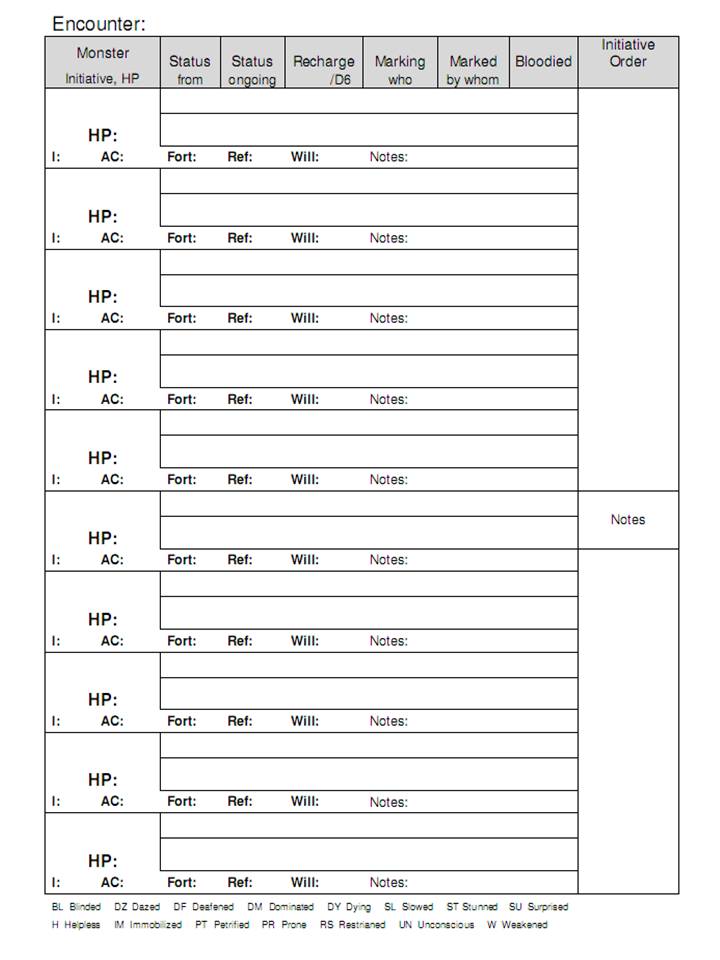
A while back I found a pretty good one page initiative tracker sheet (for the life of my I can’t find the link, so if someone can track it down gimme a shout out and I’ll link to this post). I liked it had all the pertinent defenses. It also had several spaces for recharging powers, if the target was marked, and a way to keep track of different combat conditions.

However, some things I didn’t like. I wanted a full box space to keep track of a creatures HP. I also wanted sufficient space to write in a monster/character name. So I modified mine a bit. I also kept an additional field to keep all the marked and combat conditions separate. So I whipped up my own version for keeping track of stuff.

So far it’s worked pretty well for me. I enter party information in the first few lines and then photocopy them. I then would have a few encounters prepped by adding monster on the other lines. Sometimes I’d squeeze a few encounters worth if I could, but usually had a separate sheet for each fight.

I’ve sort of moved to using applications for my 4E fights. I still keep a few sheets handy in case my computer suddenly gets fried. I think this is a definite must have if I also travel to a friend’s place to run a game sans laptop. For running a game with strictly stuff from my backpack, I like using this sheet a lot.

[Edit: Thankfully someone was able to find a link to the PDF I was looking for. Thanks!}

Expeditions of Amazing Adventure: The Cabalistic Clay of Domneran Canyon

To the south a thin section of land serves as an oasis to the harsh desert regions that surround it. A small range of mountains hold the Domneran river that winds its way down towards the flat plains. This river feeds a narrow stretch of land able to serve as an agricultural base. Enough so that a few cities have been able to establish themselves, feeding their people with simple crops and diligent fishermen that trawl the river for fish and soft shell crustaceans. Many of these cities have also been able to serve as a central trade stop between far empires and kingdoms separated by the great dessert, further bolstering these simple economies.

Far up to the river source, deep within the mountains, lies a narrow canyon which the Domneran river springs forth. The canyon (which is known for the river it contains) holds high cliffs etched through deep stone of the surrounding mountains. Legends tell that the mountains were formed when colossal giants fell in a great battle against the gods. Their flesh seeped into the ground, and their bones served as scaffolding for the mountains that arose.

These giant corpses imparted magic buried within the very core of the mountains. It is only over centuries as a river cut deep into the mountains, forming the Domneran canyon, has this magic been able to seep out of the stone. Far within the coiling canyon are pools of water, bubbling with mystical energy. The clay taken from these pools are rumored to be infused with arcane power. Some claim such power has medicinal properties, while others state the clay holds chaotic magical forces so potent they can bend iron.

It is a treacherous journey to the Domneran canyon. The climb is through perilous rock and savage creatures haunt the mountain range. This has kept many from traveling to the canyon, but high demand for the clay that lies on the silty bottom finds a few willing to try.

Some temples are willing to lead pilgrimages to the pools that lie along the canyon path. Such waters are claimed to have restorative powers, but these journeys are hazardous. Especially as gnoll tribes hold claim to much of the canyon for their own foul rituals. A wealthy noble, desperate to find a cure to an aliment might likely secure not only a temple guide, but also an armed group of adventurers, if they were so inclined.

Many wizards are willing to part with gold to obtain a pouch of the magical clay. If a group were willing to take the risk to reach the Domneran canyon, they likely could easily find a buyer for any clay they managed to gather.

Happy New Year!

One advantage being situated in Asia is celebrating New Year’s twice. I’m currently enjoying a few days off stuffing myself silly (and currently nursing a soju fueled hangover). Hope everyone this side of the hemisphere has a pleasant holiday and a prosperous year of the tiger. As for everyone on the other side of planet, hope you folks are having a pleasant weekend enjoying the Olympics. Toodles for now!