Skill challenge scenarios: Find the wizard, Nightshade (part 1)

A few comments from my last post on skill challenges got me agreeing that more examples for challenges are helpful. And more importantly, actual examples of resolving them would really capture how skill challenges can work. So on that theme, I thought I’d post a few examples of skill challenges that I run in my games.

First off, I have my own house rules for skill challenges. The big change is introducing a partial success. this is a step below the number of rolls needed for a complete success, and usually mean the players just barely complete the challenge. I also have a few tweaks on assisting others, critical successes and failures, but for the most part I run them pretty close to what is in the DMG. So, onto the challenge.

Skill challenge goal: Find the wizard, Nightshade

The Setup – The group are new arrivals to a city and are approached by a merchant. He requests they make an errand for him. Time is of the essence and being well recognized, he fears being seen entering the residence of Nightshade might lower public opinion of him. A ragtag group of adventurers that just arrived to the city however, would likely not draw too much attention.

Nightshade has concocted a potion for him, and is expecting someone to arrive today to pick it up. However, Nightshade is not very popular with the commoners. They all fear him and think he is mad. Being a recluse within the city doesn’t help Nightshade’s reputation either.

The merchant states Nightshade’s residence overlooks the Fallon Square market on the other side of the city. They should meet him later in the early evening at a local tavern. Half a payment to secure their services for the errand now, and the remaining once they return with the potion. They pay itself is rather good, especially for such a quick task. But they should remember time is of the essence and he needs the potion by nightfall. Before the characters can ask any more questions, the merchant waves them off and heads elsewhere for other business.

Nightshade is indeed waiting for them and has the potion as the merchant said. What is unknown to the players is that a rival merchant does not want this transaction to occur. He has employed thugs to intercept the players once they leave the wizard’s residence. The thieves themselves have had one of their gang assigned to tail the players and determine if they were successful in obtaining the package.

Skill challenge rating: 2, moderate DC (encounter worth 2 monsters of equivalent level)

  • Complete Success (6 successes) – Players find the residence after an hour. On a passive perception check (DC 15) they notice being tailed by a thug. If they intercept the thug, they will learn of the planned ambush after retrieving the potion. Also they will have plenty of time to explore the residence of Nightshade (a mini-dungeon in itself).
  • Partial Success (4-5 successes) – The players get turned around a bit, and harried with poor reception of many commoners when asked about Nightshade. The trek takes a bit longer than expected. Have the player with the highest skill make an active perception check (DC 25). If they succeed they notice the tail as above. Also due to the time, likely the players will not have much time to explore Nightshade’s residence (and the DM should continually remind the players about the limited time while inside).
  • Failure (4 failures before either condition above is reached) – Players find the residence much later than anticipated. They will likely have no time to explore Nightshade’s residence. They will also fail to notice being tailed by the thugs and not anticipate the resulting ambush once they leave.

Primary Skills: Streetwise, Diplomacy (Nightshade is not well liked and players will likely need a soft hand in getting directions from people) Secondary Skills: History (The layout of the city may be similar to others in the region, and Fallon Square is known as a popular marketplace)

That is the setup. Next post will be how it ran with my group.
Get out and game.

Newbie DM posted a small plea for the industry a while ago and made some good points. I agree that companies really need to push out material, or support 3rd party efforts, to make running games easier.

Personally, I think interactive face-to-face gaming is slowly being eroded. It seems the younger generation’s primary experience with games is through computers and video games. We are becoming more interconnected every day, but that connection is through proxies. I feel direct social interaction with people is slowly being lost, as tabletop or RPGs are becoming archaic forms of entertainment. So I implore people, start playing games in public.

Take time out to hit the local game store. Take some time to meet other people that game. Once in a while break off from your regular gaming crowd and play with some complete strangers at a shop. And more importantly, give that store some business.

Sadly I think online shopping is killing the neighborhood game store. You don’t necessarily have to make a store your exclusive source of games, but make sure to throw a little money their way when you can. Game stores are more than a business that sells goods, they also act as social hubs to meet new players and be exposed to new games.

Play in libraries or other public places. I used to play with a group of historical miniature buffs back in College Station, Texas. They were a great group of guys. Playing in the local library on a Saturday afternoon, typically we would get a few kids interested in what were doing. Lots of kids came by to see us and usually had a lot of questions. Most of them never heard of miniature wargaming.

Exposure to the hobby is important. You would be surprised how many people have no idea about gaming as a hobby, or worse, have a completely negative view of it. Show people what the hobby is all about. Play in public run events. Hit conventions. Participate in RPG day or other industry launch parties by hitting your local retailer and playing in public.

And if you get some kids that come by, take a little time out to answer their questions. Encourage kids to play board games. Get them playing hero clix or mageknight. Get them playing card games like dragon ball Z. Get them playing with other kids where they are actually sitting across the table facing another person having fun.

Show younger kids there is this entire hobby that World of Warcraft came from. Tell them about role playing games. Get them interested in playing with people directly, not simply through a voice box and virtual avatar. They are the future of this hobby. Show them.

Get out and game.

Expeditions of Amazing Adventure: Rogalarr and its Shoals of Ruinous Rock

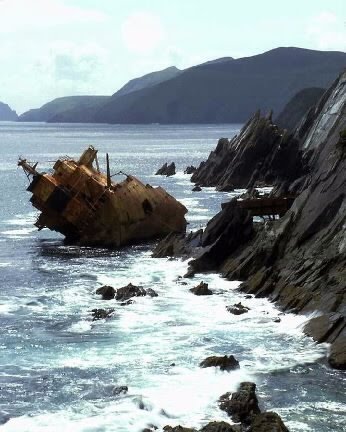
If it were not for being situated at a hub of roads, it is likely the great port city of Rogalarr would never have been established as a popular sea trade route. The coast to the north is a jagged row of dark stone with swift currents. Fortunately the coastline to the south is easier sailing.

Yet the north sea-trade is more profitable, so much so that the risk to navigate through the dangerous shoals is worthwhile. Only the most experienced of captains can prevent their ships from running aground. While many captains of lesser skill commonly have their ships smashed against the coastline, or worse, dragged under and out to the vast sea.

Hence over the years, ruined husks of ships litter the northern coastline. The waters likely hide more that have sunk to the bottom. Most ships manage to have some of their cargo recovered before thieving folk picked the wrecks clean. Still many rumors swirl about at local taverns of lost treasure beneath the waves, or of some arcane cargo never quite found in those vessels run aground against the formidable shoreline.

Yet even more dark tales are uttered when rum flows freely. Some claim that vile humanoids live under the sea, and call about spirits of old gods to dash the ships of men against the rocky coast. These evil beings then swarm over the wrecks, stealing away survivors and anything else they can carry. All being offerings to the dark sea god they worship.

A hearty band of adventurers might find employment from a merchant, seeking to recover goods from a recent wreck. Or possibly secure such a wreck, while a crew of laborers could be massed to unload it. As many thieving folk would find the opportunity hard to pass with such wealth being readily available, even if the location were rather treacherous to reach.

More ambitious explorers might seek to recover treasure lost to the sea. A local fisherman has found a wreck, and seeks to partner with willing heroes. Some of a more perceptive lot might find the request odd. Is the fisherman really aligned with a thieves guild? Would brigands be ready to strike once any treasure is recovered?

Are the dark tales true? Is the northern coast plagued by Sahuagin that prey on shipwrecks? Or do these dark creatures call forth storms and waves to destroy vessels through black rituals?

Guidance for roleplaying lacking in the DM guide?

There’s a post on Roleplaying.com which had me think a bit. This precipitated from the recent editorial in Dragon. RPing is our job. We have to step up and provide the impetus for RP.

I think the DM guide is a great book. For someone that is a new DM, there is a lot of helpful information on running a game, I especially like that they have provided a small, rather generic landscape that DMs could plug into a larger world. The Nentir Vale is a chunk of landscape sketched out with a lot of adventure ideas. Plus they have Fallcrest, a small town that is fleshed out pretty well with its own adventure hooks.

I’ll be a lot less glowing about the dungeon included. Kobold Hall is a little uninspired, but I guess it covers the basics of encounters (traps, hazardous terrain, etc.). Plus I figure it wouldn’t be D&D without a dragon, so I guess the designers felt players had to tackle one in their first run out. At least a new DM has been exposed to a solo-type encounter and can get some ideas for his own game.

Mechanic-wise I think the DM guide has done a pretty good job. There is a lot material on designing encounters, monster creation, and impromptu rule design (pg 42). Overall there is a fair amount of tools provided to allow the DM to get a handle of the game mechanics, especially combat. I can see, though, how some folks feel 4E lacks a framework of rules for covering more roleplay-centric aspects. But I think that was done on purpose.

I really feel that adding elements that dictate player motivations and interactions a bad thing. Strict adherence to alignment, reliance on training or a special event to gain an ability or prestige class, all of these things potentially hindered roleplaying. Having a rule written down on a page is miles away from just providing a suggestion to a DM. I really feel WoTC decided to leave many of these things up to the players (DM included), allowing them to be as restrictive or open as they want, with minimal offers of specific rules.

Take the retraining of powers and feats after players level (PHB pg. 28). There is some constraints mechanic-wise (you can only switch out 1). But there is no hard and fast rule describing what the player has to do to make these changes. It is totally up to the players. If they just want to erase and write something in on their character sheet, fine. If they want to RP out a small session where a player visits an old mentor, or spend some time with an NPC, no problem. It is totally up to the players. I think folks can get as much RP they want out of 4E, and not have tomes of overbearing rules dictating every possible situation. This is a great direction of the game.

At the same time I do feel that more guidance can, and should, be provided. As an adult with years of experience with DMing and gaming, I’ve got enough experience and exposure to fiction (and non-fiction) to get some decent world-building ideas. If I were a 13-year old, I might want some more guidance. I think on that aspect, the DM guide does a pretty poor job.

There is about 40 pages covered over 2 chapters (Chapter 8 and 9) in the DM guide that give suggestions on filling out a campaign. That is pretty sparse. Having examples of varying governments, religious effects on society, varying economies, all of these things could be a great tool set to helping a new DM in world-building. I don’t expect (or want) detailed rules. But having a lot of suggestions would go a long way towards helping out fledgling, and veteran, DMs.

I expect that there will be more campaign and world-building books in the pipe. I think WoTC has encouraged players to freely pillage rules from campaign sourcebooks to custom make their own game. That is great, but I hope they offer up more beef in the 2nd DM guide to cover this topic a bit more. Not providing rules is fine, but giving lots of suggestions is always welcome. Hopefully future releases will provide additional tools to help DMs make their own worlds more vibrant and unique.

The encounter grind

I’m playing with a smaller group with 3 characters right now. Despite the ‘ideal’ D&D party being 5 players. I suspect having a group that big really leads to the encounter grind. This seems to creep up in the game where a combat stops being an exciting tactical challenge and slowly grinds to a halt over long, arduous combats. I’ve seen a lot of people blog or post about solutions to the grind. But overall I think a big problem is that speedy, efficient combat flies in the face of larger parties.

4ED combat really has a lot going on. All monsters have special abilities and attacks. WOTC seems to implore DMs start throwing in neat environments and hazards to spice up combat encounters. More importantly, players now have a ton of tactical options at their fingertips. They really have to spend a little more time planning out their actions for a turn. Because there are so many decisions and so much going on, I really think smaller parties have a better time at it.

3 people is doable, but I feel the true ‘ideal’ party is 4 players. Have each one take a different role and you have a solid combat unit. The 3-4 character party allows for just enough XP to budget an encounter with interesting monsters, while keeping things small enough to get combats over in a reasonable time. Adding more folks sounds great, but in reality I think it just help make fights drag to a crawl. And keeping everyone engaged with what is happening becomes a challenge.

There are a few things I’ve been tweaking with though. I’ve been tinkering with removing 25% of the HP off of the monster totals, especially with brutes and solos. For non-elite/non-brute types, I’ll typically make sure bonus damage for their standard attacks is at least 1/2 their level. This means fights end a bit faster, while keeping the teeth in a monster’s attack.

Another key point is designing encounters with a mix of roles and trying to incorporate minions when I can. I try to avoid a lot of fights with solo monsters. And if running with a brute, I’ll try to throw in artillery types rather than melee skirmishers or soldiers (although a few lurkers with a brute can work well if you want a meaty melee fight). I tend to mix in more artillery types than controllers, as I think controllers usually drag the fights out a little. Yet, I think controllers work wonders with lowly minions and can make for an interesting combat, while doing the same controller combo with soldiers or skirmishers can make things a tad bit of a grind.

One last thing I do when making encounters is using creatures that are as close to the level as the PCs as much as possible. When you throw that +7 lvl monster out as a solo encounter expect a long, drag out fight, even if the exp budget works out. Keeping the monsters closer to the group’s level means the abilities and defenses scale up a little better. If players face a chunk of HP and a high AC to boot, you are going not get an exciting battle, but a multiple-round dicefest of ‘miss, miss, hit, miss’ that will slow the action to a crawl.

A way to get around that is just mix it up and throw a few other creatures into the encounter. Don’t be tempted to just plop down a single monster and call the encounter a solo fight. Get something a little closer to the party level and throw in some lowbie creatures to fill out the budget. Then you have your big baddie, plus a few smaller minion-types fluttering around in the background to harass the players. It’ll make things more engaging and avoid the slugfest of the entire party just repeatedly hacking away at the lone monster in the middle of the room.

Are you getting the combat grind in your games?EarOtisF

WOTC reworking skill challenges?

Double post day (WOOT!), but I wanted to quickly get something out before this becomes old news.

Dungeon has a new article up on designing skill challenges. I’m glad they put stuff out like this. I like the concept of skill challenges, but it is clear that the system originally put out in the core 4E books needed a little refining. A lot of posts, blogs, and general buzzing on the internet covers this topic a lot.

The folks at WOTC have made some suggestions working skill challenges. I do like the general idea of breaking up epic tasks into small skill challenges. I also like the idea of the article that failures and successes can effect further checks. It gives the DM a lot of solid ideas for designing and running wilderness skill challenges themselves.

I’m a fan of variants on the 4E system, but a small part of the article threw me a bit:

‘Each time the characters make a check as part of the skill challenge, roll a d20. If the DM’s d20 result exceeds the player’s d20 roll for the skill check, the characters encounter something in the forest. Remember to compare only the die rolls; ignore all modifiers.

You can roll a d6 to determine the encounter, or you can pick one from the list below.’

Okay, again I can see putting this out there. It is a small tweak to how skill challenges run. What bothers me is how completely tacked on it seems. As put forth in the article, the players either succeed getting to their destination, or they end up outside the forest. So it becomes and binary result (successfully navigate the woods or lost outside).

What is then suggested, from the quote above, is throwing a wrench into the whole challenge by having other random encounters. What I don’t get is why not have these encounters part of the overall challenge? How about for every failure the players get during the challenge, a potential encounter can happen. Or if the players barely meet the conditions to win the challenge, they run into an encounter. If they exceeded the number of successes, they would have bypassed it.

I’m all for variants and suggestions for modifying skill challenges. But I really wish WOTC would make an effort to show us how skill challenges can work, without having to bring forth all these kinks and changes. By doing so I think it reinforces the notion that skill challenges, as written in the DMG, are clunky and need to be reworked. When I see stuff like this, it gives an indication the mechanics need a little more tweaking.

I guess with the release of the DMG2, we can expect a lot more on skill challenges. So if you have been trying to run skill challenges straight out of the DMG, and having some difficulty. If, by following suggestions in the DMG, you just can’t quite get a challenge designed to work the way you want. Or you receive a lackluster response from your players while running one. Don’t fret. It’s clear to me WOTC doesn’t seem happy with how skill challenges are presented either.

You all start in a tavern…

I’ve started many campaigns with players bumping into each other over a tankard of ale at the local tavern. Almost too many I think. It became a long standing joke back in my old AD&D days with my players. It is not a horrible way to start a campaign, but it takes a bit of time getting everyone introduced and willing to work with each other.

I find players are usually a forgiving lot on this point. They may all have their individual desires and motivations, but at the same time they all metagame. They all know they are sitting around a table and wanting to play D&D. So already they know they have to at least try to work together, especially for that first session.

Return to Northmoor is a great D&D podcast I listen to. It handled the initial session in an interesting way. Their 1st session the players sketched out their relations with key NPCs, each other, and their own reasons for why they were there. In effect they all were associated with each other, and all had a similar impetus to strike out on an adventure if the opportunity arises. It’s a great idea. Plus for a DM they can spend more time planning an adventure, rather than wracking their brains trying to come up with a plausible reason why a rag tag group of heroes would want to group in the first place.

Establishing a campaign where the players already have a relationship with each other is a great way to start. You don’t need to spend an excessive amount of time and planning to get a group formed up. They are set from the start, and can head off to explore. I’ve been trying a few things with new campaigns and it has made those initial sessions a bit more focused on adventure, rather than a meet-and-greet at the local tavern.

You all know each other – It can be a precursory meeting in the past, or a long standing friendship. This point is solid though, all the players have had some interaction with each other in the past. This helps bury group distrust among characters from the start. Why would a fighter trudge along after some unknown wizard and rogue, to investigate an old crypt in the first place? If they’ve initially known each other, this becomes an easier scenario to imagine.

Your secret impression of 2 other players – Each player has some secret thoughts on other players. Maybe they think the paladin is a blowhard, pompous do-gooder. Maybe they have a crush on the Deva. This is material the DM can use to push and pull the players in certain directions as the game unfolds. The usefulness of this can vary (especially if all the players secretly respect each other), but sometimes as a DM players will surprise how far they take this.

2 secrets about yourself that you want no one to know – Again, more fodder for future story arcs and adventure. This can have a very dynamic effect combined with the previous situation. Maybe that holier-than-thou paladin had a hedonistic past? Maybe the Deva, subject to a player’s crush, in turn loved their grandmother (/insert soap opera music here). This is an excellent source for molding the dynamics of the group after a few sessions.

The DM assigns 1 of these secrets to be known by another player – This is optional, but can be a real doozy for a group. Take one of those 2 deep, dark, hidden secrets that each player has opened up to the DM, and quietly pass that information on to another in the group. Now you have a party that really knows a lot more about each other. Where they take it depends a little on the DM, and a lot on each other.

I like using these tools. From the start you have a group of people that have quickly established relationships with each other. More importantly the DM has a good sketch of the personal dynamics of the party. They can find material there to have plenty of hooks for other adventures. Also they have some tools to predict how players will react in certain situations.

That is it for about now, what do other folks use to get their group together?

Thoughts: Eberron Player’s Guide

Being in Asia I typically end up getting many of the new releases months after they hit the US market. Of course between traveling and being generally a little lazy with reviewing new WTOC material, I typically have an even longer lag time. After all the Eberron campaign guide was released last month. Hee… I’ll post my thoughts anyway.

I like the Eberron campaign setting. I like the swashbuckler adventuring feel, with plenty of noir plopped on. Plus the concept of magic as a trade is interesting. The more ‘modern’ influences resulting from this magic concept on the campaign world makes it stand apart a bit from other traditional fantasy settings.
One thing that makes this book a little different from the Forgotten Realms setting, is how much has remained the same from the previous edition after being revamped for 4E. Forgotten Realms made a lot of drastic changes to the world landscape. So much so, you could consider 4E Forgotten Realms almost a reboot of that setting. Eberron has taken a simpler approach and just refined a lot of the mechanics to reflect 4E changes. As such, the world has not changed much from 3.5 which I consider to be a good thing as it makes it tons easier to port an existing campaign over to 4E.

Because of this similarity to the previous edition, I want to just sketch out a few things I got from the Player’s Guide:

Races – Changelings, Warforged, and Kalshtar all are detailed. For the most part I feel changelings and warforged have interesting abilities. I think both of them will offer some dynamic character possibilities. The kalashtar however are a little lacking. They have a means of mental telepathy which is neat, but their racial power is a little lackluster. It is clear the race screams psion class, but I think without that rule set in concrete (aside from Dragon play test rules) the race is a little limited in potential.

Artificers – I’m liking this class. It is nice to see another arcane leader option provided. Particularly I like the extended semi-daily powers of healing infusions. Artificers get a dynamic heal/buff that can be recharged through using healing surges after a short rest (making them effectively encounter powers). What is particularly neat is that any player can donate these surges. So the entire burden is not on the artificer to keep healing infusions going, it can be spread around a bit (especially that one guy that always seems to get though fights without a scratch).

Feats and Dragonmarks – Lots of new options and dragonmarks provide some interesting abilities. Another neat point about dragonmark feats is access to specific rituals, without needing the ritual caster feat. Dragonmarks are also not tied down to racial prerequisites. For maintaining the feel of the campaign, being a racial outsider having such a feat should have a lot of repercussions in game. I suspect it will impact campaigns differently, depending on the DM, but I’m fine with that.

The Good – There is a lot a basic information and background to flesh out a campaign. I think they provide a lot of ideas for the player to whip up a personality and bio that fits the setting. They also give a lot of thoughts on the theme of the campaign, and I think it helps both the DM and players ease into the setting, providing some solid guidance on what makes Eberron different from traditional fantasy worlds.

I think enough detail on the political and social structure of the world is provided, so that both DMs and players can get a hold of the fantasy-noir aspect of the game. It is great that enough detail is given to run a game and get people excited about Eberron without requiring the campaign guide.

The Bad – However some things are a little skimmed over. I find a lack of a proper player map disappointing. The provided map is okay, but printed so small much of the detailed settlements are illegible. Having a larger, simplified map with clear regional borders would have been a good addition. I can see keeping a super detailed map for the campaign book, but a larger player-oriented map would have been nice.

Adding to this point is the player regional backgrounds. Over all I think the section is good, as it gives players a good snapshot of each region, with plenty of ideas to fit their character into it. But having a small mapped portion like the Forgotten Realms player guide would have been pleasant.

I’m also disappointed artwork was not provided for some of the player equipment, especially the weapons. Some of the descriptions are rather lacking. If they can provide a full page spread of example player travel documents, a simple black and white sketch of the weapons would have been a plus.

It is also too bad other details like lizard mounts of the Talenta Plains are totally missing. Okay, keep the stats for the campaign guide, but some simple fluff text with artwork would have been fine. Right now there are hints eluded to dinosaur-like mounts, but no concrete details. Bleah…

The Verdict – A good purchase with enough meat to allow players to run a 4E Eberron campaign. Even if a DM had no interest in running the setting I would consider picking up the book. The new races and especially the artificer allow for some interesting options that would be a good edition to an existing campaign. Plus the concept of the dragonmark feats might add a little spice to a homebrew setting without too much alteration.

The group ends victorious! Now how did they get there?

Dave Chalker over at Critical Hits has his 5X5 method to flesh out a campaign, and it is a pretty neat idea. The skinny on it is taking 5 major quests, then assigning 5 steps (mini-quests) to complete each major quest. You end up having enough quests out there with players running all over the world doing different things. All at the same time however, the group is ‘on the map’ of the DM storyline, despite the possibility of them being all over the place geographically with various plots and quests. Pretty neat stuff.

That got me thinking of ways to sketch out a campaign. Usually it is easy enough for me to get the big idea of a campaign, identifying the main villains as the ‘Who’ and their nefarious plans as the ‘What’. I typically then fill in the ‘How’ with a series of quests and tasks the villains are set to complete as different branches converge. The PCs then are led into certain encounters to thwart them at those steps. Sometimes the group succeeds, and sometimes they fail (leading to further branches in the story arc). Those results then morph the overall plans of the villains until things boil to some conclusion ending the campaign (or at least that major arc).

Now for a lot of fun, I try to keep 2-3 major milestones of the villains going at once. So that continually, players have a few choices to make. I try to set things up so they have opportunities to foil all the different villain’s plans, but sometimes give a hard choice of an either/or situation. It works pretty well, but it makes it a little harder to recover if they really go off the track and in a completely different direction. Things can get a little convoluted.

Another big problem I tend to have is getting a tidy ending to the story. Things are sketched out, but the details are usually lacking. I sort of like this as the campaign has an organic feel to it, constantly growing and adapting to the characters actions as they progress. Overall there is a general theme and a main plot, but it is more of an outline rather than a strict doctrine.

Granted if you have a lot of time to run your campaign, it can be fun. However, if you know you are running a game for a set amount of time (say over summer break, or for 6 months), you might want that strict outline for a campaign. In that case, you may want to lay out exactly where the characters should be after X amount of sessions in the campaign.

Another way to think about plotting a campaign is assume the players have won at each step. Rather than think what the villains are planning to do, approach the story that the characters have all ready been successful foiling them at the campaign end. Now it is just a matter of working backwards to see how they got there, and figure out at what other previous steps were they successful.

So the group has defeated the huge villain and lived happily ever after. They arrived at that point by stopping the villain from casting ritual Z. They found out about the ritual from exploring dungeon Y. They found out about the dungeon as they had managed to foil the villain from obtaining artifact X, etc.

This leads to a very linear story, but if the players get off track it is easy to jump back on. You simply work on a few side quests to move them onto the next plot point. Failure is always an option, but you have a good guideline where the players can slide into the main storyline (and still keep everything on track). The biggest challenge is just figuring out a new way to give them an opportunity to succeed at the next plot in the campaign. For a campaign on a tight timeline, I might have to give this a whirl.

Trampier-AdventurersReturn

I am a Luddite, but I’m Trying to Change…

WOTC has released a beta of their new monster builder on their website a few days ago. I do have a subscription to D&D Insider and find it a pretty useful service. For the most part however still was running many of my games away from the PC. I cut my teeth on gaming when PCs were not in every household and everything was done with pencil, paper and at best, a calculator.

I’m trying to break away from that though. I’m starting to use an excel sheet to track initiative, HP and such. I’m starting to write up my adventures as word docs and using maps I’ve scanned in. But I am not quite there yet. I still keep many of my NPCs on index cards. I still use markers to indicate status effects. I still roll dice myself (I tend to make my rolls out in the open for players to see). I’m trying to change but 30+ years of gaming has settled me into habits that are hard to break.

There are a lot of useful tools out there too, especially for adventure prep. Dungeon Mastering has a lot of tools for building encounters, monsters, traps and the like. They require a signup to access but it is free. They also have quite a few links to other useful sites.

Asmore.com still has a monster and encounter builder at their site, but with limited support as WOTC have released their own versions. Still I found their monster builder pretty useful and liked their encounter builder if I needed something in a pinch.

Obsidian Portal is something else I am using as a handy campaign reference and planning tool. I’ve found I’m starting to use that for tracking my NPCs and key campaign plots. Likely I’ll post more on that later as it has a lot of uses.

There are a lot of computer resources available now for running games. I’ve been limiting my use of them and concentrating more on the adventure prep tools. I’m still a fan of having monster profiles printed out and handy for me to scrawl over with a pencil. I like adding a few post-it notes to my written adventures as I plod along during a game. I still do not like clicking a mouse when rolling 3d6.

I’m a little hesitant to go completely digital. Somehow I find it rather sad to see a circle of people playing D&D, all huddled around their different laptops. I like the open interaction of players facing each other, rolling dice, and moving their figures around a battlefield with a character sheet sitting at the wayside.

I’m trying to embrace new technology. I really am. I just have old habits and prejudices I can’t seem to shake when playing D&D.