Games I Will Play With My Kids

I remember playing board games as a kid. I had a slew of Parker Brothers games (Monopoly, Clue, Sorry, etc.) that I played regularly. Looking back at those classic family games, I realize now how horrible some of them were playing together as a family. Something I will not be repeating with my kids.

One thing that stands out in Monopoly and Risk (two old past favorites of mine) is that each game revolves around the elimination of other players to win. Now I am simply boggled by the game concept where the losers are dropped sequentially and forced to wait around until the winner is decided. As a family game, I just don’t see this as fun. Winning and losing is part of playing a game. I’m all for teaching that idea to kids, but dragging out the process forcing them to become spectators while the winner is slowly decided is not fun. Now that I’m older and thinking of playing games with my kids, I’ll be making sure these four games are regulars in my lineup:
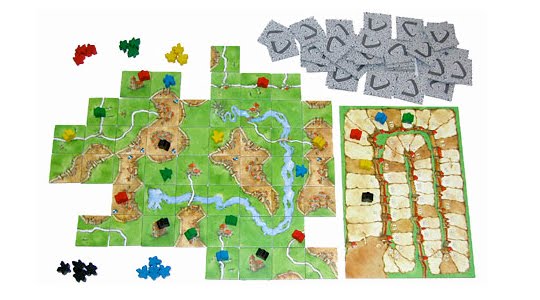
Carcassonne – You place tiles to slowly expand cities and roads, filling up the country side. All the while you place followers (or meeples) to score points on completed features. It’s fun, has simple rules, and is surprisingly strategic. My niece loves this game, and the adults I’ve played with have really enjoyed it too. Play is fast and definitely has that draw to play ‘just one more game’ to it.
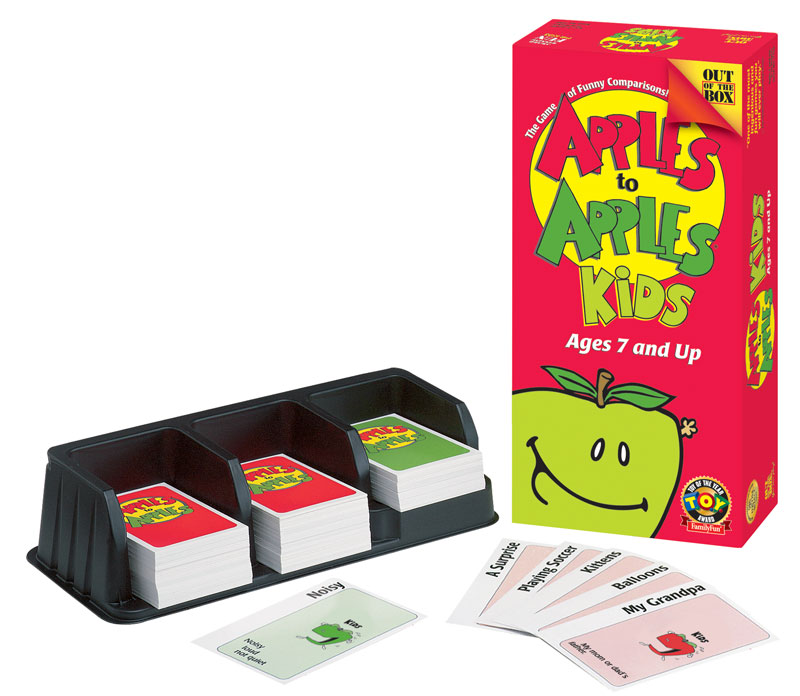
Apples to Apples Kids – The adult version is a hoot and an excellent party game, but I got tired of trying to describe who Maryln Monroe or Dr. Jack Kevorkian was. The Kid edition is a great fit. Players try to secretly match adjective cards in their hand with a specific noun. Rotating as a judge, a player will pick which one seems to be the best fit. If your card is picked you score a point. Another simple game that is fast moving. The only downside is you need at least 3 players, with more definitely making a better game.

Settlers of Catan – This will be my replacement for monopoly. Plenty of info can be found on this game. As a quick description, you play a settler on a new island and must engage in barter and trade to further build settlements. The first player that builds the most wins. It is a resource management game that requires interaction with other players. And more importantly as a family game, everybody is in until the end. The hexagonal board pieces also make for a different game each time.

Risk 2210 – What better game to seed my children with thoughts of world domination. A fun light war game. The combat mechanics are very similar to that of risk. There is a small economy portion. Plenty of luck with the addition of power cards. Lots of different territories to control, defend, and attack (water, land, and the moon). Three territories are randomly removed from the start for each game, effectively becoming natural barriers, thwarting a wrench in specific map strategies (like turtling up in Australia).

Two important points I love about this as a family game. There is a 5 turn limit. You have to get moving quickly as there is limited time to set plans in motion. Say goodbye to the all-nighter risk game. Also, there is no bonus for eliminating a player. Yes, you can wipe out a fellow player from the game but there is no incentive for doing so. In the original game of risk, it is a main strategy to eliminate players in order to get their territory cards. Fortunately this rule is removed from 2210.

This is a short list of games I think are a bit more family oriented and will be playing with my kids. What are your favorites?

Running with New Players

I’ve had the great fortune in my current game of having some players completely new to RPGs. It has been a great feeling getting new people exposed to D&D and roleplaying in general. At the same time, things can get a little rocky. Its easy to overwhelm a new player with rules, tactics, options and choices. If you are in the situation of having a new player fold into an established group of veterans however, this can be even more daunting to the new player. I try to do a few things to make it easier.

Get them plenty of tools to learn the game – I get a copy of the quickstart rules to new players well before game night. Sending them a link via email or handing out a hard copy is a huge help to new players allowing a chance to get some of the mechanics down beforehand. During the game consider giving them a cheat sheet, especially something covering the basics of combat.

I’ve also become a huge fan of power cards. There are a lot of resources on the web. I’m a big fan of one site in particular as I can save and upload pages of cards I’ve already made. I print the cards, slap them between two self laminar sheets, cut them out, and you have a helpful play aid for a new player. I found it really helps having something physical in their hands (aside from a character sheet) to describe potential actions their character has during combat. Plus bookkeeping is minimal, as they simply hand over encounter and daily cards to the DM once they use them.

Simplify character creation – You have to be prepared to really spend some time on character creation with them, especially with the release of PHB2. There are tons of options and likely a new player is going to get overwhelmed quickly. I found a great way to approach generating a character is describing the 4 roles (defender, leader, striker, and controller) and have the player decide what role would fit thematically. Then I would give give a general description of the classes and races. Don’t bog down in stat bonuses and ditch the concept of min-maxing builds from the start. Priority should be something they enjoy playing, not that their racial bonuses are ‘THE AWESOME’ for a particular class.

I also keep several pre-gen characters on hand. If a character wants to play a dwarf cleric and I don’t have one prepared, I grab some other pre-gen cleric, scratch out any obvious racial abilities, and have the player run with it for the first session. Letting the player get a session under his belt allows him to get a feel for the game, well before making any long-lasting decisions with his character. He can then go back, shuffle around the stats, skills, and powers to fit his character a bit better.

Have a flexible first level – 4ED already allows you to retrain a particular power or feat each level. I make it a house rule that players can completely reshuffle their powers, feats, and skills after the first level. I also don’t have the players pick any perks for a background until they reach 2nd level. Sometimes they need to get a better feel for how their character works in combat. Maybe that idea of having an intimidating meathead did not work out, and they rather be a little more diplomatic fighter. I also like holding off the background bonuses to give them some time to figure out who they are after having a few RP sessions.

In game mechanic terms, maybe they realize they need to pick up another skill. Character-wise, they might realize a different motivation for their character and want to utilize a background that fits that concept better. As much as initial concepts might sound good, you really get a better idea on a character by playing it. I like being accommodating initially to allow characters to work out any kinks.

Hold off on the epic storyline for the 1st adventure (or 2) – A solo adventure is a great way to start. It is even better if the new player can run though a short session with 1-2 other players. Having a smaller group will keep the new player more actively engaged. If you shuffle him into a large group and just run with the regular campaign, likely he is going to be lost in the crowd for a few sessions. That small group for a first session will really allow the player to focus on their abilities and powers, with just enough help to figure out how they mesh in a group for future game nights.

Also, if you already have a relatively high level group. Playing a 1st level character, with a few of the veteran party members handling pre-gens, is a great way to get the new player up to speed with how game mechanics work. They can learn basic tactics, skill checks, how healing surges work, and the types of actions they can use during their round, all without getting overwhelmed by running a high level character. Consider the session as a ‘flashback’ to when the player was a relatively inexperienced adventurer. This also screams for the DM to introduce villains and other NPCs that are notable to the current campaign, and given the new guy has gotten a few lumps with similar past experiences means he can mesh a little better with the existing group in the gaming present.

That is about it for now. What other tips would folks impart about getting new players comfortable playing D&D?

Expeditions of Amazing Adventure: The Bustling Bazaar of Kashgor

The nomadic people of Kashgor are known for their fine horsemanship, hunting skills, and exotic foods. Their home is the rolling plains ripe with game and wild spices. Monthly various tribes converge to sell their wares, tell tales, and resolve any tribal issues. A temporary city arises of tents and long rows of wood-framed stalls. Throngs of people move about clamoring to sell goods typically through barter. In no more than a week the people scatter, leaving nothing behind, and the following month they congregate again in a different location.

Kashgor nomads also collect many exotic spices and dried flowers which are prized for their medicinal and arcane properties. As such many merchants from ‘civilized’ regions will seek to purchase what they can, and sell what little manufactured goods the Kashgorians desire. Deals are struck through a word and clasping of hands, but negotiations can be difficult. Kashgor nomads are proud people, quick to take offense, and demand respect of their culture and ways.

– Kashgorians will honor deals made with outsiders, but travel through their region can be dangerous. Adventurers are typically sought to offer protection to, and from, the bazaar.

– The bazaar also becomes a center for judicial matters and political bickering among tribes. It is not uncommon for outsiders to become embroiled in Kashgor affairs, typically causing some slight to a tribal leader. On rarer occasions the tribes may seek a group of outsiders to be arbitrators in a dispute (with some parties willing to secretly offer monetary ‘incentives’ to obtain a favorable ruling).

– It is rumored that some dishonorable Kashgor tribes engage in slavery. Hostages are commonly obtained in raids against rival tribes. Typically these hostages are used to negotiate for political favors against other tribes, being returned once a deal is struck. However, some whisper that a few tribes willingly sell slaves to merchants of the other lands, however unsavory most Kashgorians would find such a practice.

Out for a bit.

I’ll be running around out of the country for a while. Likely my internet connectivity will be spotty at best. So I’ll be holding off posting for a few weeks.

Why not check out newbiedm or Roleplaying pro for a few interesting things on 4ed D&D? I’ll be sure to have more mutterings of things geek when I return.

Fiddling with Skill Challenges: Part 2

To continue on with my tweaks to skill challenges, I’ll add a few more points on aiding others and detail the effects of critical failures and successes.

Each skill challenge I write up has a set of primary skills and secondary skills. I try to list off skills that would provide a direct solution to a challenge as the primary skills. Skills that might have an application I consider secondary skills. If players use skills from either of these sets, they gain a +1 bonus to their checks. The main difference between primary and secondary skills is that players can only assist characters making checks with primary skills.

I further tweak cooperation checks also. If players fail their roll to assist another character, they actually give the target character a -2 penalty to the current check. So players assisting another can either hinder, or help, their party members. This keeps them involved and helping towards the group passing the challenge if they don’t want to risk earning failures, but adds a small element of risk to it.

Keep in mind with everyone assisting 1-2 players, you will likely get a partial success before a complete success. Yes, this makes it easier for players to pass the challenge but typically they just barely fulfill the conditions for doing so (and get half the XP).

I use elements of critical failures and successes for rolls of a natural 1 and 20. A natural 1 automatically grants a -4 penalty to the current check, and for the next roll on the following turn. So if the current total including all modifiers (including the -4 penalty) beats the target DC, a natural 1 one can still be a success. On a natural 20, the check is automatically a success and the following turn the player can add a +4 bonus to their roll.

A quick summary for how I run my skill challenges:

• Each challenge has 3 possible results: complete success, partial success, or failure. A partial success is typically 2 less the passed checks needed for a complete success. For a trivial challenge, a partial success is 1 less (4 for a complete success, 3 for a partial success, all before getting 2 failures). A partial success is worth ½ the XP a complete success would grant.

• Challenges have 1-2 skills assigned as either primary or secondary skills. If players use these skills, they gain a +1 bonus to their check. Only players making checks with the primary skills can be assisted by other players.

• If players successfully assist a player, they grant a +2 bonus to the current check. If they fail, they grant a -2 penalty to the current check.

• A natural 1 incurs a -4 penalty to the current check, and to any rolls made the next turn. A roll of 1 may still result in a success.

• A natural 20 is an automatic success and gives a +4 bonus to a roll for the following turn.

• All the players describe their actions. The DM and players determine the likely skill used. Players then all make rolls and check their results against the target DC (modifiers from players assisting other characters are also applied). Results are tallied and then used to determine if the challenge is passed. This is repeated until a complete success, partial success, or failure is reached. Remember that all players are contributing every turn (either by assisting or making skill check attempts).

I like having layers of results for skill challenges. A key point to this is making sure that partial successes mean the players ‘just squeeze by’ claiming a victory. Typically I’d be willing not only to give an advantage for earning a complete success, but also be willing to incur some penalty for obtaining a partial success. Earning action points and taking away (or granting) healing surges work great for discriminating between a complete and partial success.

I hope a few try this out, and more importantly, give a little feedback. Later I’ll likely offer up a few key examples of this skill challenge variant in action.EarOtisA

Fiddling with Skill Challenges: Part 1

I like skill challenges. I like the idea they can serve as a structured framework for outlining milestones during a RP session, and more importantly, offer a set way for awarding experience. I love the idea that RPing an encounter can be rewarded with XP, similarly to cutting through a swath of kobolds. Skill challenges are a neat addition to 4ED.

Running skill challenges however is a bit clunky. I’m expecting the Dungeon Master’s Guide II having a larger section on skill challenges, including a lot of rule variations. Combined with the cooperation rule (PHB pg. 179), players can easily take a challenge that is supposed to be engaging roleplay to new heights of drudgery, rolling dice simply to give that one character with skill training the ability to trivialize any skill challenge the DM throws their way. I felt skill challenges could be tweaked a little.

There are a lot of alternate rules out there for running skill challenges. One alternate set of rules I found particularly interesting was the Obsidian system for skill challenges. But I did not want to wander too far away from the 4ED rules. I liked the ones laid out in the DM manual, but I just wanted to tweak them a little. So I took one concept from the Obsidian system and put another result in skill challenges, a Partial Success.

A partial success is a result 1-2 less from the total needed to complete a normal skill challenge. So complexity 3 skill challenges would require 8 success results for a complete success, 6-7 successful results for a partial success, and either must occur before the players tallied 4 failures (failing the challenge entirely). The exception for this would be a trivial challenge, where a partial success is simply 1 less from the total needed for a complete success (4 for a complete success, 3 for a partial success, all before getting 2 failures).

So what does a partial success mean? At its core, the players complete the challenge. They successfully negotiate a price, obtain a ritual, or make it across the desert. A complete success rewards the same thing, but they have some advantage by winning the challenge, such as getting an even better negotiated price, obtain the ritual along with components to cast it, or make it across the desert without losing any healing surges. Using a two-tiered success results allows me to give varying rewards instead of a ‘pass/fail’ result. As for experience with a partial success, I reward ½ the XP players would normally get from completing a normal skill challenge.

There is a trick to running these though. Everyone states what they are doing. The DM and players wrangle over what skills would be appropriate. Then each player rolls a D20 and checks against the challenge DC. All players roll during each round, and every roll is tallied during each turn. A success always trumps a failure after the totals are summed each turn (something that could happen with large groups even with simple challenges). I allow players to aid another player also, but I’ll put a few more details on that in the second part.

Overall, it does make skill challenges a little easier for the players. But if they really want an advantage and serious rewards, they have to push their luck making active skill checks. With a partial victory the skill challenge is a success, however they just barely fulfill the conditions for doing so (and get half the XP).

This isn’t the complete set of rules I use for skill challenges. I have a little more on primary and secondary skills needed for a challenge, plus critical failures and successes on those 20s and 1s, but I’ve outlined the framework here. Adding another tier to the challenge allows me to tinker with the rewards and outcomes. Much better than the simple ‘pass/fail’ results of the typical 4ED challenge. I hope some folks are willing to give this a spin and give their feedback.TombHorrorBack

Expeditions of Amazing Adventure: The Secluded Sanctum

As something of a fun series of posts, I’ll try to periodically throw out some (hopefully) adventure inspiring locales. Lately between wandering the Korean countryside and enjoying the League of Extraordinary Gentlemen (sigh… my geekness never ends…yes, I enjoy comics too), I’ve been motivated to try this creative exercise. So every two weeks or so, I hope to produce some interesting fantasy location, ripe with a few ideas for adventure.

The main temple lies in the shadow of a large mountain face. A small path precariously winds upwards towards its summit. Nestled in a slight recess is an image of an unknown god of old. Many of the commoners revere this idol, despite the wishes of the religious leaders in the temple.

Small depressions are scattered around the idol. These hollows in the mountain face are used to hold offerings. Copper coins are commonly placed there. But it is not uncommon for some to leave something of greater value if a strong blessing is particularly desired.

It is rumored that coins are taken up by the old god, a belief reinforced by the continual presence of a few empty holes. Do some villagers secretly pilfer the offerings made by others?

The continual reverence, and more importantly the offer of coin, chafes the religious leaders of the temple. They have avoided any decree towards the villagers stopping their practice. Quite possibly a group of adventurers could covertly deface the idol (and get a suitable reward from the temple)?

What does the idol represent? Is it a primordial god worshiped primarily by animal humanoids? Is this really a revered god found by a nomadic tribe of shifters? Such the presence of a temple below the idol would likely be an affront to their god. The shifter tribe may seek to remove such a temple by force if necessary.

Working with Extended Rests

Like just about everyone running a D&D game, I like to tweak the rules a little. I think the 4ED rest and recovery rules work. It keeps players in the action and taking an extended rest effectively replenishes all their resources including HP. But I wanted to put a brake on players using all their healing surges, drop severely low on HP, and just take an extended rest to do the same thing next day. I just feel continually taking extended rests could easily be abused.

To get around this I modified the extended rest rules a little having the player recover healing surges differently, and it being largely dependent on their condition before they hit the sack for 6 hours. I feel that daily powers and HP have to be replenished to their full amount, no matter what condition the player was in before the extended rest. Dragging out HP recovery over days just seemed to hurt the player. Besides, if you buy that HP are more about endurance and will power, rather than just tick marks for vitality, it doesn’t make sense hampering HP recovery.

So after an extended rest, the player regains their maximum HP and regains all their daily powers. However, recovery of healing surges depends on the following conditions before they take an extended rest:

Is the player at less than full HP? – If the player has less than full HP before they rest, they gain their full healing surges (HS) -3. If the player is bloodied, they gain full HS -4 (4 less healing surges from their maximum).

If the player is at full HP, how many HS have been currently used? – If the player used 4 or more healing surges, they regain full HS -2. If they used 3 or less, they are at full healing surges after an extended rest.

Players should be encouraged to burn through their healing surges, and possibly use them in combination with encounter powers, to be at maximum HP before they rest. The player recovers less healing surges if they have any damage at all (even being one point under their maximum). So it is worth using up all those surges to get back to max HP before resting.

In addition, if players take a comfortable rest they gain back one more healing surge (a bloodied player resting in an inn would be at full HS -3 after an extended rest, not full HS -4). A comfortable rest means the players are in a sheltered location (not exposed to the elements), eating a prepared meal that is not trail rations, and are in a relatively secure location (not taking guard shifts).

This encourages players to seek out civilization and crash at an inn, rather than being cheap gold misers sleeping in the woods all the time. Granted some players might feel their character is more at home in the wild, but taking the time to get a campsite together, rustle up some food and water, and sleep hoping nothing stumbles on them in the night, will likely make the player not be at 100% the next day.

I’ve been a little lenient applying the comfortable rest bonus to characters using specific rituals. Create campsite ritual (PHB2) is a great example. Using traveler’s feast combined with eye of alarm (or magic mouth at an entrance to a small cave) would also work, especially if the players packed a few tents. I think rituals seemed to be glossed over in 4ED and with a little tweaking, they can add a lot to the game.

That’s it for now. Another example of using healing surges instead of HP to hamper, or reward, the players.Willingham-IronCobra

It’s not the game. It’s you.

There has been some pretty juicy discussion on troublesome players over at the Chatty DM and Dungeon Mastering. Something I felt about handling such players, is that it can be very tricky if the jerk player in question is your friend, or a friend to one of the players. If the person is simply an acquaintance that you happen to run the game with, then I’d have no problem throwing down the ultimatum of ‘shape up or get out’. Yet, this point really got me thinking about fun with games, and more importantly, our fond memories of past sessions and campaigns.

I’m convinced that with RPGs, people derive fun less from the game design and mechanics, and more with the people around the table. It is the social interaction that drives these games. I really think what clouds our fond memories of playing past games, is not the actual love for a system or rule set, but really with the people you were playing with at the time.

I’ve heard something which I’ll paraphrase here, “You can’t relive that past experience of your high school D&D game.” I believe it. And I truly think these memories of good times are mainly derived from remembering the time you spent with your friends, sharing an experience playing a game.

That is the key point with RPGs (that make them stand apart from other games), social interaction with other players is so integral to having fun. If you have a jerk player, that social interaction is troublesome and stressful, making the fun factor an all time low. If people are backstabbing each other and doing spiteful things, that might just be fine in some groups but a death knell with others. And I think the key difference is that in one group, people are solid friends and their relationships recognize such antagonistic behavior as non-threatening. In other groups, although they may be good friends, such behavior is seen in a poor light, making the experience unpleasant.

I think fondly back to my college days playing Illuminati. It’s a goofy board game, where players actively seek to grasp power by making under-the-table deals that can be broken on a whim. Tons of backstabbing and trash talk were abound in those games. When I look back at it, I really think it had practically nothing to do with the game (I wouldn’t consider it a great board game). I think all my real fun had to do with socializing with my friends around the game table.

So is that really the big issue a troublesome player? It’s that our socializing is hampered, not the actual game, which leads to us not having fun? Something to ponder over I guess.EarOtisG

Preview: the Psion Class

ph3psionContent for the new Dragon magazine is now up detailing the Psion class. Personally I was never a fan of the psionics character, but in some campaigns I could see them working. I just never quite liked the fluff of having players manipulate things with their minds. I guess I am just an old-timer with my magic and spells (‘You dagnabbit psionic kids. Get off my lawn!’)

Still it looks like an interesting class. What I particularly like is how the implementation of power abilities are slightly tweaked. Players slowly expand primarily with their at will powers and get daily and utility powers as normal. They gain no encounter powers. Rather they obtain power points (starting with 2) that they spend to augment their at will powers. Most at will powers can be augmented twice, effectively having 3 ‘levels’ of effects. After a short rest, they regain those points back. They’ll end up with the same number encounter powers as other players, just some differences in the game mechanics for using them.

I foresee this becoming popular in a lot of knock off systems (and likely has already been implemented elsewhere). You have a few key signature powers or moves, with a pool of points to tap additional effects to them. You end up having a few options, deciding how much to buff up a certain attack. I like it, and it screams for being used in certain genres (pulp-action or superheroes).

As for 4ED though, I can see more bookkeeping for the player. It’s a neat idea, and I expect for many veterans they will like the free-wheeling power use of this character class. I’d be hesitant dumping it on a new player. Yet, the play style of being able to selectively bump up abilities, rather than picking from a predefined set is intriguing. An alternate magic system in the works maybe?