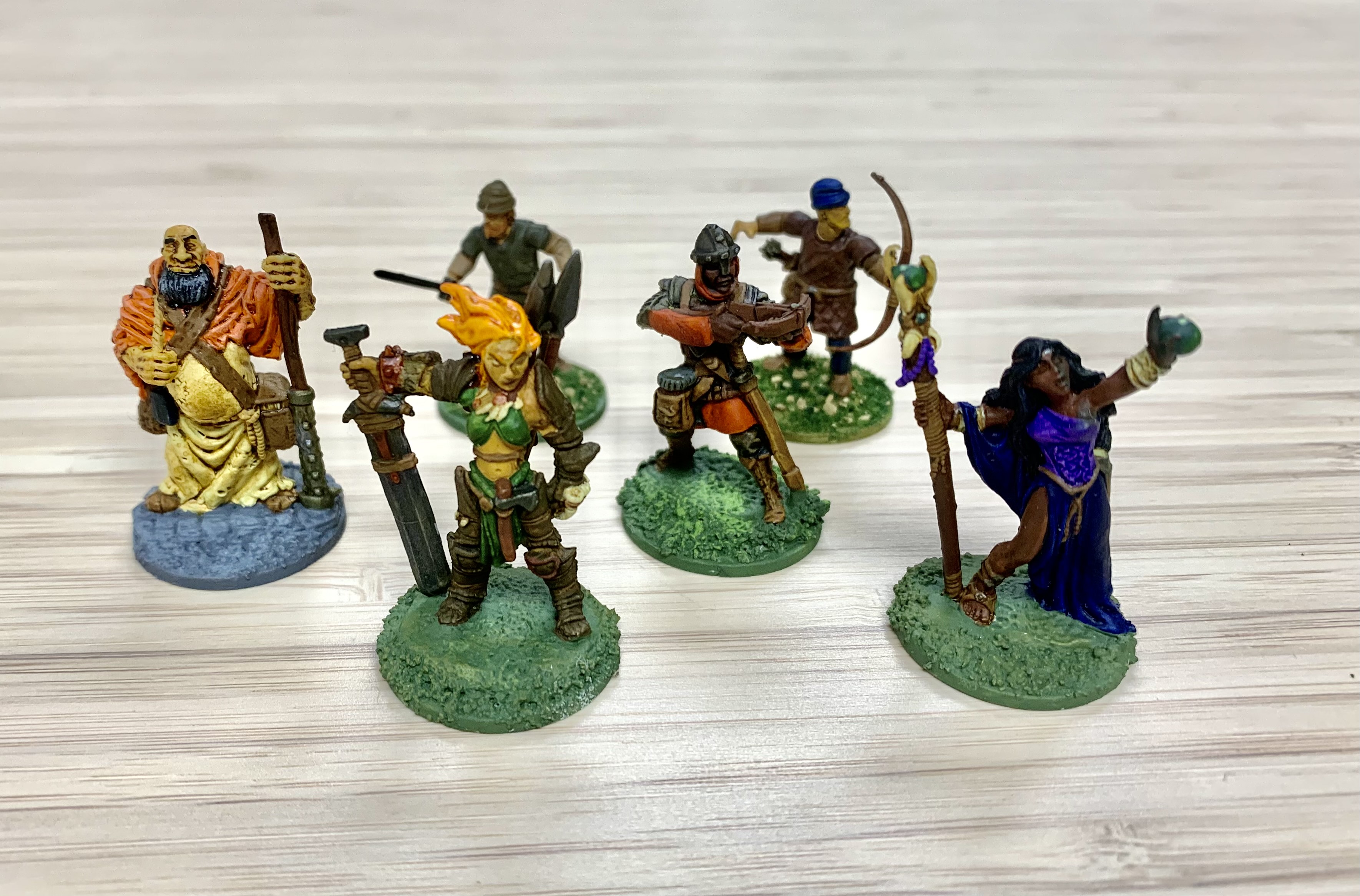
The Torchbearers, take two: 5 Leagues from the Borderlands

About to jump into another campaign for 5 Leagues from the Borderland and decided to tread over old ground some with rolling up the warband. Loved the idea of a wild barbarian running the show, wrangling up an enigmatic mystic to help her cleanse the land of evil. So I stuck with that idea having Tamari and her mysterious spellcaster Druuna as the founding members of the Torchbearers. They were easily able to convince Karl the Inquisitor to join their company. The fervent zealot knew of a crafty crossbowman, Zane, through past dealings and were able to convince the rogue to join with promises of riches. 

The group were charismatic enough to encourage a stout citizen guard, Corben, to accompany them north and he eagerly did so wielding his trusty sword and shield. The Torchbearers set out to the North Coast, set about to reach Lakes Crest first. Along the sparsely traveled West Road they came across a frantic peasant, Teller. His hovel was overrun by shambling dead, and he implored the company to help out his kin.

A New Campaign: 5 Leagues from the Borderlands

My previous 5 Leagues from the Borderlands campaign I set up sort of sputtered out. I did a few campaign turns that I tweeted. However real life encroached, painting work lapsed, and it ended up being put on the back burner. I decided to do a fresh start and try working up a new region map to reinvigorate myself.

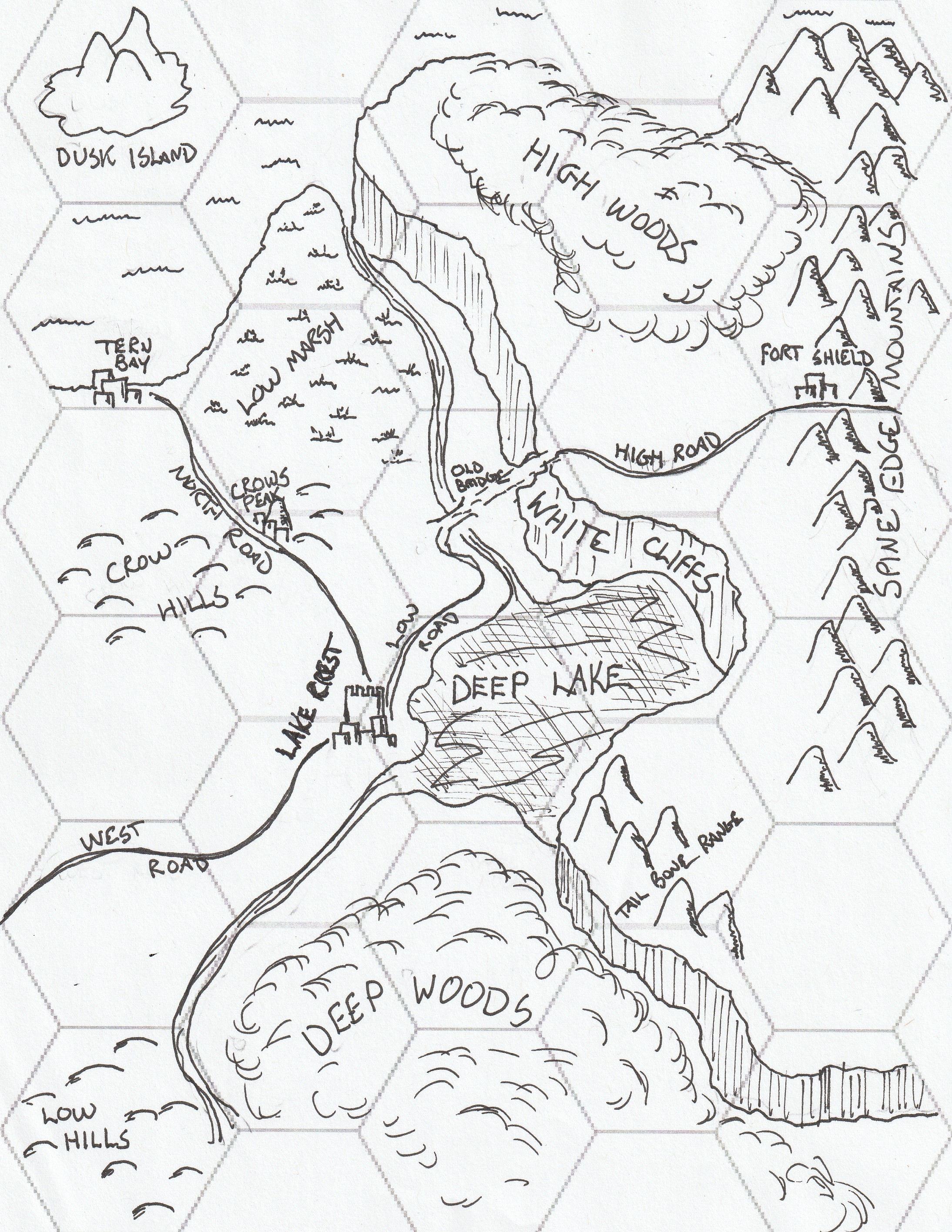
While I loved the sparse maps I nabbed using the Nentir Vale, the problem became keeping track of current locations. I loved the idea of general areas, but the game seems to work better if you can define the areas of the region more. So I opted to use a simple hexagonal map.

Rolling up settlements in the area, I ended up with a town, 2 villages, and a hamlet. All the more civilized villages were market towns, while the hamlet was a military outpost. I decided a town would be at the relative region center, bordering a deep lake, rivers running north and south, along with being the nexus of the region’s roads fitting for a trading hub. One border would be laced with an ominous mountain range, along with a coastal region to the north. 

Given there was a coast, I had to have a small village on the shoreline as well as an expansive marsh. Not to mention an island nearby. I figured a fortified outpost along the mountain trail would be the best place for the hamlet. And a small village along the road connecting most of the communities would be a good spot. I also liked having a large chunk of the region cordoned off, so it is essentially split by the eastern portion up on an elevated range. The western section being more civilized lands having woods, rivers, and roads, all under a far-reaching series of cliffs that define the region.

Seems as a displaced region on the edge of the empire the Ruin Within will be an apt internal threat, as well as the Gnawing Horde rampaging about the countryside. Not to mention the never ending conflict to the south coming to the region too with the Curse of War. Overall I’m pretty happy with the layout and eager to get a new warband rolled up. However still sticking with the Torchbearers as a name. Gonna be fun!

Contrast Paints

A while back I mentioned a new type of product on the market, contrast paints. Essentially it’s a paint-medium mix that is more of an intense glaze. The idea is the paint flows easily over a surface, gathering in cracks and having a thinner coat over raised surfaces. What you would usually get with a base coat and wash, you could get with a single coat of contrast paints. Additionally as it’s more transparent that your typical paint, you can get a slight highlight effect too. 

Aside from Games Workshop, Vallejo and Army Painter have also thrown their hats into the contrast paint ring. I’ve only dabbled in using paints from GW and Vallejo so far (and I’ve fallen in love with the Vallejo Xpress paints). I steered clear of Army Painter due to issues of the paint reactivating when it becomes wet. There are workarounds with the Army Painter Speedpaints to minimize this, but the property of these contrast paints was pretty much a deal breaker for me ever buying them.

The concept of contrast paints is to use a neutral primer as an undercoat. And then pretty much lay down coats of contrast. As the paints are a little transparent, you really can’t paint over existing coats with different colors unless you are looking to mix hues to get a different shade. Instead you need to apply an undercoat and repaint. So if making some mistakes, it’s best to have brush-on primer handy in a shade similar to the undercoat being used, touch up any whoopsies, and keep painting with contrasts. 

Working with contrast paints has been a learning experience though. Generally you can get away with using it directly from the pot. But depending on the pigmentation intensity you are going for, you may need to carefully thin it some with water and/or contrast medium. I found it better to work with lighter shades first, and then use darker shades so that you might be able to bypass touch ups with primer entirely. 

The GW contrast line dries quickly and works best steadily painting to cover an entire section of a surface while it’s wet, before moving onto other parts of a model. If say, painting only half a space marine shoulder pad, you might get some uneven results coming back to the other half once that section dries. The portion you painted previously might get some brush strokes and repainting over those parts can impart a darker hue, potentially making that desired color you are striving for a little uneven.

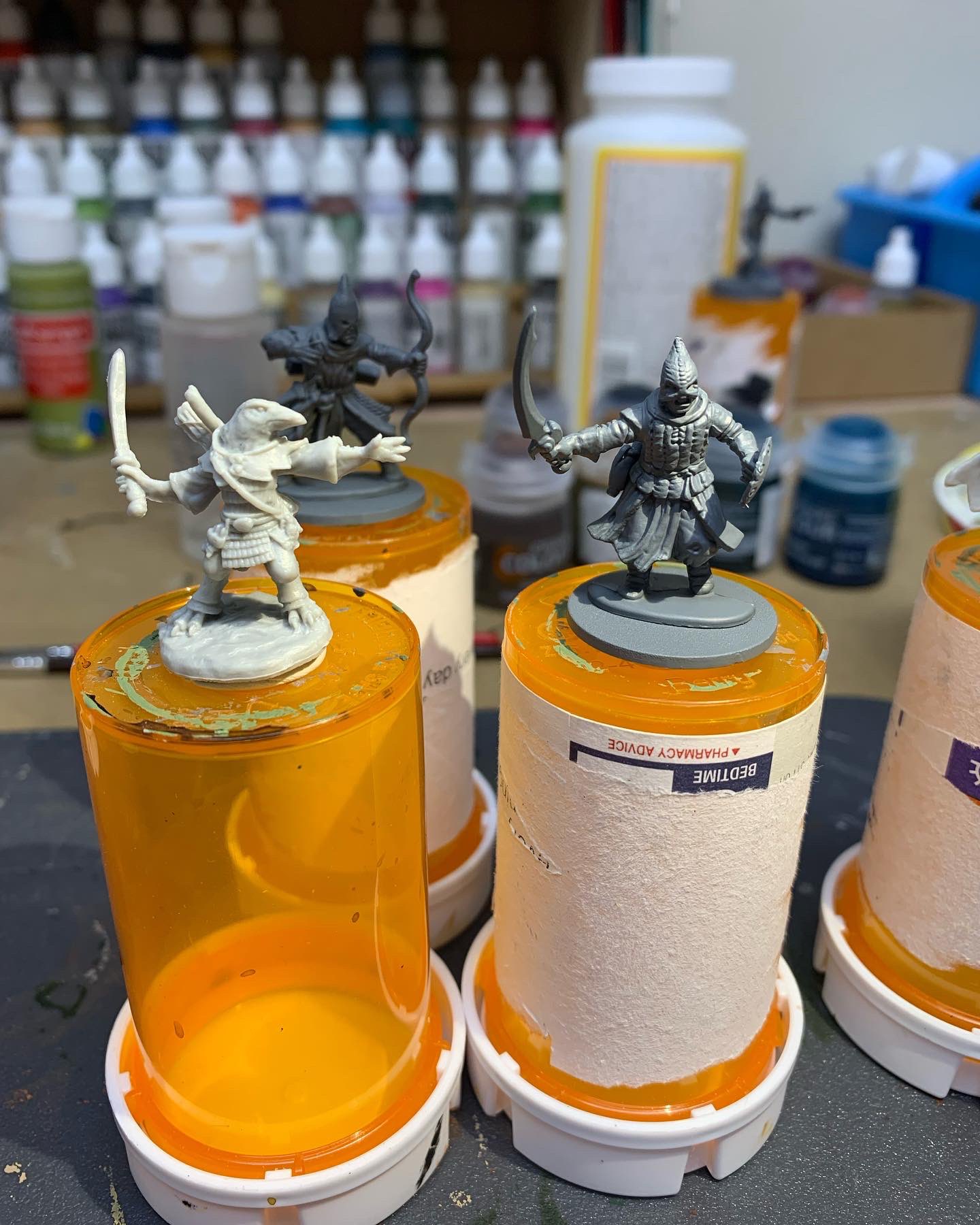
I also learned that a single undercoat just wasn’t enough to bring out the depth possible with contrast paints. I tried first drybrushing white over gray primer. This helped in bringing out the highlights of a model allowing the contrast paint to work better as a glaze. 

However I still wasn’t quite happy with the depth of color for the models as you can see with these battle mechs I worked on. I will freely admit though that it could have been the particular GW contrast paints I was using. Maybe thinning it out more would have worked better.

On the interwebs though was the slapchop method. The concept was using a darker undercoat with white highlights obtained through drybrushing. I used a gray undercoat followed up with a thin black wash.

Finally doing a copious white drybrush. The key is to try and leave the recesses of the model black, and give any raised sections a nice highlight of white. This immediately provides a foundation that has a fair amount of depth that will be enhanced with the contrast paint.

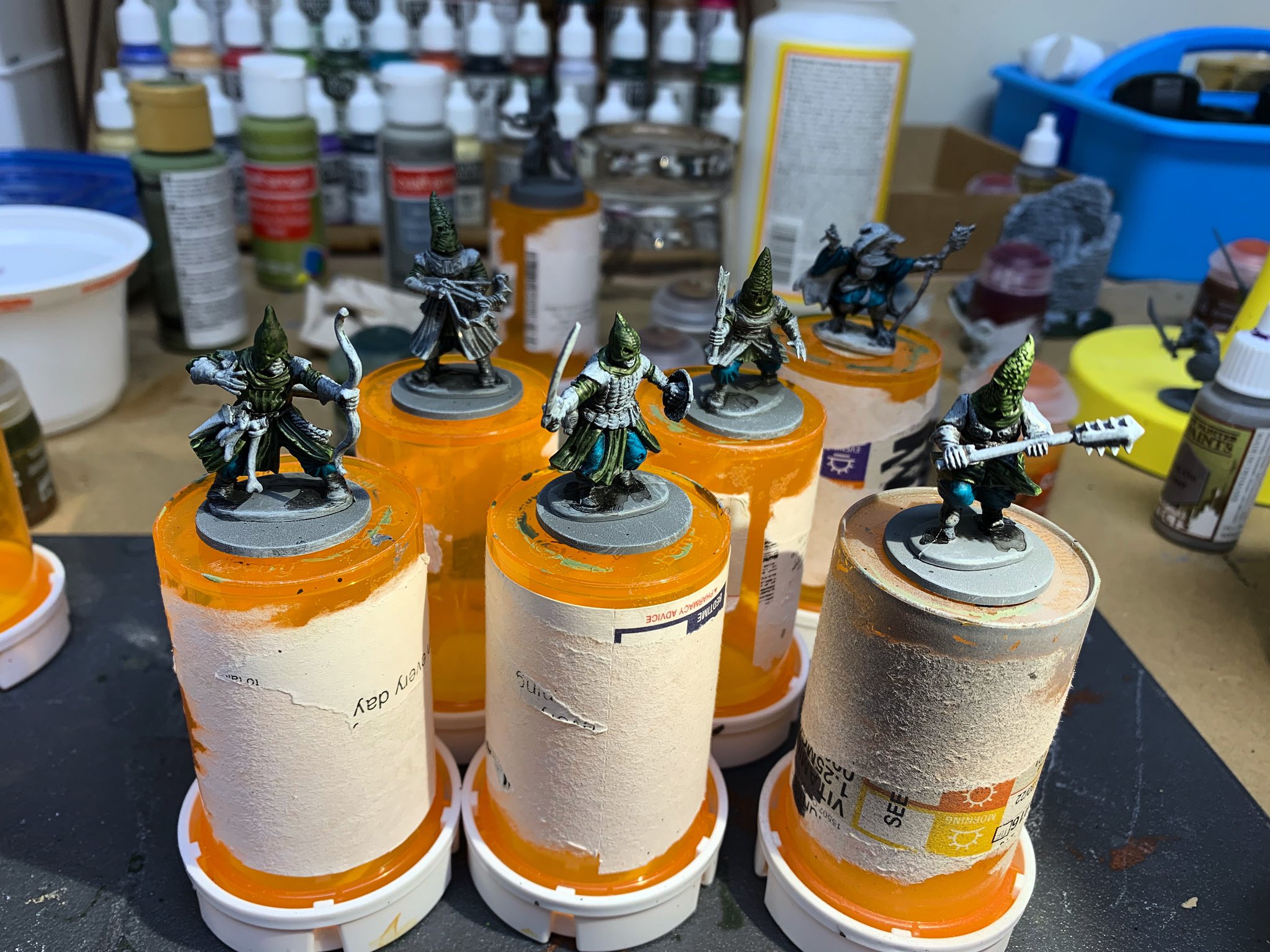
You can see with these cultists, the properties of the contrast paint easily give models with this undercoat method a great look. The nooks and crannies of the model get that deep tone of color, while raised sections with the white base coat have more depth over other areas on the mini. I could get a fair amount done with a single coat over different sections. And as the paints flow well and cover quickly, I could also get models painted up much faster than using conventional paints.

Hands down, using contrast paints will not give you the vibrancy and shadows that the Big Three offers. You cannot get the depth on a model that you normally would using blending. But if wanting to get a fair amount of minis painted to tabletop standard, contrast paints are an excellent choice. I had seriously thought of just giving a horde of my Zombicide minis a simple wash. Now I’m thinking that a quick coat of contrast paints instead would make them look fantastic. If looking for a means to get a fair number of models painted efficiently and still look pretty nice, contrast paints are worth looking into.

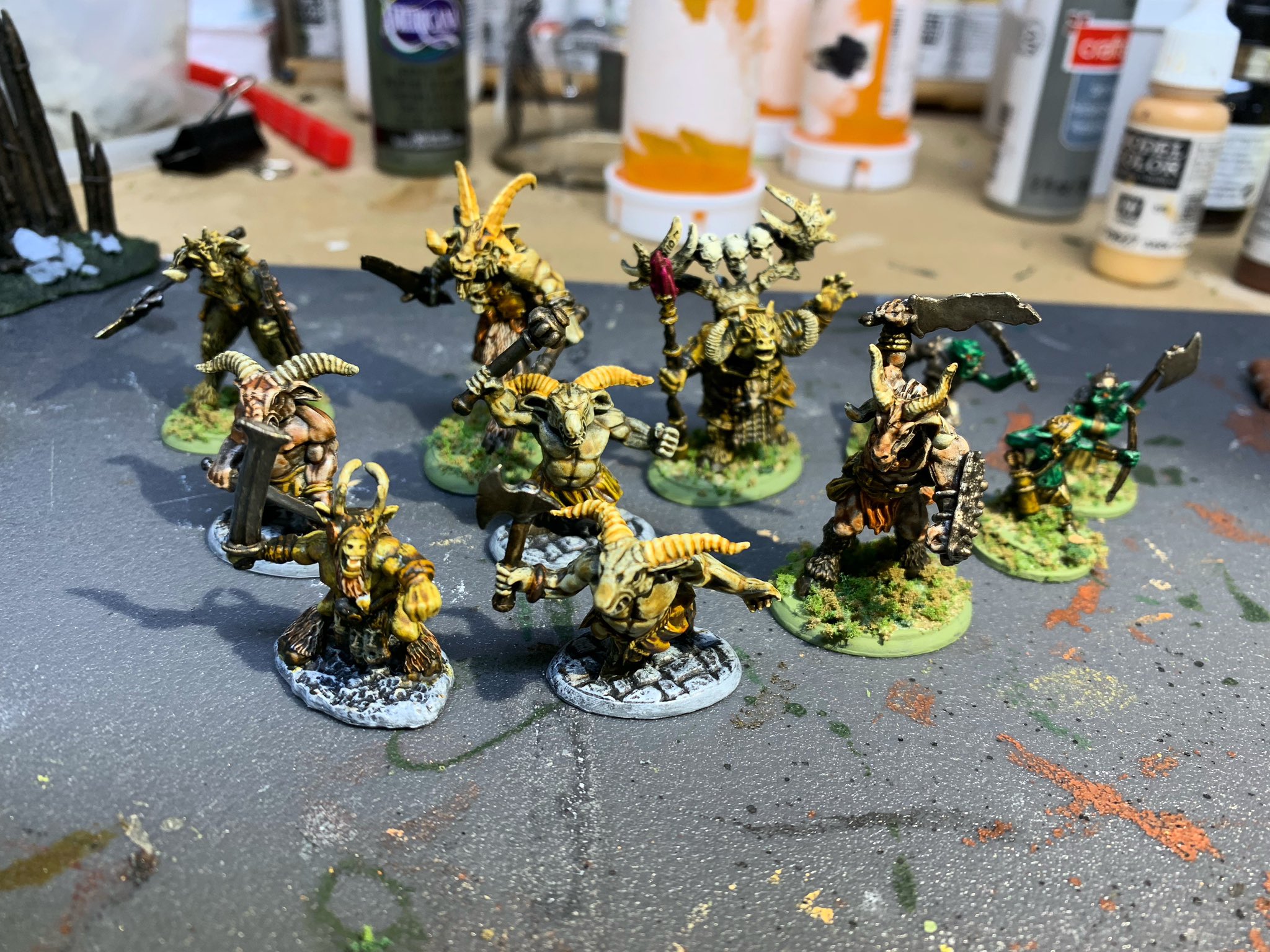
Some Reaper Minis beastmen and goblins done with contrast paints.

Review: 5 Leagues from the Borderlands

A long while back I picked up a solo sci-fi wargame, 5 Parsecs from Home. I later found out a new edition of a fantasy version was in the works and scooped it up as soon as I could. 5 Leagues from the Borderlands (5LB) is a solo skirmish wargame with RPG elements from Modiphius. You gather a warband of six adventurers, selecting one as your avatar, and seek to cleanse the land of evil.

The campaign has 3 main threats set at different thresholds, and you are tasked with removing them completely from a region. By gaining adventure points through encounters, you acquire enough to attempt various actions to find their hidden camps and eliminate them. A departure from 5 Parsecs from Home is that you start with an actual region map. You’ll sketch out some features, leave some areas as unexplored wilderness, add a few villages, and finally sprinkle some locations of interest throughout the map. This will define the region you’ll be adventuring in.

The campaign turn follows a sequence starting with preparation, upkeep, travel, and finally a potential encounter with enemies. Generally preparation allows for 2 actions providing opportunities to gather resources, rest up, buy or sell equipment, or seek out quest rumors. The type of actions will be dictated if you are in a village or out at remote home camp in the wilderness. You have to constantly keep money on hand to pay your troops. Skip out paying your hirelings too long, and eventually they will become disgruntled and leave.

You direct your warband to travel, investigating unexplored locations, strike out at an enemy camp, or patrol traveled roads. During your journey, you’ll have various random events with some being boons and others complicating your efforts. These events can also dictate the types of encounters you’ll have when engaging the enemy. While out on patrol, you might encounter a befuddled scholar that seems friendly enough, only to find they were a scout for a band of brigands that ambush you. 

The types of encounters are split among a few scenarios, with some having defined defender and attacker positions. The enemies you encounter are determined randomly, rolling on different charts for the types of threats in the region. These threats broadly will align with particular enemy types such as undead, chanting cultists, ravenous beastmen, or even a spearhead of an invading army. Each encounter type will also have defined objectives. While it’s ideal to hold the field, a fair outcome can be to achieve the scenario objective and make a quick retreat. If things turn too sour on the battlefield, you can always call for the warband to retreat but expect more dire outcomes to your hirelings. Encounters can also encompass dungeon delves or attacks on monster lairs.

Scenarios run through several turns first starting with initiative. You will roll a d6 for each warband member, trying to not roll above their Agility score. You assign successful rolls to individual units that can undertake their full allotment of actions for the turn. Then enemy forces act next, and finally have your remaining forces act before the turn ends. A mode’s turn encompasses a movement action combined with an attack, some manner of a task action, or possibly a further dash of movement.

Ranged combat is rolling a d6 and trying to commonly roll over a 6+ or a 5+ (if the target is in the open). If the target is hit, a d6 roll is made to overcome armor and then an additional roll against the target’s toughness. If the total roll exceeds the toughness of the unit, it becomes a casualty. Rolls equal to, or less, result in the unit taking a wound and being stunned, with a second wound taking it out of the fight. Stunned models grant bonuses if in melee and are always treated as defending but the condition is removed at the end of the turn.

Melee combat is a little more involved and is fought over 3 rounds. Each model makes a combat roll trying to roll the highest adding their combat skill. After each round the defender moves back 1” and the attacker has the option to move in to continue the combat, or break off and end it. On ties, the attacker never follows up and the combat ends. If the attacker scores higher, they have a chance to inflict damage (resolved like ranged attacks). If the defender wins, the next round they become the attacker avoiding any damage for that exchange. Unlike ranged attacks, stuns only have an effect during that fight and are removed at the end of the exchange.

The player has as few tactical options when in combat, like whether to fight defensively or throw caution to the wind and fight wildly. Some weapons and positioning (such as being on higher ground) allow a model to counter attack, essentially being able to strike a hit while defending (instead of just being the attacker the following exchange). This special maneuver is avoided by selecting certain fighting tactics. So against particular enemies, or being at a disadvantage in positioning, you can overcome counter attack situations employing defensive tactics. Given you only need to exceed a model’s toughness to make it a casualty (with typical values between 3-4) being the attacker is ideal and combat can be deadly. 

Movement is pretty simple, doing so up to a model’s rate in inches, with a second move as a dash action. Most difficult terrain uses 2” of the figure’s movement for every inch on the table. Models cannot pass through each other and there are simple rules for climbing and falling. Terrain is fairly abstract with line of sight based on drawing unimpeded lines of fire from the attacker to the target. Inverveining features, models, or beyond 3” in area cover will block line of sight. At the very least most features will offer some manner of cover to the target.

Your warband is always striving to gain adventure points. If you win an encounter against an enemy you gain d6 adventure points, and some simpler missions like patrols will only earn you one point. Once per campaign turn you can expend them and roll a d6, trying to roll less or equal to the number of spent points. If successful, you complete a major campaign milestone. This can be finding an enemy camp, finding a hidden location, further developing a settlement, or if you are lucky after being victorious in battle, reduce that faction threat to the region. Regardless if you are successful or not, the points are spent. The campaign becomes a balancing act between taking major risks to get high adventure point rewards, to doing more mundane campaign actions gaining resources, heal wounded members, and prepare for more dangerous fights.

Individual members of your warband will also slowly accrue experience. Earn a set number and they can advance, rolling to randomly increase a particular stat allowing them to fight more effectively, shrug off damage more easily, seize the initiative, or cover ground faster. They can also pick up skills that can help with particular campaign actions. 

5LB does have magic and one of your heroes can be a mystic. However that model is limited to 3 spells per encounter using a resource called strands, and its entire action is used when casting. The spells are more for hindering your opponent, or providing a temporary boon to your warband, rather than all powerful spells, like hurling bolts of lightning and fireballs. Spells have a target number to cast, rolling 2d6 and expending a strand of energy doing so. Fortunately if you fail, the strands of mystical energy are not lost (and only happens if you make an abysmal roll).

You will find yourself trying to maintain funds to keep your warband together, repair and improve equipment, and do tasks to discover enemy camps during the game. All the while, random events during travel and end of campaign turns will be constantly throwing curveballs at you. Most will put an obstacle or hindrance in your way, but a few events will offer boons to your warband. As mentioned earlier, you are constantly seeking to gain adventure points that are expended to complete major campaign milestones. Given that faction threats commonly have values of 5-6, it can take a long time to eliminate an enemy from the region.

There are quite a few different factions to fight against and also unique foes and monsters that your warband will meet. Encounters fall into five general scenarios and some incorporate some type of combat at a location that requires exploration. While clearing the enemy from the table is always an option, usually you are tasked with completing an objective. Given that combat is deadly, with a chance of casualty becoming a corpse, you find yourself trying to complete what objectives you can and retreating before events on the battlefield become too dire.

At the end of each campaign turn after an encounter, surviving warband members gain experience. After gaining a certain number they can choose to randomly advance a trait or potentially gain a particular skill. Skills crop up when attempting to do certain actions during an encounter, or trying to do a campaign action. So that hero effective at crafting might be able to repair equipment or gain a few marks to ease the burden of upkeep. You’ll find yourself trying to maintain equipment, get better gear, and also purchase items to mitigate obstacles that get in your way during travel and after fights.

The Good – 5LB offers an enjoyable narrative experience that fits within a region, providing an ever evolving story. The melee combat can offer a dynamic swing back and forth, as each side gains advantage after a round of rolls. You have some choices during melee either fighting defensively or maybe go with all out attacks. Positioning can offer advantage and sometimes it’s worthwhile to gain the initiative in a combat round only to break it off so you can extract yourself the next turn. You’ll find yourself looking over a map, choosing to explore locations, and strive to seek out the enemy in hopes of delivering a decisive blow or to gain treasure.

The Bad – Combat is brutal and fast. At times almost too fast. You might find yourself painstakingly setting up a table with gobs of terrain, only to have a fight last a few turns before your warband has to turn tail and run which can veer towards being anti-climatic. It could also be considered there are simply too many random events which can result in detrimental effects for your warband. So much so that you are constantly in a hole of debt, injury, and poor equipment, with the campaign spiraling slowly towards a disastrous end. 

Also, the accrue of adventure points can be ponderously slow where you can never seem to make any headway beating a foe. A typical campaign will have one threat with a level of 6 and the others with levels of 5. To lower a single threat by one level, you have to roll a d6 and score under a number of spent adventure points. Meaning to have a reasonable chance of defeating one threat, you’d need to get at about 8 campaign turns in. This can almost seem like an impossible task and is compounded some with outcomes of random events typically throwing even more problems at your warband.

The Verdict – I enjoy 5 Leagues from the Borderlands immensely. The combat is brutal and I do appreciate melee fights being a little more engaging over rounds of exchanges between figures. It can still provide some quick battles once things get going, almost to the point you spend more time setting up the table and combatants than running the fight itself. However the outcomes of travel, random warband events, and the push to achieve objectives in fights tends to offer a narrative tale for your warband. Losing a hero can hurt and there can be serious repercussions to fights. You are ever balancing maintaining enough resources to keep your warband afloat, and still try to make an impact on the region, dispatching enemies. 

I’ve stated this before, but 5LB has vibes of the old microgame, Barbarian Prince. You have this goal to remove evil forces from the region and are always trying to explore the lands, take the fight to the enemy, and maintain resources and equipment to keep your warband together. But things happen. You commonly will have random events throw wrenches into your plans, and once in a while maybe get a boon to help. All of this helps weave together this story of your warband over the campaign turns. I really enjoy it. It helps immensely too having a wide variety of foes to fight, from nameless undead, wily fae, viscous goblins, to monsters like wyverns and trolls. Being a miniature agnostic system, you really get a chance to bust out your collection and play with different toys.

So if you fancy a solo wargame with a fantasy theme, and can embrace the occasional dip into light roleplaying, certainly give 5 Leagues from the Borderlands a look. You’ll find a game that’ll offer an epic adventure campaign wrapped around miniature wargaming rules.

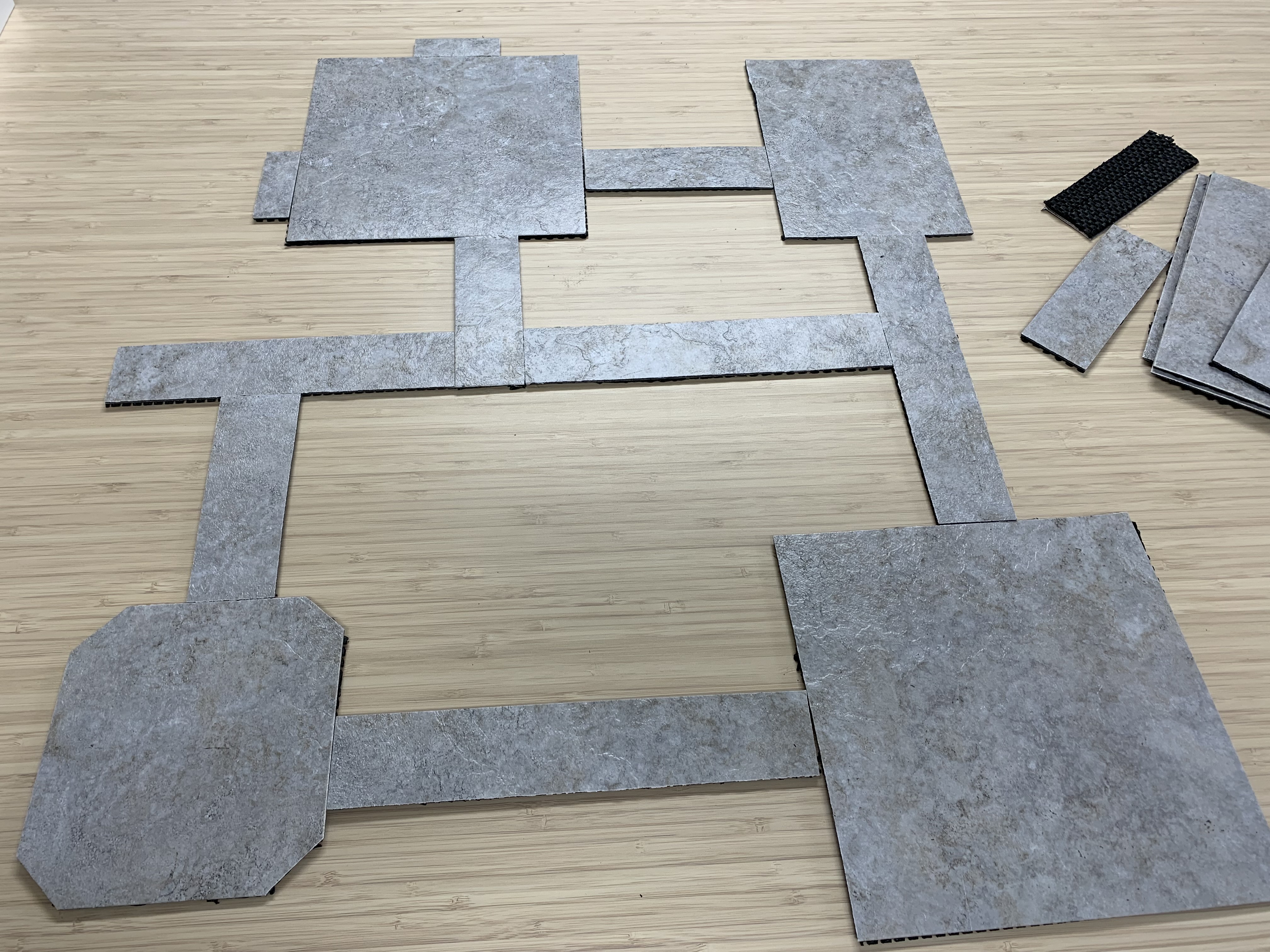
Using Floor Tiles for Dungeons

So my 5 Leagues of the Borderlands campaign is ramping up. I’ve got a fair amount of terrain from my Frostgrave stuff, but one type of battle encounter revolves around dungeon delves. I’m sort of kicking myself in the butt as I had a lot of WotC dungeon tiles. However, moving across the world I had to think long and hard on stuff I was going to ship, and felt the boxes of tiles at the time would just be carrying around junk I’d never use. Sigh…

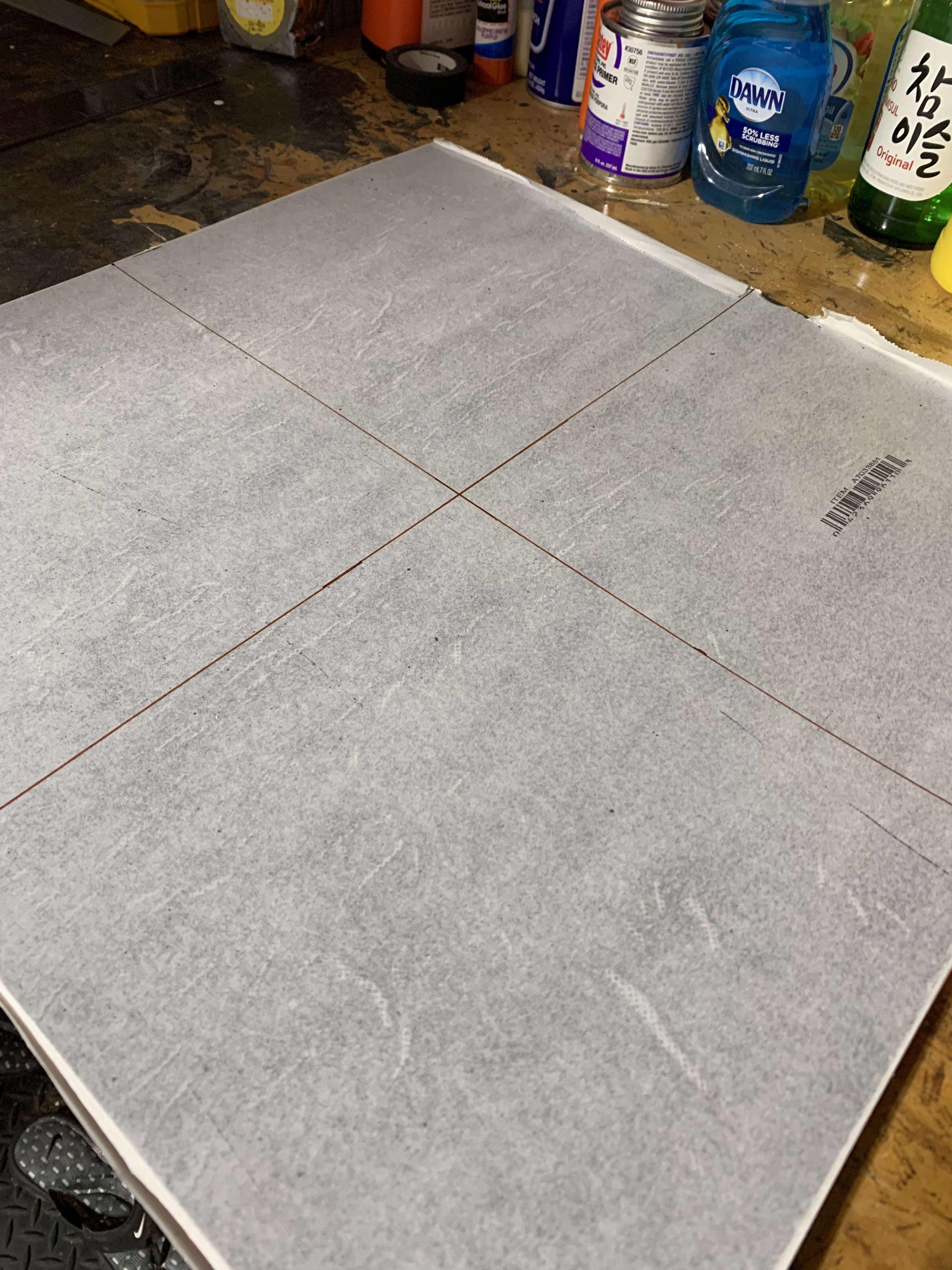
So I set about making up new tiles. I went down to the hardware store and picked up some laminate floor tiles on the cheap. I also bought some non-slip shelf liner to keep the tiles from skidding around. The tiles themselves had an adhesive backing, so it would be a snap to attach the shelf liner to the back.

I cut the tiles, scoring them with a utility knife and breaking them apart. Pretty easy going. The trick was to figure out what size tiles. I ended up having most being oversized at 9×9 inch. I also made a few rectangle rooms. The bigger rooms will allow for more maneuvering and shifting around to accommodate the corridor sections.

The corridors I made a standard 2” wide with sections between 6 and 9 inches long. I had a few smaller pieces I kept to add alcoves to break up some of the sections. Instead of making corridor Tees and angles, I made small 2×2” sections to give me a little more flexibility and will also use a few as stair tiles (writing on them with permanent markers). As the rooms are oversized, I can shift them around to accommodate the corridors. Plus I can use smaller corridor sections overlaid on the room tiles with stair sections to break up the rooms some with different height levels. Overall they look pretty good and weren’t too much of a chore to make up. Now to get some games in!

The Torchbearers: 5 Leagues from the Borderland Campaign

After establishing the threats to the Nentir Vale, the next step was to gather adventurers for my warband. I fully embraced the random generation charts but still ended up with a group of humans. Their backgrounds ranged from townsfolk, sturdy frontiersmen, and even a zealot. I also wanted to dabble in magic and chose one of my heroes to be a mystic.

For gear, I was able to wrangle up a few quality weapons and some simple enchanted items. I loved the idea of a rough and tumble barbarian with just enough charisma to gather a group under their leadership. So I chose Takari to be my warband leader wielding a bastard sword. I definitely wanted some ranged attackers and selected Kester, a tradesman-turned-adventurer, who opted to finally wield the crossbows he diligently made for years in the city. There was also Sigmund, the zealot monk on a mission to drive evil from the land. And lastly, Matilda, the strange mystic from the south was willing to join the company (although no one knows if it is to rid scourge from the region or for her own arcane purposes). To round out the warband, I had two additional human followers. Den, a simple man-at-arms henchman and Nip, an adept bowman, that were both willing to join the group. 

Falling under Takari’s oratory spell at a city tavern, she wove an enticing pitch to join under her banner. Rumors abound that the Nentir Vale was under siege from evil cultists and bandits. Howling beastmen were said to have come up from the coastal marshes. And the decades-long war to the west was drawing ever closer. The vale was ripe with opportunities of fame and fortune for those steely enough to take it. Takari’s Torchbearers were heroes of such mettle to grasp it.

The Threats: 5 Leagues from the Borderland Campaign

I had decided to map out my 5 Leagues campaign in the Nentir Vale. The campaign will have you trying to stave off 3 threats to the region determined randomly, two from within human realms and one external threat. I got to rolling and ended up with Whispers from Beyond and the Gnawing Horde. Feels like cultists and beastmen would be likely models for them. From the Foes Without, I rolled up the Curse of War. Seems the drums of war from the west has brought armies of a long conflict to the vale. 

I sketched out some locations and added a few camps for the different threats. While not written on the map, I ended up having a marsh near the Downs and a towering mountain on the King’s Road East as unexplored locations. There is still plenty of unnamed wilderness to fill in as the campaign goes along. I also ended up with another unexplored location of note, the Sword Barrows. A likely delve to adventure in soon.

I also decided to push for a shorter campaign with threat levels being 5, 4, and 3 instead of the default values. Expect this will be more attainable getting a final conclusion to the campaign instead of dragging it out too long. Hee. I’m not that hopeful I will be able to complete it anyways, but will give it the college try. 

Next time, onto my warband.

dandddoodles.blogspot.com

5 Leagues from the Borderland Campaign: The Nentir Vale

While I’ve had the PDF version for a while, I finally got my mitts on the book version of 5 Leagues from the Borderland. Some time back I gushed over its sci-fi sibling, 5 Parsecs from Home. At some point of time I’ll get a review up, but for now documenting my campaign sounds like a bit of blogging fun. One departure from 5 Parsecs is that 5 Leagues from the Borderland (5 Leagues) has a defined map that encompasses the entire region my warband will adventure in.

I thought the Nentir Vale from 4E would be appropriate. Even better, I was able to dig up a sparse map from D&D Doodle, a favorite blog of mine. What I love about the map is it’s rather sparse with names and locations, but has a wonderful depiction of large terrain features, and will be a perfect start for filling in details. 

I’m going to leave much of it unlabeled for now and likely deviate from the proper Nentir Vale location names in the future. Luckily enough I rolled the perfect amount of starting settlements with 1 hamlet, 2 villages, and one town. The town serving with the market town characteristic will certainly be Fallcrest. Another village is also a market town, so I’m making that Hammerfast. The last village is supposed to be a small community that surrounds an extensive manor, which will be ideal for Harkenwold. The last settlement was determined to be a nomadic camp, which at first got me stumped some, but realized that Winterhaven would be a perfect name. I could completely see it being a camp that arises from wandering tribes on the periphery of the vale, seeking respite from the brutal winter season.

Expect more posts in the future as I go through the campaign. Gathering my warband will be my next task. Can’t wait!

Gates of Antares getting dropped from Warlord Games and becoming a fan-supported project

I like Bolt Action and the sci-fi offering, Beyond the Gates of Antares is also a fun game using a similar system. GoA always had a sort of uneven rollout. It was first announced as a Kickstarter which got pulled, and Rick Priestley (the game designer) worked with Alessio Cavatore to put out Bolt Action instead, which pretty much exploded. However it was proof of concept that the core GoA mechanics (random activation and pins) were solid, I think it resulted in Warlord giving a nod to Priestly to get GoA out to the gaming public.

You are likely climbing an uphill battle with trying to spark interest in a platoon level, sci-fi skirmish game, as 40K is the wargame leviathan. Even worse you’ve got most of your armies available initially as metal minis. Over time core units for GoA were released in plastic kits, and another boxed set for GoA was put out to lower the bar of entry for new players. There were a few campaign books put out and the model range slowly expanded. Yet GoA just never seemed to get much traction like Bolt Action did for people.

I heard some rumors for a while a new edition was on the horizon, which ended up being somewhat true. However I was surprised to hear Warlord Games dropped support for the game. I first thought there’d be some future for GoA as Skytrex would be taking over the model line from Warlord. However the announcement from the official GoA blog looks like the future for GoA will pretty much be a fan community game. The devs are working on it part time as a side “hobby.” So there is a new draft version of the rules out there and there might be new stuff in the pipe, but it’s pretty much a system with severely limited resources for developing future content. I expect it’ll flounder along for some time and have a few dedicated fans, but looks like GoA will be forever doomed to be that niche system.

It’s such a shame as so many bits of it are solid. Bolt Action has some pretty gamey mechanisms and for a WW2 game, they can accumulate to become rather jarring. I drifted away to Chain of Command simply because lmgs and machine guns were badly implemented in Bolt Action. Along with truncated ranges, it all pretty much flew in the face of historical tactics. So much so, folks didn’t even bother using LMGs and MMGs for a platoon game at all. But in a sci-fi game, rules like this are fine. It’s odd that all the parts a lot of stodgy wargamers grumble about in Bolt Action would be embraced in GoA as fun design choices.

So it’s a shame to hear GoA being dropped from Warlord. It’ll still be around, but I don’t see much growth for the game at all. Especially so for the sci-fi genre as you’ve got so many choices that get solid support with new models. Time will tell, but I don’t expect Gates of Antares to ever expand from that small circle of die hard fans.

Review: Zona Alfa

Occasionally I get a bug up my butt to try out odd skirmish genres. I was interested in painting up some modern military figures but wanted to steer away from historical/modern conflicts and Osprey Publishing’s, Zona Alfa popped up on my radar. It’s heavily laden with sci-fi trappings but wrapped up in primarily modern weaponry and technology. Taking some inspiration from the Stalker PC game (and in turn, the movie), it truly draws its theme from the sci-fi book, Roadside Picnic. 

A classic russian sci-fi story, Roadside Picnic has an unusual premise. Aliens arrived on earth, poked around, and then left, leaving behind remnants of their technology. Humans can’t deduce their actual purpose with most items breaking the laws of physics and beyond human comprehension. To draw from the book title, we are like ants crawling over the leftovers from aliens that happen to stop by earth for a short “picnic.”

The site of the alien landing becomes a secluded area, heavily guarded by the military. Only select personnel and researchers can enter it. Even more odd, the Zone is littered with physical anomalies that twist time and space. Segmented off from the public, individuals (Stalkers) sneak into the Zone, seeking strange tech to snatch up and sell on the black market. Throw in the PC game theme, you also have the Zone hit with radiation and horrible mutants. It becomes a fun setting to game in. 

The skirmish rules are for 2 players that draft up a squad of mercs and fight against each other within the Zone. Crews are commanded by one leader type and typically have 3 to 6 other figures. Each figure represents a single man of varying tactical experience. Troops are defined by a simple stat line to represent movement, combat ability, defense, and Will, a catch-all trait used for both morale and task resolution. A nice departure from most systems is that varying levels of troop quality are also reflected in the number of actions they can take during their turn. It’s not just simply a change in stat profiles. So that lowly rookie can only do one action during their turn, while a hardened veteran can undertake 3 actions at the same time.

Players roll off initiative and alternate activating figures of their choice. All actions can be repeated multiple times, making veterans able to maneuver and fire effectively, while that rookie (limited to just one action) needing more turns to do similar tasks on the battlefield. Actions cover a range of abilities, from movement, shooting, melee, aiming (to improve a following attack), and rally, to interacting with the environment (like filling gas into a vehicle, or opening a secured door). There is also a special action that allows models to go into overwatch/ambush. But this requires 2 actions meaning only more trained troops are able to hold off and interrupt the opponent’s turn if desired.

Gear and abilities are also reflected in troop quality. Every unit will be able to wield one ranged, one melee weapon, and at least one peice of gear. However, more trained units will be able to carry more gear (up to 3 items) and have abilities that can help with other specialized tasks or particular combat actions. Gear and weapons are based on WYSIWYG (what you see, is what you get) of the model.

Shooting is a pretty easy affair. A unit must be in range and LOS, with intervening cover affecting how easy they can be hit. Pistols top off at roughly a foot, while rifles reach up to 36” and given that most tables are 3 to 4 feet square, you can easily throw out a lot of effective fire. Rolls are made against the attacker’s combat ability, trying to roll equal to or under their value. This target number is adjusted due to cover, with each piece of intervening terrain lowering it. Successful hits then have the defender roll for saves, trying to roll equal to or less than their armor stat (which is adjusted by any weapon modifiers). The number of attacks are based on weapon profiles, with your typical rifle throwing out 3 shots. So expect a lot of dice for those automatic weapons.

Unsuccessful saves result in wounds which will drop your typical trooper. If saves are successful, the target makes a Will check (again trying to roll equal to or less than their stat). If successful, they are fine, otherwise they take a pin. Pins penalize initiative rolls for the following turn and lower the melee combat ability of the figure. Removing them is automatic, but requires expending an action per pin. 

Melee combat is simultaneous and each figure can use their weapon of choice, even ranged weapons. The catch is that an attacker can use any additional successful hits to cancel strikes from a defending model. So it certainly pays to be the aggressor and initiate that assault, rather than be the defender in melee.

Additionally the game has critical hits and failures. Regardless of the target number and modifiers, a 1 is always successful while a 10 is an automatic failure. There’s a simple rule implemented that rolling simultaneous 1s and 10s for a particular action cancel out this effect, just using the die results as normal. This can throw a wrench into the game as that 1 will also allow a figure to take one additional free action. Conversely rolling that 10 adds a pin to the model.

The game revolves around a larger campaign goal of accumulating 10,000 rubles, enough to have your leader retire from the stalker business. The concept of actual missions are pretty loose and the emphasis is to strive for a narrative experience. There are a few random tables, but sadly this part of the book is rather sparse. Each scenario however needs to have some specific objective and commonly you’ll find yourself settling for looting from a particular location on the tabletop. In addition to mission objectives will be Hot Spots which can spawn enemies. Once any hostiles from a Hot Spot or mission objective are cleared out, the location can be looted.

Post mission, crew members will gain experience that can be used to improve their stats and pick up new abilities. Loot gathered up can be sold and rubles can be spent to recruit new squad members and/or buy more gear. When creating your squad you also align yourself with one of 6 factions which can result in having allies, neutral parties, and enemies. Paired off on the table, you find your faction having an impact on how to approach the scenario. Allied squads work together to eliminate any hostiles and split the loot found (or try to make a Will test to break the alliance). Enemy factions will throw the scenario objective to the wayside and killing the enemy becomes the primary objective. While neutral parties can tackle the scenario and interact with the opposing crew as they see fit. Tagged with this faction system are discounts when purchasing types of equipment or free gear. It’s a nice wrinkle in these types of games.

The game can be ported to be a solo game pretty easily too. And there are optional rules out there to create co-op and solo games if desired. However it still revolves around a long campaign goal of hoarding enough rubles to make that 10,000 mark and retire. So while you can certainly play a one off game, it seems to offer a more full experience running an actual campaign to allow for advancement, getting loot, and more gear.

The Good – It’s a pretty fast and easy modern skirmish game revolving around light arms. The setting is certainly different and has room for more weirder hostiles if wanted. I like there is some gradation of troop abilities and equipment, but it’s not mired down in a long list of stat lines. The turn flow is fluid with alternating activations, and pins are a thing to think about. I also like that it’s based on d10 rolls, so you can get modifiers having an impact but it’s not as pronounced as you’d see with d6s.

The Bad – The rules are serviceable. But there are sparse areas that could use some tightening up. It seems to default back to that relaxed, reach a compromise with your opponent or roll a die, for determining odd situations quite heavily. It’s also unfortunate there are not more scenarios and detailed campaign rules. Even rules for implementing odd Zone anomalies seem tacked on and not fully developed.

The Verdict – Zona Alfa is a pretty fun set of rules. There are lots of bits I like in a skirmish wargame. You get a nice potential distribution of results using a d10 that allows for modifiers and slight tweaks from weapons and gear. There’s a good implementation of trained troops being able to do more on their activations. So what’s offered has some variety but not saddled down with extensive lists of gear, weapons, and units that just simply offer a different stat modifier. 

I also enjoy the critical hit and misses rule. I can see folks wanting a more structured range of outcomes, but for skirmish games I’ve grown to enjoy those occasional swings of fortune and disaster that lead to some memorable experiences. There is also room here to account for other actions models can take during their turn, opening up options for different scenarios. If you wanted to make the objective to retrieve a keycode, and in turn spend time trying to open a vault, while simultaneously disabling a bomb, the rules can account for this. That feels like what the designer was going for. To present a flexible ruleset that lets you play these fun scenarios while also offering a light arms skirmish engagement.

But this is also where the game falls flat. It’s a fun setting that strives for a narrative experience, but doesn’t have the meat in the rules to back up this design philosophy. I really wish there were another 6-8 pages for scenarios, expanded encounter tables, and/or hostile creature profiles. You have a slim number of pages with a few anemic tables, and most of the burden for creating scenarios is up to the player. I get having a simple campaign goal, but the lack of rules to offer diverse scenarios and a narrative campaign is glaringly absent. Especially as there are other games (5 Parsecs from Home) that have a wealth of tables to randomly make up a scenario that just feels like it’s telling a story and can lend itself to a longer, more engaging campaign.

What you get with Zona Alfa is a serviceable skirmish ruleset that’s a fun twist on modern combat settings. It is an interesting world that can provide a gritty, grounded merc experience, or lean more into fighting weird creatures, mutants, and radiation zombies. However it seems you’re expected to do all the heavy lifting to get into the world it describes. You get more of a framework of rules that will offer a few fun games, but not quite the breadth of material to build a string of missions and encounters for a fleshed out campaign, which seems a shame as the wargame parts are so enjoyable.